Harnesses and Leads for a Strong Doberman
Let's be honest, walking a Doberman can sometimes feel like you're tethered to a small, extremely powerful freight train. Their strength and enthusiasm can make even a simple stroll around the block a wrestling match, leaving your arm aching and your patience tested. This guide is all about equipping you with the knowledge to choose the right harnesses and leads that provide both control for you and comfort for your magnificent Doberman, turning those walks into enjoyable bonding experiences rather than battles of wills.
The Challenge of Walking a Strong Doberman: Why a Standard Collar Isn't Enough
Many Doberman owners start out with a standard flat collar, just like they might use for any other dog. And for some, especially very young puppies or exceptionally laid-back adults, it might work for a little while. But let's get real: a Doberman is a powerful, athletic breed, often weighing in at 70-100 pounds, and they were bred with an innate drive and confidence. When they decide to pull, a flat collar often does little more than strain their neck, cause them to gag, or even slip right off if they back out of it. It's a frustrating situation for both of you, and frankly, it's not very safe.
Think about the sheer force a Doberman can generate when they suddenly lunge at a squirrel or pull towards another dog. That pressure is concentrated entirely on their delicate neck and trachea. This isn't just uncomfortable; it can lead to coughing, choking, and potentially even long-term damage to their throat. Beyond the physical discomfort, a dog that is constantly choking and gagging isn't in a state to learn good leash manners. They're too focused on the pressure around their neck to pay attention to your cues. It’s a common frustration, and many owners feel like they’re failing, but often, it's simply the equipment that's failing them. It’s also crucial to remember that a Doberman's lean, muscular build means they don't have a lot of padding around their neck, making them even more susceptible to injury from pulling.
Furthermore, a Doberman’s natural inclination to be aware of their surroundings, combined with their strong prey drive, means that sudden reactions are always a possibility. A standard collar offers very little leverage or redirection. If your Doberman spots something enticing across the street and decides to go for it, a regular collar is more likely to dig in or slip rather than effectively communicate to them to stop. This lack of control can quickly lead to unsafe situations, especially in busy environments or near traffic. For a breed known for its intelligence, you need equipment that helps you communicate effectively, not just restrain. Trying to manage an eighty-pound Doberman with just a flat collar can feel like trying to steer a horse with a shoelace.
Decoding Doberman Harness Types: Pros and Cons
When it comes to harnesses, it’s not a one-size-fits-all world, especially with a Doberman. Different harness designs offer varying levels of control and suit different needs. The key is to understand how each type works and how it interacts with your Doberman's natural pulling tendencies and physique. Finding the right fit is paramount – a poorly fitting harness can chafe, restrict movement, or allow for escape, defeating its entire purpose. Many pet supply retailers, like Chewy, offer detailed sizing guides and customer reviews that can be incredibly helpful when you're trying to figure out which harness might suit your Doberman's unique build.
Let’s explore the most common types:
Front-Clip Harnesses: The Game Changer for Leash Pullers
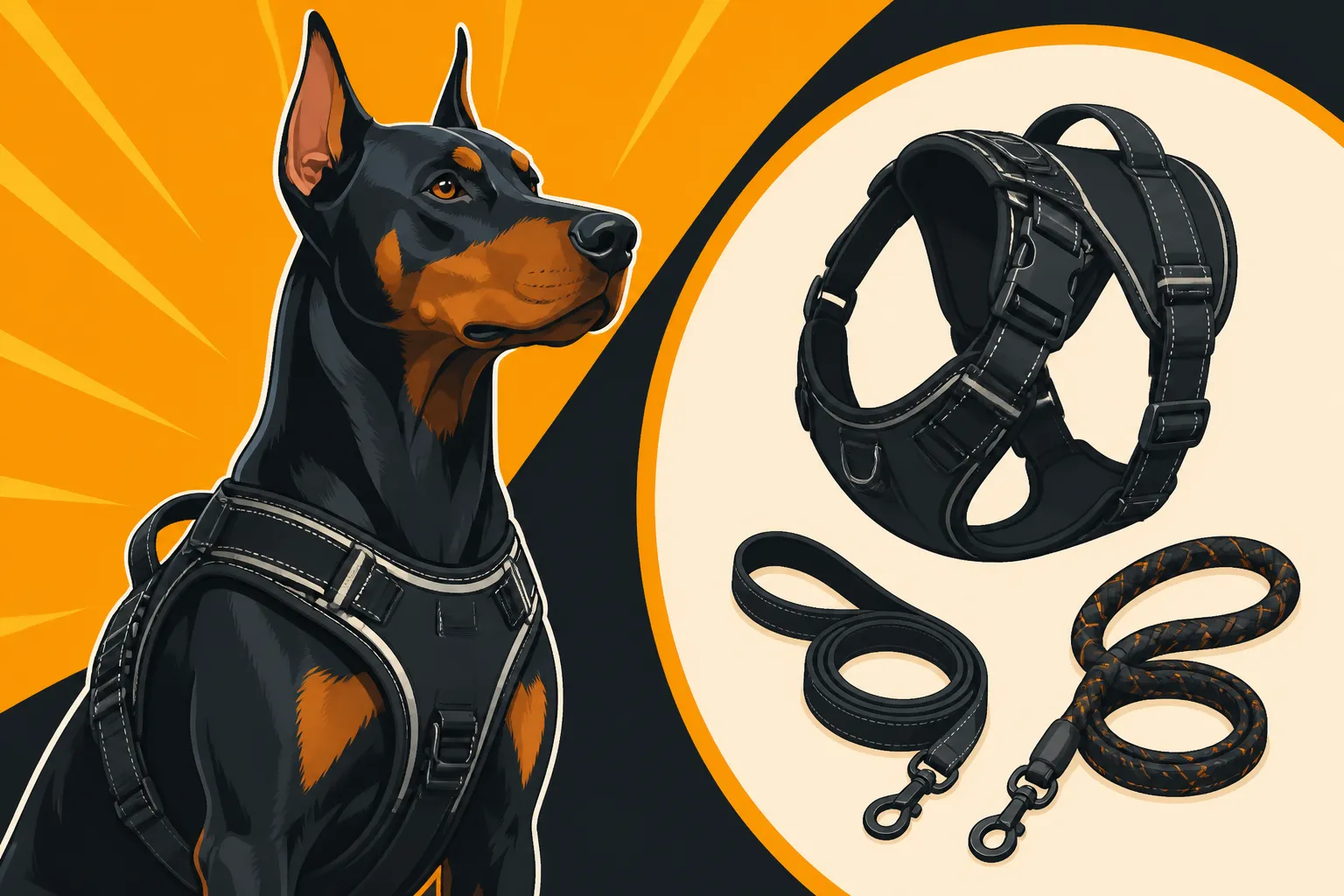
Front-clip harnesses, sometimes called "no-pull" harnesses, are a popular choice for Doberman owners struggling with leash pulling. Instead of the leash attaching to the dog's back, it clips to a ring on their chest. The genius of this design is simple: when your Doberman pulls forward, the leash connection on their chest gently redirects their body sideways, back towards you. This makes it very difficult for them to continue pulling in a straight line with full force. It’s a subtle yet effective mechanism that works with your dog's physics, not against them.
For a Doberman, who often possesses immense strength and a powerful forward drive, this redirection can be incredibly valuable. It prevents the constant choking and gagging that often comes with a collar, making the walk more comfortable for your dog and more manageable for you. Many owners report an almost immediate reduction in pulling when they switch to a front-clip harness. It’s a tool that helps teach them that pulling doesn't get them where they want to go faster. Look for options with good padding around the chest and under the armpits to prevent chafing, as Dobermans have thin skin. Some popular brands include Freedom No-Pull Harness and Easy Walk.
Back-Clip Harnesses: Best for Confident, Non-Pulling Dobermans
Back-clip harnesses are perhaps the most common type you'll see. The leash attaches to a ring on your Doberman's back, usually between their shoulder blades. These harnesses are excellent for dogs that don't pull on the leash, as they distribute pressure across the chest and back rather than concentrating it on the neck. They're comfortable, don't restrict movement, and are generally easy to put on.
However, for a Doberman who does pull, a back-clip harness can inadvertently encourage the behavior. By attaching the leash to the back, you're essentially providing them with a comfortable chest strap to lean into, much like a sled dog harness. This means their pulling power is amplified, and you might find yourself being dragged along even more. They are great for secure car travel or for dogs needing support, but if your Doberman is a strong puller, this might not be your first choice for daily walks unless combined with intensive training to build Leash Manners for an Eighty-Pound Doberman. If your Doberman is already well-behaved on the leash, a quality back-clip harness provides security and comfort without hindering their natural gait.
Head Halters: The Steering Wheel for Your Doberman
Head halters, often resembling a horse's halter, fit around your Doberman's muzzle and behind their ears. The leash attaches under their chin. The principle here is that "where the head goes, the body follows." By having control over your Doberman's head, you can gently guide their direction and attention. It's a very effective tool for managing strong pullers and for quickly gaining control in distracting situations.
While highly effective, head halters often require a bit of positive conditioning to get your Doberman comfortable wearing them. Many dogs initially try to rub them off, as it's an unusual sensation. Introduce it slowly, with lots of treats and praise, making it a positive experience. It gives you incredible leverage, allowing a smaller person to confidently walk a large Doberman, but it must be used gently. Avoid yanking or using harsh corrections, as this can cause discomfort or even neck injury. Instead, think of it as a gentle steering wheel. With careful introduction, a head halter can be a wonderful tool for teaching a Doberman, especially a clever one who might outsmart its owner, how to walk politely.
Summary of Harness Types
Here’s a quick overview of the harness types:
| Harness Type | Best For | Pros | Cons |
|---|---|---|---|
| Front-Clip | Strong pullers, training leash manners | Redirects pulling, prevents choking, good control | Can tangle legs if not fitted well, some chafing if unpadded |
| Back-Clip | Non-pullers, comfortable walks, car safety | Comfortable, easy to put on, good for secure dogs | Can encourage pulling, offers less control for strong dogs |
| Head Halter | Very strong pullers, reactivity, quick control | Excellent control over head and direction, gentle redirection possible | Requires conditioning, dogs may dislike it initially, risk of neck strain if yanked |
Choosing the Right Lead for Control and Comfort
The lead, or leash, is just as important as the harness. It's your direct line of communication with your Doberman, and choosing the right one can significantly impact your control and your dog’s comfort. Forget those flimsy retractable leashes; for a Doberman, you need something robust and reliable.
Material and Length: Durability is Key
For a strong Doberman, prioritize durability. You’ll want a lead made from sturdy nylon webbing, biothane, or good quality leather. These materials are strong, resistant to chewing (though no leash is truly chew-proof if given enough time), and comfortable to hold. Avoid thin, flimsy materials that can dig into your hands or snap under pressure.
The length of the lead is also crucial. A standard 4-6 foot lead is generally ideal for everyday walks. It gives your Doberman enough room to explore safely while keeping them close enough for you to maintain control. A 6-foot lead offers a bit more flexibility, allowing them to sniff and wander slightly further while still being responsive to your cues. Longer training leads (10-20 feet) can be fantastic for practicing recall in a safe, open area, but they are not suitable for crowded streets where quick control is essential. Remember, you're looking for something that can handle a full-grown Doberman at Eighty Pounds.
Handle Comfort: Protect Your Hands
Don’t overlook the comfort of the handle! A Doberman’s sudden lunge can easily rip through your hand if the handle is thin or abrasive. Look for leads with a comfortable, padded loop handle. Some leads even have a second "traffic handle" closer to the clip, which is incredibly useful for keeping your Doberman tight by your side in high-traffic areas or when passing other dogs. This second handle allows you to quickly shorten the leash without fumbling or wrapping the lead around your hand multiple times, which can be dangerous. Your Doberman can easily exert enough force to cause injury to your hand if you're not careful.
Hardware: Strong and Secure
Always inspect the hardware on any lead you purchase. The clasp that attaches to the harness should be robust, made of strong metal, and have a secure locking mechanism. A flimsy spring-loaded clasp can fail, potentially sending your Doberman on an unexpected solo adventure. Solid brass or heavy-duty steel clasps are excellent choices. Similarly, check the stitching or riveting where the clasp meets the leash material and where the handle forms its loop. These are common points of failure, and with a strong Doberman, you cannot afford any weaknesses. Many quality products, found on sites like Chewy, will highlight their heavy-duty hardware as a selling point.
Training Strategies for Leash Manners with Your Doberman
Even the best harness and lead are just tools; they don't do the training for you. They assist your training. A Doberman is an incredibly intelligent breed, and with consistency and positive reinforcement, they can learn impeccable leash manners. It’s all about teaching them what you want them to do, rather than constantly correcting what you don't. While a good harness prevents pulling, the ultimate goal is for your Doberman to choose not to pull. And remember, sometimes a sudden change in leash manners can be a sign of underlying issues; if your Doberman suddenly starts pulling more or shows Weight Gain and Low Energy in a Doberman, a vet visit might be in order.
Start with Positive Reinforcement
The foundation of good leash manners is positive reinforcement. Every time your Doberman walks nicely beside you, with a loose leash, reward them! Use high-value treats (small, soft, super tasty morsels), verbal praise, or even a quick game of tug if that's what they love. Mark the good behavior with a "yes!" or a clicker the instant they are walking politely, then deliver the reward. The goal is to make walking nicely far more rewarding than pulling. Your Doberman wants to work with you; they're very eager to please the people they bond with so strongly.
Keep training sessions short and frequent, especially in the beginning. Five to ten minutes several times a day is far more effective than one long, tedious session. Practice in low-distraction environments first, like your living room or backyard, before gradually moving to more stimulating places like your neighborhood street or a park.
The "Stop and Go" Method
A classic and effective technique for pullers is the "stop and go" method. The moment your Doberman starts to pull, stop walking. Stand still like a tree. Don’t say anything, don’t yank the leash. Just wait. As soon as the leash loosens (even for a second, if they turn to look at you or relax the tension), immediately start walking again, praising and rewarding them. If they pull again, stop again. Your Doberman will quickly learn that pulling makes the walk stop, and a loose leash makes it continue. This can be particularly effective with front-clip harnesses, as the slight redirection combined with the stop reinforces the message. This method works well for a Doberman That Learns Your Routine Too Well, as they quickly pick up on the cause and effect.
Changing Direction
Another useful technique is changing direction. The moment your Doberman starts to pull, quietly change direction. Walk the other way, make a sharp turn, or even do a 180-degree pivot. This keeps your Doberman's attention on you and prevents them from fixating on whatever they were pulling towards. It teaches them to pay attention to your movements and that you are leading the walk. Again, combine this with praise and rewards when they follow your change of direction with a loose leash. This helps build a Doberman that is confident, not sharp on walks.
Consistency is Everything
Dobermans are smart, but they thrive on consistency. Everyone who walks your Doberman needs to use the same equipment and the same training methods. If one person allows pulling and another doesn't, your Doberman will get confused and be less likely to learn. Make sure all family members are on the same page. Remember that a Doberman needs a secure and comfortable space to rest too, so ensuring they have a properly sized Crate Sizing for a Doberman at Full Height is also part of their overall routine and well-being, which contributes to a more relaxed and focused dog during training. If you're struggling, don't hesitate to seek help from a professional dog trainer who has experience with strong working breeds. They can offer personalized guidance and help you troubleshoot any specific challenges you're facing.
Disclaimer
This article is for general informational purposes only and does not constitute professional advice. Laws, prices and regulations vary by location and change over time. Consult a qualified professional for guidance on your specific situation.