Fence Height for a Doberman That Can Clear It
Oh, the Doberman. Such magnificent, athletic creatures, aren't they? And often, that athleticism comes with a side of Houdini-like escape artistry. If you've ever watched your Doberman eye the top of your fence, or worse, witnessed them sail over it with a surprising grace that belies their size, you know the heart-stopping panic it causes. This isn't just about a dog being naughty; it's about their safety, your peace of mind, and ensuring your beloved companion stays right where they belong. This guide is here to walk you through understanding why your Doberman might be eyeing the fence line and, crucially, how to build or modify your yard to keep them securely contained.
Understanding Your Doberman's Athletic Prowess and Escape Artist Tendencies
Let's be honest, Dobermans aren't your average couch potatoes. They were bred for a purpose, and that purpose involved intelligence, speed, and incredible physical capability. When we talk about fence height, it's not just a number on a measuring tape; it's about respecting the natural abilities of this remarkable breed.
The Doberman's Natural Agility and Strength
Take a moment to truly appreciate the Doberman's build. They are lean, muscled machines, designed for bursts of speed and powerful movements. Their long legs, deep chests, and strong hindquarters act like coiled springs, ready to propel them upwards and forwards. It's not just a matter of height; it's about pure, unadulterated athletic power. A Doberman can assess a situation, calculate the leap, and execute it with surprising precision. They don't just "jump"; they launch themselves with intent. This isn't a flaw in their character; it's a testament to their heritage. They are incredibly intelligent, and sometimes that intelligence manifests in finding the path of least resistance to whatever catches their attention on the other side. This means that if they see an opportunity, they will likely take it. It’s also worth considering that a Doberman's physical appearance can sometimes mask underlying health issues, as seen in Why a Doberman Can Look Fine and Be Ill, which could also play into unexpected behavior changes.
Common Reasons Dobermans Attempt to Clear Fences
So, why would your perfectly happy Doberman suddenly decide the grass is greener on the other side of that fence? It's rarely malicious, and almost always driven by instinct or unmet needs. One of the most common culprits is boredom or lack of mental stimulation. A Doberman's sharp mind needs a job, even if that "job" is just regular training sessions or engaging puzzle toys. If they're under-stimulated, they'll find their own entertainment, and sometimes that involves exploring beyond the yard. Think about it: an empty yard for hours can become a giant bore, making the world outside seem endlessly fascinating.
Another major factor is separation anxiety or distress. Dobermans are famously "velcro dogs," deeply attached to their families. If left alone for extended periods, especially without proper acclimatization, they can become anxious. This distress can manifest as destructive chewing, incessant barking, or, yes, desperate attempts to escape and find their people. A Doberman That Cannot Cope When You Go Out delves deeper into this challenging issue. Their drive to reunite with you can be incredibly strong, overriding any perceived barrier.
Then there's the prey drive. That squirrel teasing them from the neighbor's tree, the rabbit darting across the road, or even a stray cat – these can trigger a powerful instinct that makes them forget all about your fence. They see it as a challenge, not a barrier, and their focus becomes solely on the chase. Similarly, a desire to explore or join owners outside the yard can be a huge motivator. If you regularly walk past your house with another dog, or if the kids play outside the fence, your Doberman might just want to be part of the action. Finally, simply seeking companionship with a neighbor's dog can be a strong draw. The allure of a playmate can make even the highest fence seem surmountable. To keep their minds engaged, there are many strategies, including those discussed in Keeping a Doberman Mentally Tired.
What's the Minimum Safe Fence Height for a Doberman?
This is the million-dollar question, isn't it? And unfortunately, there isn't one perfect, simple answer that applies to every single Doberman out there. While there are standard recommendations, your specific dog might just laugh in the face of conventional wisdom.
The Standard Recommendation and Why It's Often Not Enough
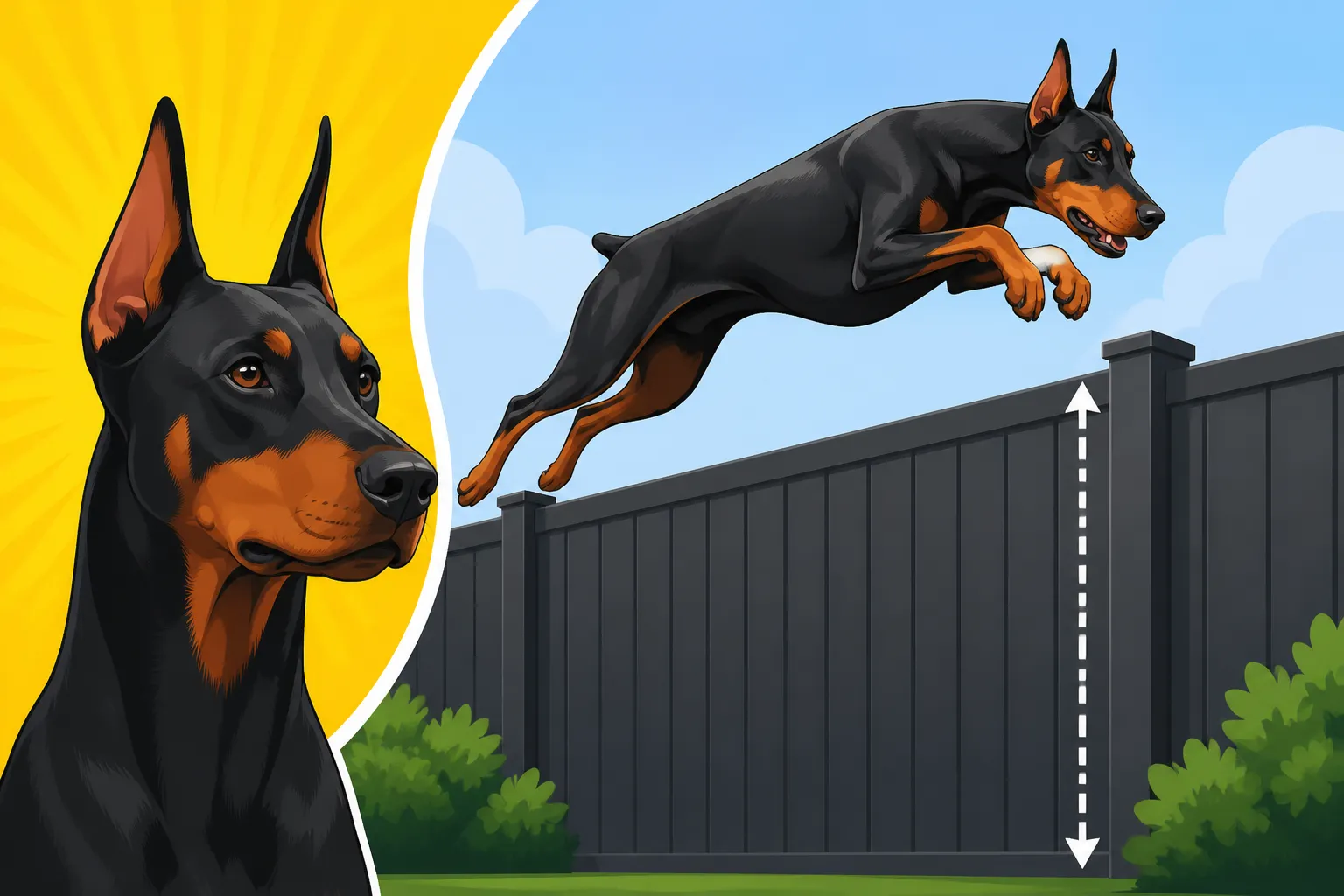
Many reputable sources and even some local ordinances will recommend a minimum of a 6-foot fence for a large, athletic breed like a Doberman. On paper, 6 feet (or about 1.8 meters) sounds pretty tall, right? For many dogs, it is. But here's where the Doberman's unique combination of athleticism, intelligence, and sheer will power comes into play. For a truly determined Doberman, a standard 6-foot fence can sometimes be more of a suggestion than a solid barrier.
I've heard countless stories, and have a few of my own, about Dobermans clearing 6-foot fences with what seems like minimal effort. It might be a standing jump, a powerful leap with a run-up, or even a strategic scramble. Imagine a Doberman spotting a deer across the street – that 6-foot fence suddenly looks like a hurdle in an Olympic event. It's not uncommon for a particularly agile or motivated Doberman to clear this height. While a 6-foot fence is a good starting point for many large breeds, for a Doberman, it's often the absolute minimum you should consider, and even then, it might require additional considerations to truly be secure. Some owners of exceptionally athletic Dobermans even find that an 8-foot fence can be scaled if there are any toeholds or nearby objects that provide an advantage.
Factors That Influence Jumping Ability
It's not just about the Doberman's inherent ability; several environmental and behavioral factors can significantly impact their capacity and motivation to jump.
First, fence type plays a massive role. A chain-link fence, while seemingly secure, offers a Doberman a ladder of paw holds. Those little diamonds are perfect for gripping and climbing, turning a vertical barrier into a scramble wall. A solid wood or vinyl fence, on the other hand, presents a smooth, slick surface, making it much harder to get a purchase and scale. If you have a chain-link fence, you might need to consider adding a smooth topper or other deterrents to remove those tempting footholds.
Next, consider your yard setup. Anything near the fence that can serve as a stepping stone or launchpad significantly reduces the effective height of your barrier. This includes dog houses, storage sheds, woodpiles, large planters, sturdy patio furniture, or even built-up snow drifts in winter. A clever Doberman will absolutely use these to their advantage. A Doberman that might struggle with a 6-foot standing jump could easily clear it with the boost from a nearby object. Always scan your fence line for potential springboards and remove or relocate them.
Motivation is perhaps the most powerful factor. A Doberman who is casually exploring might not attempt a difficult jump. But a Doberman driven by intense prey drive (that squirrel again!), the scent of a female in heat, or severe separation anxiety will be far more determined and resourceful. Their desire to get to the other side will often push them past what you might think are their physical limits. Even a well-trained Doberman, which you can read more about in Training a Doberman That Is Smarter Than You Expect, can sometimes have their strong instincts override their learned manners in moments of high motivation.
Finally, while not a physical factor, training and temperament can influence jumping behavior. A well-socialized, confident Doberman that receives consistent training and ample mental and physical exercise might be less inclined to attempt escapes simply because their needs are met within the confines of their yard. However, even the most well-behaved Doberman is still a Doberman, and their instincts are powerful. No amount of training will completely remove the physical capacity to jump.
Building and Reinforcing Your Doberman-Proof Fence
Knowing your Doberman's capabilities is half the battle; the other half is creating a secure perimeter that truly keeps them safe. It's about thinking like a Doberman and anticipating their potential escape routes.
Beyond Just Height: Essential Features for Security
While height is crucial, it's just one piece of the puzzle. A truly Doberman-proof fence integrates several design elements to deter both jumping and digging.
First, consider vertical extension or inward-angled toppers. If a straight 6-foot fence isn't quite cutting it, an additional 1-2 feet of fence, angled inwards at a 45-degree angle, can be incredibly effective. This makes it impossible for the dog to get a solid grip or leverage to pull themselves over the top. It creates an overhang that physically pushes them back into the yard if they try to climb or jump. For fences that offer footholds, like chain link, ensuring there are no footholds near the top is paramount. You might consider adding a smooth metal or PVC panel along the top section of a chain link fence to remove those climbing opportunities.
Then there's the equally common escape route: digging prevention. Dobermans are intelligent, and if they can't go over, they'll often try to go under. To prevent this, you can install an "L-footing" (a section of fence material buried horizontally along the base of the fence, extending inward into your yard). Burying a section of chicken wire or heavy-gauge mesh wire about 12-18 inches deep along the entire fence line is another effective method. Some owners even pour a concrete footer, which is the most robust solution. Without proper digging prevention, even the tallest fence is only half secure. For all your heavy-duty needs, from fence supplies to tough training toys, brands like Chewy offer a wide array of products to help Doberman owners secure their homes.
Finally, don't overlook gate security. A fence is only as strong as its weakest point, and that's often the gate. Ensure you have strong, robust latches that your Doberman can't easily manipulate. Self-closing hinges are a fantastic feature, preventing accidental escapes if someone forgets to fully close the gate. Ideally, gates should open inward, making it harder for a powerful Doberman to push against them and potentially compromise the latch. Routinely double-check all latches, hinges, and posts for wear and tear.
Advanced Strategies and Considerations
For the most determined escape artists, or simply for owners seeking maximum peace of mind, there are even more advanced strategies to consider.
Roller bars, sometimes called coyote rollers, are an excellent addition to the top of an existing fence. These are long, round tubes (often made of aluminum or PVC) that spin freely when a dog attempts to grab or push off them. This removes any leverage they might gain from reaching the top of the fence, effectively making it impossible to pull themselves over. They're a humane and highly effective way to prevent climbing or jumping.
Many owners consider invisible fencing (electronic fences). While these can act as a deterrent for some dogs, it's crucial to understand their limitations, especially for Dobermans. An electronic fence delivers a static correction when the dog crosses a boundary. However, for a highly motivated Doberman – chasing a squirrel, experiencing separation distress, or simply wanting to explore – the brief discomfort of the correction is often not enough to stop them. They might blow right through the boundary if the reward on the other side is tempting enough. And once they're out, they often won't cross back over the invisible boundary to return to the yard. Therefore, electronic fences should never be considered the primary means of containment for a Doberman, especially if they are known jumpers or diggers. They might be a supplemental layer of deterrence but cannot replace a physical barrier.
Ultimately, the best fence, no matter how tall or reinforced, is never a substitute for supervision. Especially when you first implement new fencing or if you have a known escape artist, active supervision is critical. This allows you to observe their behavior, identify any new weak points, and intervene before an escape happens. Setting up a secure Crate Sizing for a Doberman at Full Height area indoors can also be a lifesaver when you can't be supervising them in the yard.
| Fence Type | Pros for Dobermans | Cons for Dobermans | Jumping Deterrence | Digging Deterrence |
|---|---|---|---|---|
| Solid Wood/Vinyl | Smooth surface, hard to climb; good privacy | Can be expensive; requires maintenance; can obscure view | High (if tall enough, 6-8ft) | Low (needs buried additions) |
| Chain Link | Affordable; allows visibility | Easy to climb; often needs additions to be secure | Moderate (very climbable) | Low (needs buried additions) |
| Wrought Iron | Very durable; aesthetically pleasing; no footholds | Expensive; gaps might allow small dogs/wildlife | High (if spacing is tight) | Low (needs buried additions) |
| Mesh/Field Fence | Good for very large areas | Often not tall enough; easily climbed/chewed through | Low (unless very tall) | Low (needs buried additions) |
| Brick/Stone Wall | Extremely durable; no climbing/digging | Very expensive; permanent; no visibility | High (if smooth and tall) | High (inherent barrier) |
Beyond the Fence: Addressing the Root Causes of Escape Attempts
While a physically secure fence is paramount, it's equally important to address why your Doberman might be trying to escape in the first place. Often, jumping or digging is a symptom of underlying needs that aren't being met.
Mental and Physical Stimulation
Dobermans are athletes, both physically and mentally. They thrive on activity and engagement. A Doberman left alone in a yard with nothing to do for hours on end is a recipe for destructive behavior and escape attempts. They need adequate exercise daily, which means more than just a quick trip to the backyard. Think brisk walks, runs, games of fetch, or even joining you on a hike. This physical outlet burns off energy that might otherwise be directed towards fence-clearing efforts.
Beyond physical exercise, their sharp minds need challenges. Incorporate puzzle toys filled with treats, engage in regular training sessions (even short, fun ones), or explore scent work games in the yard. Giving your Doberman a "job," even a simple one like finding hidden treats, can do wonders for their mental well-being and reduce boredom-driven escape attempts. Many owners find that high-value treats, such as the wholesome offerings from Ollie, can be incredibly motivating for training and enrichment activities, keeping their Doberman's focus squarely on you. It's truly about preventing them from getting bored enough to consider scaling the walls. You can read more about engaging their minds in Keeping a Doberman Mentally Tired.
Training and Management Strategies
Even with the best fence, training and consistent management are critical layers of security. First and foremost, a solid recall command is absolutely non-negotiable for a Doberman. If, despite all your efforts, they do manage to get out, a reliable recall could literally save their life. Practice this command frequently, in various environments, and always make coming back to you the most rewarding choice.
Boundary training within the yard can also be beneficial. This involves teaching your Doberman to respect an invisible line a few feet inside the physical fence, reducing the likelihood of them even approaching the fence for a jump. Use positive reinforcement to reward them for staying away from the perimeter. Avoid leaving your Doberman unsupervised for long periods, especially if they've shown escape tendencies. If you work long hours or have commitments that take you away from home, consider hiring a trusted dog walker or enrolling them in a reputable doggy daycare. This provides much-needed exercise and social interaction, which can drastically reduce the motivation to escape. If you're looking into daycare or boarding options, it's worth knowing that Boarding Kennels That Turn a Doberman Away can be an issue, so research is key. For those times you need to leave them, especially if they struggle with being alone, A Doberman That Cannot Cope When You Go Out offers more insights into managing separation distress.
The Role of Health and Insurance in Peace of Mind
Sometimes, unexpected behavioral changes, including increased attempts to escape, can be linked to underlying health issues or stress. A Doberman experiencing pain, discomfort, or even a hormonal imbalance might become restless, anxious, or more prone to seeking an exit. Regular veterinary check-ups are essential to rule out any medical reasons for changes in behavior. An otherwise secure Doberman might suddenly try to escape if they feel unwell or stressed.
Despite all our best efforts, accidents can happen. A gate might be left ajar, a storm could damage a fence, or a particularly determined Doberman might find a new weak spot. In these moments, having pet insurance can be an absolute lifeline. If your Doberman escapes and gets into an accident (hit by a car, injured in a fight, or ingests something dangerous), the vet bills can be astronomical. An insurance provider like Healthy Paws can help cover those unexpected costs, allowing you to focus on your dog's recovery rather than the financial burden. While we all hope it never happens, it's a realistic consideration for any Doberman owner. It's also vital to ensure you get your Doberman covered before any pre-existing conditions arise, especially given common breed-specific issues like those discussed in The Yearly Heart Bill for a Doberman and Insuring a Doberman Before the Heart Turns.
Disclaimer
This article is for general informational purposes only and does not constitute professional advice. Laws, prices and regulations vary by location and change over time. Consult a qualified professional for guidance on your specific situation.