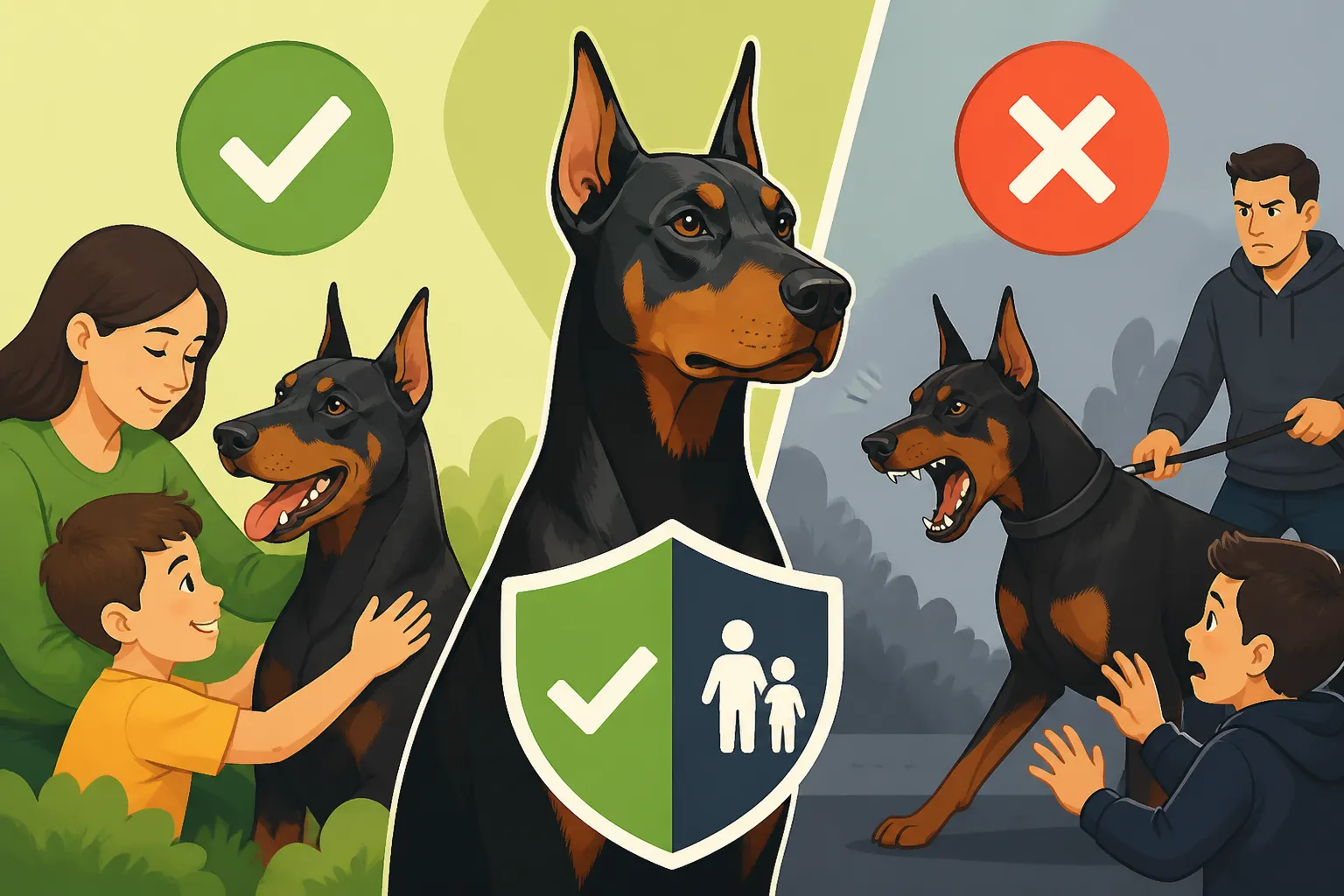
Whether an Adult Doberman Is a Safer Choice
An adult Doberman can be a safer choice than a puppy when you need a clearer picture of the dog’s size, habits, and established temperament. But “adult” does not automatically mean calm, predictable, or suitable for every household. This guide explains what you can learn before adopting, what you still cannot know, and how to make a careful match for your home.
Is an adult Doberman really a safer choice
Sometimes. With an adult dog, you can observe more of the personality you will live with: how the dog recovers from surprises, responds to handling, behaves around familiar people, and settles after activity. That can make matching easier than choosing a young puppy whose adult temperament is still developing.
But age alone does not determine safety. A confident, well-adjusted adult may be a wonderful companion; another adult may have significant fear, separation distress, or a history of conflict with dogs. Puppies also vary, and their behavior is shaped by genetics, early experiences, training, health, and the environment they grow up in.
What adult age can make easier to assess
An adult Doberman’s approximate size and physical needs are already apparent, so you are less likely to be surprised by how much room the dog takes up or how powerful it is on leash. You can also ask about the dog’s ordinary routine: whether it can relax indoors, how it handles visitors, and what kind of exercise it has been used to.
There may be a more substantial behavior history, too. A foster caregiver who has lived with the dog might describe what happens when someone knocks, whether the dog guards food or resting places, or how it behaves during a quiet evening. Details like “settles after a walk” are more useful than a broad label such as “good dog.”
Still, behavior in a shelter or foster home may not predict every response in a new household. A dog can seem subdued in a noisy kennel and more energetic at home. It may also need time to feel secure before its usual habits become clear. An adoption profile is a starting point for questions, not a guarantee.
What age does not guarantee
An adult Doberman is not automatically trained, easy to handle, or safe around children and other pets. A dog may have excellent house manners but struggle with a particular trigger, such as unfamiliar dogs approaching on leash. Another may be affectionate with adults but uncomfortable with fast, unpredictable movement from young children.
A history of living with a cat, for example, is helpful only if the source can explain what that looked like. Did the dog calmly share a home with a cat behind a gate, or did it repeatedly chase the cat when given access? Those are very different situations. When the details are unclear, plan for careful separation and controlled introductions rather than assuming they will get along.
If you are comparing an adult with a puppy, start with Choosing a Doberman Breeder or a Rescue and The Owner a Doberman Actually Needs. These topics can help you think beyond age and consider whether your time, household, and experience fit the breed.
What to find out before adopting an adult Doberman
The strongest adoption decisions are based on specific observations, not reassuring generalities. Ask the rescue, shelter, foster caregiver, or current owner to describe what the dog has actually done in ordinary situations. If the answer is “we haven’t tried that,” treat it as unknown—not as proof the dog will have a problem, and not as proof there will be no problem.
Ask for examples, not labels
Instead of asking only whether the dog is “friendly,” ask what happens when a visitor enters the home. Does the dog bark and then settle when given a cue? Does it remain tense, retreat, or block access to the doorway? Ask how it responds to veterinary handling, nail care, being moved off a resting spot, and being left alone.
Questions about other animals should be equally concrete. Ask whether the dog has lived with dogs, what size and sex those dogs were, and whether there were conflicts over food, toys, or attention. If there has been no direct experience with cats or small animals, assume a careful introduction and management plan will be needed.
A useful history also includes what is unknown. A rescue may not know why a dog was surrendered or how it behaved in its previous home. That uncertainty is common; it does not make the dog “bad.” It does mean you should be realistic about what you can manage and avoid promising that the dog will fit a situation that has not been tested.
Observe recovery, handling, and everyday behavior
During a meeting, notice the dog’s ability to recover after a mild surprise. A sudden loud test is not necessary. Instead, observe ordinary changes: a person entering the room, a new object being placed nearby, or a pause in interaction. Does the dog return to relaxed behavior, or does tension linger? A single meeting cannot diagnose temperament, but recovery and flexibility are useful things to discuss with a qualified behavior professional.
Ask to see the dog in more than one setting if possible. A quiet room, a short walk, and a brief settling period can reveal different parts of its behavior. If the dog appears tired, highly stressed, or shut down, a lack of visible reaction may not tell you much. Do not pressure the dog into handling or introductions just to “test” it.
For a first-time Doberman owner, arrange an assessment with a reward-based trainer or veterinary behavior professional who has experience with large, powerful dogs. A knowledgeable person can help interpret what you see and suggest a transition plan. For broad temperament context, Doberman Temperament as the Standard Describes It and What a First Doberman Demands of Its Owner are useful reading.
Matching an adult Doberman to your household
A safe match is not simply “a nice dog” placed into a home. It is a fit between the dog’s needs and the people, routines, space, and animals already there. Be honest about your household on a difficult day, not just on the day you meet the dog.
| Household situation | What to learn about the dog | A careful approach |
|---|---|---|
| Young children at home | Comfort with child-like movement, noise, and handling; any guarding or startle concerns | Supervise closely, provide child-free resting areas, and do not rely on breed or age as a safety guarantee |
| Resident dog | History with similar dogs, resource guarding, and ability to disengage | Arrange gradual introductions on neutral ground with professional guidance if needed |
| Cat or small pet | Whether the dog has calmly lived with that type of animal | Use barriers and separate spaces; do not leave animals together unsupervised until safety is well established |
| Long workdays | How the dog copes alone and whether it has separation-related distress | Build alone time gradually and plan for support rather than assuming the dog will adapt immediately |
| First-time Doberman owner | Leash skills, settling, handling needs, and behavior challenges | Choose a dog with a well-documented history and line up qualified training support |
Children and visiting guests
Even a dog described as gentle should have a protected space where children cannot follow it. Children need simple rules: do not climb on the dog, disturb it while eating or sleeping, or take toys from its mouth. Adults are responsible for supervision; a child’s good intentions do not remove the risk of an accidental bite or knockdown.
Ask whether the Doberman has actually lived with children of a similar age. “Good with kids” may mean it has calmly met older children on a walk, which is not the same as sharing a home with a toddler. If the history is limited, do not make the dog the test case. A qualified professional can help assess the situation and plan introductions, but some households may be better matched with a different dog.
Guests also need management. A dog can be affectionate with family and wary of unfamiliar visitors. A gate, leash, or quiet room can give everyone more space while the dog settles. For practical visitor routines, see Teaching a Doberman to Accept Visitors and Spotting the Moment a Doberman Is Uncomfortable.
Resident pets and alone time
A previous history with another dog is useful, but it does not guarantee compatibility with every dog. Differences in size, play style, age, and household competition matter. Plan introductions carefully, remove high-value items at first, and give each animal separate spaces for food, rest, and escape. If either dog stiffens, guards, or repeatedly tries to avoid the other, slow down and get professional help rather than forcing contact.
If you work outside the home, ask how long the dog has been left alone and what happened. A dog that was calm for short periods in a foster home may still struggle with a full workday in a new place. Set up a gradual plan, use safe enrichment, and arrange a dog walker or trusted caregiver if needed. Chewy can be one place to compare basic enrichment supplies, but toys and food puzzles do not replace a gradual alone-time plan.
For further reading, A Doberman That Cannot Cope When You Go Out covers separation-related challenges, while Adding a Doberman to a House That Has a Dog focuses on introducing a new dog to an existing one.
Making the transition safer and more manageable
A thoughtful transition reduces pressure on both the dog and the household. Even a well-matched adult Doberman may need time to learn your routines, sleep comfortably, and understand where it can rest. Try not to schedule a crowded welcome gathering, a dog-park visit, and several new introductions in the first few days.
Set up the home before arrival
Prepare a quiet resting area behind a gate or in a low-traffic room. Choose a secure leash and well-fitting walking equipment, check fences and doors, and decide in advance how visitors will enter. Keep food, medication, and household hazards out of reach. If you have other pets, use barriers so they can observe one another without being forced into close contact.
A predictable first-week routine can include meals, bathroom breaks, walks, and rest at roughly consistent times. Start with calm, familiar activities rather than testing the dog’s limits. If you need bowls, bedding, or basic supplies, Chewy may help you compare options, but ask the rescue or veterinarian whether the dog has preferences or health-related needs before changing food or equipment.
Avoid overwhelming the dog with new people and places all at once. A short walk on a quiet route is often more useful than an outing to a busy public area. If the dog is reluctant, give it space and use rewards to build positive associations rather than pulling it toward a person or situation.
Use a gradual, supported adjustment plan
During the early weeks, keep notes on appetite, sleep, toileting, reactions to household sounds, and how the dog settles after activity. Look for patterns over time, not one isolated moment. If the dog guards a resource, growls, lunges, or seems persistently fearful, do not punish the warning or try to handle the problem by force. Create distance and consult a qualified professional.
Book a veterinary examination soon after adoption and bring any available medical records. Ask about the dog’s previous vaccinations, medications, and screening history, and discuss an appropriate plan for ongoing care. A health issue can affect comfort and behavior, so a sudden change in tolerance or activity deserves attention. The guide The Owner a Doberman Actually Needs can also help you think through the long-term commitment.
Give the dog an appropriate way to decompress. That might mean sniffing walks, simple training games, or resting near the family without being expected to greet everyone. Chewy may be useful for finding everyday supplies such as treat pouches or enrichment items, but the goal is to choose tools that suit the individual dog—not to buy a collection of products in place of training, supervision, and patience.
A simple decision check before you commit
Before adopting, ask yourself whether you can manage the dog you have observed, including the areas that remain unknown. Can you safely separate the dog from children or pets when needed? Can you handle its size on leash? Is there a realistic plan for exercise, training, veterinary care, and time alone? If the answer depends on the dog never making a mistake, the match may be too fragile.
Where possible, ask whether the rescue offers a structured foster period or a supported adoption process. Confirm what support is available if the transition becomes difficult and what the return or rehoming process involves. Policies differ, so get the details in writing rather than assuming a trial arrangement exists.
An adult Doberman can be a safer, more informed choice when the dog’s behavior is well documented and its needs fit your household. The real advantage is not that age removes risk; it is that you may have more evidence to make a careful decision. A patient assessment, sensible management, and honest expectations matter far more than the label “adult.”
Disclaimer
This article is for general informational purposes only and does not constitute professional advice. Laws, prices and regulations vary by location and change over time. Consult a qualified professional for guidance on your specific situation.