Doberman Against Belgian Malinois for Work
Choosing between a Doberman and a Belgian Malinois for work is not simply a choice between two impressive-looking protection dogs. The better fit depends on the job, the handler’s experience, and the dog’s individual temperament. This guide compares their working styles, training demands, and practical needs so you can make a choice based on the work you actually plan to do.
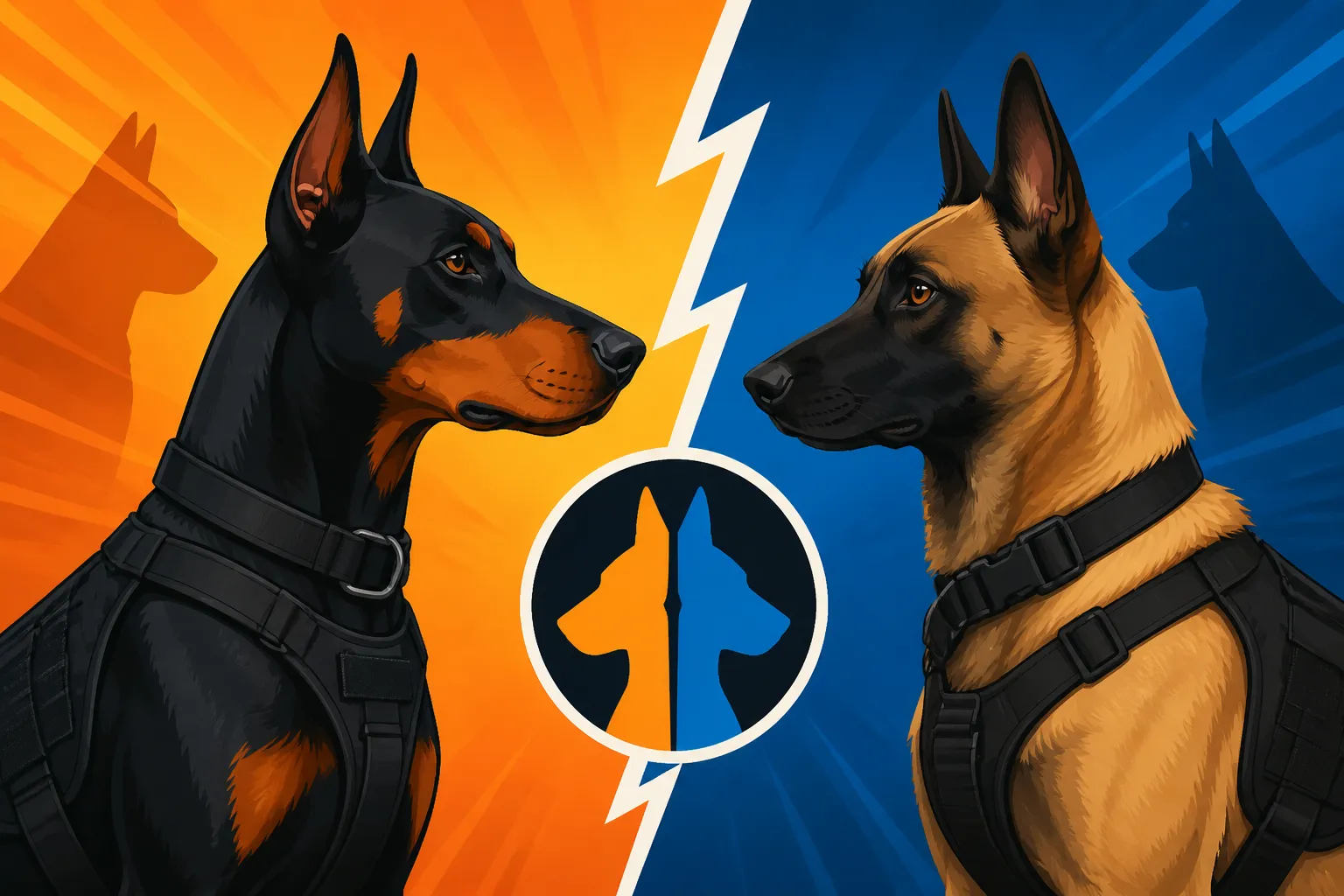
Doberman vs Belgian Malinois at work
Both breeds are athletic, intelligent, and capable of learning demanding tasks. But they are not interchangeable. A Malinois is often selected for work that rewards speed, endurance, quick responses, and intense engagement. A Doberman can also work seriously, but many handlers value the breed’s combination of athleticism, close human connection, and a steadier presence in the home.
Those are broad tendencies, not promises. A dog’s genetics, early experiences, health, training, and day-to-day handling all matter. A well-bred, suitable Doberman may be a stronger candidate for a particular job than a poorly matched Malinois, and vice versa.
Different working styles, not different levels of ability
The Malinois is known for a fast, energetic working style. Many are eager to move, chase, retrieve, and repeat tasks, and they can respond quickly to a handler’s cues. Those traits can be useful in demanding jobs that involve sustained activity or precise, rapid behaviors. They can also make everyday life challenging when the dog has no appropriate outlet or has not learned to settle.
Dobermans can be highly motivated and responsive, too. They often form strong attachments to their handlers and may be attentive to changes in their surroundings. Some excel in obedience, tracking, protection sports, and other structured work. The breed’s working history and expected temperament are explored in Doberman Temperament as the Standard Describes It.
A common mistake is to assume that the Malinois is automatically “more driven” and the Doberman automatically “more manageable.” Individual dogs vary considerably. A high-energy Doberman can be demanding, while a Malinois with a thoughtful temperament and skilled training can be composed at home. When assessing a prospective working dog, watch how it recovers after excitement, how it responds to frustration, and whether it can disengage—not just how enthusiastically it performs.
Quick comparison by work demands
The table below describes common breed tendencies, not guarantees about every dog. The right match depends on the specific task and on whether the dog has the physical and behavioral qualities to do it safely.
| Work consideration | Doberman | Belgian Malinois |
|---|---|---|
| Typical working impression | Athletic, attentive, often closely bonded to a handler | Fast, energetic, highly engaged and quick to respond |
| Potential strengths | Handler connection, presence, versatility, structured sport work | Agility, speed, stamina, rapid task engagement |
| Common challenge | Needs consistent training and meaningful activity; individual dogs can be intense | High activity and arousal can be hard to manage without suitable outlets and careful training |
| Fit for a novice working handler | Not an automatic beginner choice; needs skilled, consistent guidance | Often especially demanding for inexperienced handlers |
| Home life | Can be affectionate and people-focused, but still needs training and exercise | Can live well at home, but may struggle if activity and rest are poorly balanced |
| Important selection factors | Temperament, health history, recovery, trainability, breeder practices | Temperament, health history, recovery, trainability, breeder practices |
Neither breed should be chosen based on appearance, reputation, or a single exciting training video. A dog that looks intense during a demonstration may not have the stable judgment, sound health, or reliable off-switch required for real work.
Matching the breed to the job
“Work” can mean very different things: detection, patrol, search, sport, assistance tasks, livestock-related work, or simply a structured daily activity shared with an owner. A breed that suits one role may be a poor fit for another. Start by defining the actual task, then ask what physical and behavioral qualities it requires.
Police, military, and other operational roles
Malinois are common in many modern police and military working-dog programs, in part because suitably selected dogs may combine athletic movement, high work motivation, and adaptability to demanding training. But the job requires far more than speed or willingness to engage. Dogs must learn to work around noise, unfamiliar environments, transport, people, and changing demands, while remaining responsive to their handlers.
Dobermans have a history as working and protection dogs and can take part in demanding activities. Their working suitability depends on the dog, the task, and the standards of the organization or employer. A breed’s historical role does not guarantee that a particular dog is appropriate for operational work today. Learn more about breed history and modern use in Whether Dobermans Are Still Used in Protection Work.
For either breed, the selection process should focus on health, temperament, resilience, and trainability. Look for a dog that can recover after a startling event, accept direction, and remain clear-headed rather than simply escalating. Prospective handlers should also ask about the organization’s training methods, evaluation standards, veterinary support, and what happens when a dog does not meet the required criteria.
Sport, detection, and structured activity
Protection sports can provide a structured outlet for dogs that enjoy obedience, tracking, and controlled bite-work exercises. They are not a shortcut to creating a safe personal-protection dog, and participation should be guided by qualified trainers who understand both the dog and the sport. The activities involved are explained in What Protection Sport Involves for a Doberman.
Both breeds may also be considered for tracking, scent work, obedience, and other organized activities. In scent work, for example, the important question is not which breed looks more imposing. It is whether the individual dog enjoys searching, can work with its handler, and can learn the task without becoming overwhelmed. A calmer activity can be valuable for a dog that needs mental engagement but is not suited to high-arousal work.
Sport and work should complement the dog’s welfare, not become a reason to push past pain, fatigue, or behavioral stress. If a dog’s performance suddenly changes, consider discomfort or illness as well as training. A dog that becomes reluctant, unusually reactive, or slow to recover may need a veterinary assessment before its routine is intensified.
Training demands and the handler’s role
A smart, athletic dog is not automatically easy to train. Both breeds need clear communication, practice in varied environments, and consistent boundaries. The handler must be able to build the desired behavior while preventing rehearsals of unwanted behavior—and should be prepared to keep learning as the dog matures.
Why experience and professional guidance matter
A Malinois may be especially challenging for a first-time working-dog handler because intense engagement and high activity can leave little room for inconsistent training. That does not mean every Malinois is unmanageable or that every experienced handler will suit one. It means the handler needs a realistic plan for exercise, training, rest, and everyday behavior—not just a willingness to work hard.
Dobermans also need competent handling. Their size, strength, alertness, and close bond with their people can create difficulties if they are under-socialized, poorly managed, or encouraged to act suspiciously toward ordinary situations. A dog does not need to be taught to threaten people to be a capable working companion. For guidance on finding suitable support, see Finding a Trainer Who Has Worked With Dobermans.
Before bringing home either breed, ask potential trainers how they assess temperament, teach calm behavior, and handle fear or over-arousal. Be cautious of anyone who promises that a dog can be made protective on demand, or who treats aggression as proof of good working ability. The goal is a dog that can perform trained tasks and still respond thoughtfully to its handler.
Building reliable behavior away from the training field
A working dog still has to live in the real world. That means walking on a lead, resting at home, riding in a vehicle, accepting veterinary handling, and behaving safely around people and other dogs. These skills should be taught deliberately, rather than assuming that a dog will “know when it is off duty.”
Start with basics such as a reliable recall, a settle cue, loose-lead walking, and calm crate or resting-area routines. Practice around manageable distractions and increase difficulty gradually. A dog that can focus in a quiet training space may need separate work to remain composed in a busy parking lot, at a veterinary clinic, or when a visitor arrives.
For Doberman owners, it is worth understanding that sport participation does not automatically make a dog dangerous. At the same time, sport is not a cure for poor temperament or inadequate management. Whether Sport Makes a Doberman More Dangerous offers a closer look at that distinction, while Why Guard Training Ruins Most Pet Dobermans addresses the risks of treating ordinary guarding behavior as something to intensify.
Health, care, and choosing an individual dog
Working ability has little value if a dog cannot stay comfortable and healthy enough to do the job. Both breeds need appropriate veterinary care and responsible breeding. The health questions are not identical, so prospective owners should ask breed-specific questions rather than relying on general assurances that a dog is “healthy.”
Health screening is part of working-dog selection
Dobermans are notably associated with dilated cardiomyopathy, a serious heart disease that can be difficult to identify from appearance alone. A family history and appropriate veterinary screening are important considerations when choosing a Doberman, especially if the dog is expected to participate in strenuous activity. Read The Heart Disease That Reaches Most Dobermans for a broader discussion of the breed’s cardiac risk.
Ask breeders what health evaluations they perform, how they interpret results, and whether they can discuss health issues in related dogs—not just provide a list of test names. A DNA test or a clear result on one examination does not establish that a dog will never develop disease. For a closer look at the paperwork and questions to ask, see The Health Testing a Doberman Breeder Must Show.
For a Malinois, ask about the health and soundness of the parents and close relatives, and how the breeder evaluates temperament as well as physical ability. No working pedigree eliminates the need to assess the individual dog. If you are considering a dog from a working program, ask what the dog has actually been trained to do and how it behaves in ordinary, low-pressure settings.
A practical checklist before committing
Before choosing either breed, visit more than one breeder or working program where possible. Meet adult dogs, observe how they settle between activities, and ask to see the kind of behavior you would expect in everyday life—not only a high-energy demonstration. If you are considering a rescue or adult dog, ask for a detailed history and arrange a careful assessment with a qualified professional.
Use this checklist to keep the decision grounded:
- Define the job. Write down the specific tasks you want the dog to perform and how often it will work.
- Assess your experience honestly. Include your ability to manage a powerful dog, not just your interest in training.
- Meet the individual dog. Look at recovery, sociability, confidence, frustration tolerance, and ability to rest.
- Review health information. Ask about screening, family history, veterinary records, and the demands the dog can safely handle.
- Plan ordinary life. Consider exercise, enrichment, travel, visitors, housing, and who will care for the dog when you are away.
- Choose qualified support. Find a trainer or organization that prioritizes safety, welfare, and practical behavior alongside performance.
The equipment needed for daily care is a separate issue from working-dog suitability. A well-fitted harness, lead, crate, and enrichment items can make routines easier, but no product substitutes for training and supervision. Some owners use retailers such as Chewy to look for everyday supplies; check product dimensions carefully, especially for a deep-chested dog, and choose gear appropriate to the individual dog. Chewy may also be one place to compare food-storage or enrichment options, but ask your veterinarian about diet if the dog has a health condition or an unusually demanding workload.
A dog’s needs will change with age, training, and health. Keep the routine flexible, monitor weight and recovery, and revisit the plan if a dog begins to tire, avoid a task, or show a change in behavior. Chewy can be useful for locating routine care items, but medication, supplements, and diets intended to treat a condition should be discussed with a veterinarian rather than selected based on a product description.
Disclaimer
This article is for general informational purposes only and does not constitute professional advice. Laws, prices and regulations vary by location and change over time. Consult a qualified professional for guidance on your specific situation.