What Protection Sport Involves for a Doberman
Many Doberman owners feel a pull towards activities that harness their dog's incredible intelligence, athleticism, and natural guarding instincts, often wondering if protection sport is the right path. It's easy to get caught up in the dramatic images of "bite work" you might see online, leading to a lot of questions and sometimes, misconceptions about what these sports truly involve. This guide aims to peel back the layers and explain the multi-faceted world of protection sport, clarifying what it demands from both you and your Doberman.
Understanding Protection Sports: More Than Just "Bite Work"
When most people hear "protection sport," their minds immediately jump to dogs biting sleeves or attacking decoys. While that is a component, it's a tiny fraction of a much larger, highly disciplined, and deeply engaging sport. The truth is, protection sport is a rigorous test of a dog's temperament, nerve, trainability, and handler control, woven into a tapestry of obedience, tracking, and controlled protection exercises. It’s not about creating an aggressive dog; it’s about channeling a dog's natural drives into a highly structured, rule-bound activity.
The Core Disciplines: IPO, IGP, and Schutzhund
Historically, "Schutzhund" was the umbrella term, meaning "protection dog" in German. Today, you'll often hear "IGP" (Internationale Gebrauchshund Pruefung) or "IPO" (Internationale Prüfungs-Ordnung) as the more current, internationally recognized terms for these multi-discipline trials. These sports were initially developed in Germany in the early 1900s to test the suitability of German Shepherd Dogs for breeding and working roles. The same principles apply to Dobermans, who, with their innate drives and keen intellect, often excel.
These trials aren't just one event; they’re three distinct phases that test different aspects of your Doberman's abilities. Imagine trying to get a perfect score in a triathlon that combines mental acuity, physical stamina, and unwavering focus. That's what IGP asks of a dog and handler team. It truly showcases a Doberman's full potential, highlighting their intelligence and biddability as much as their physical prowess. For more on how these dogs are inherently built for such tasks, you might want to read about Doberman Temperament as the Standard Describes It.
What it Isn't: Not About Aggression, But Control and Genetics
It’s crucial to understand that protection sport is not about making a dog mean or aggressive. In fact, a truly aggressive or unstable dog would fail miserably in these trials. The dog must demonstrate complete control, immediately releasing the decoy on command, and showing no fear or undue aggression. Judges are looking for a dog that is confident, stable, and eager to work, not a loose cannon. Any sign of uncontrolled aggression or fear-biting would lead to disqualification.
The sport relies heavily on a Doberman's natural prey drive and defensive drives, teaching them to engage and disengage on cue. It's a highly sophisticated game where the dog learns that responding to the handler's commands, even in high-drive situations, brings the ultimate reward. This means a strong foundation in basic and advanced obedience is absolutely non-negotiable. Without it, you simply don't have a sport dog, no matter how much drive they possess. This contrasts sharply with informal "guard training" that often pushes dogs into fear or actual aggression, which is why Why Guard Training Ruins Most Pet Dobermans is such an important read.
The Journey Through Protection Training Phases for Your Doberman
Embarking on protection sport with your Doberman is a marathon, not a sprint. It's a journey that builds slowly, systematically, and with immense dedication from both dog and handler. Each phase is interconnected, building on the skills learned in the previous one, and emphasizing the Doberman's natural abilities while refining them into precise, sport-specific behaviors.
Phase 1: Obedience – The Absolute Foundation
Before any "protection" work begins, your Doberman needs to be a rockstar at obedience. This isn't just knowing "sit" and "stay"; it's about precision, willingness, and absolute reliability under distraction. In IGP, the obedience phase (Phase B) involves a routine performed off-leash, including heeling patterns, sits, downs, stands, retrieves over obstacles, and a long down stay. Every movement, every position, every transition is meticulously judged.
Think of it as the ultimate test of your bond and communication. Your Doberman needs to be keenly focused on you, even with other dogs, people, and novel sounds around. This requires countless hours of consistent, positive reinforcement training, building a dog that wants to work with you. Many trainers recommend starting with virtual obedience courses, like those offered by BAXTER & Bella, to build a solid foundation before stepping into a specialized club. This early, consistent training is paramount. Without it, a Doberman's impressive intelligence can quickly lead to them outsmarting their handler, as discussed in Training a Doberman That Is Smarter Than You Expect. The better the obedience, the safer and more effective all subsequent training will be.
Phase 2: Tracking – Engaging the Doberman's Natural Instincts
The tracking phase (Phase A) highlights the Doberman's incredible scenting ability and focus. In this part of the trial, your dog must follow a human track laid out across varied terrain, often several hundred paces long, and indicate "articles" (small, man-made objects like wallets or keys) dropped by the track layer. It's a quiet, intense, and methodical discipline that demands immense mental stamina and concentration from your dog.
For many Dobermans, tracking is a truly enriching experience. It taps into their primal instinct to follow a scent and allows them to engage their minds in a way that physical exercise alone often doesn't. It’s a wonderful way to build confidence, particularly for a dog that might be a bit environmentally sensitive. This phase often involves starting with simple food tracks on fresh ground and gradually increasing complexity, age of the track, and distractions. You'll spend hours walking fields, laying tracks, and observing your Doberman's natural hunting and problem-solving skills come to life. Using high-value training treats, sometimes found easily on Amazon, can be incredibly motivating for dogs learning to track.
Phase 3: Protection – Controlled Drives and Precision
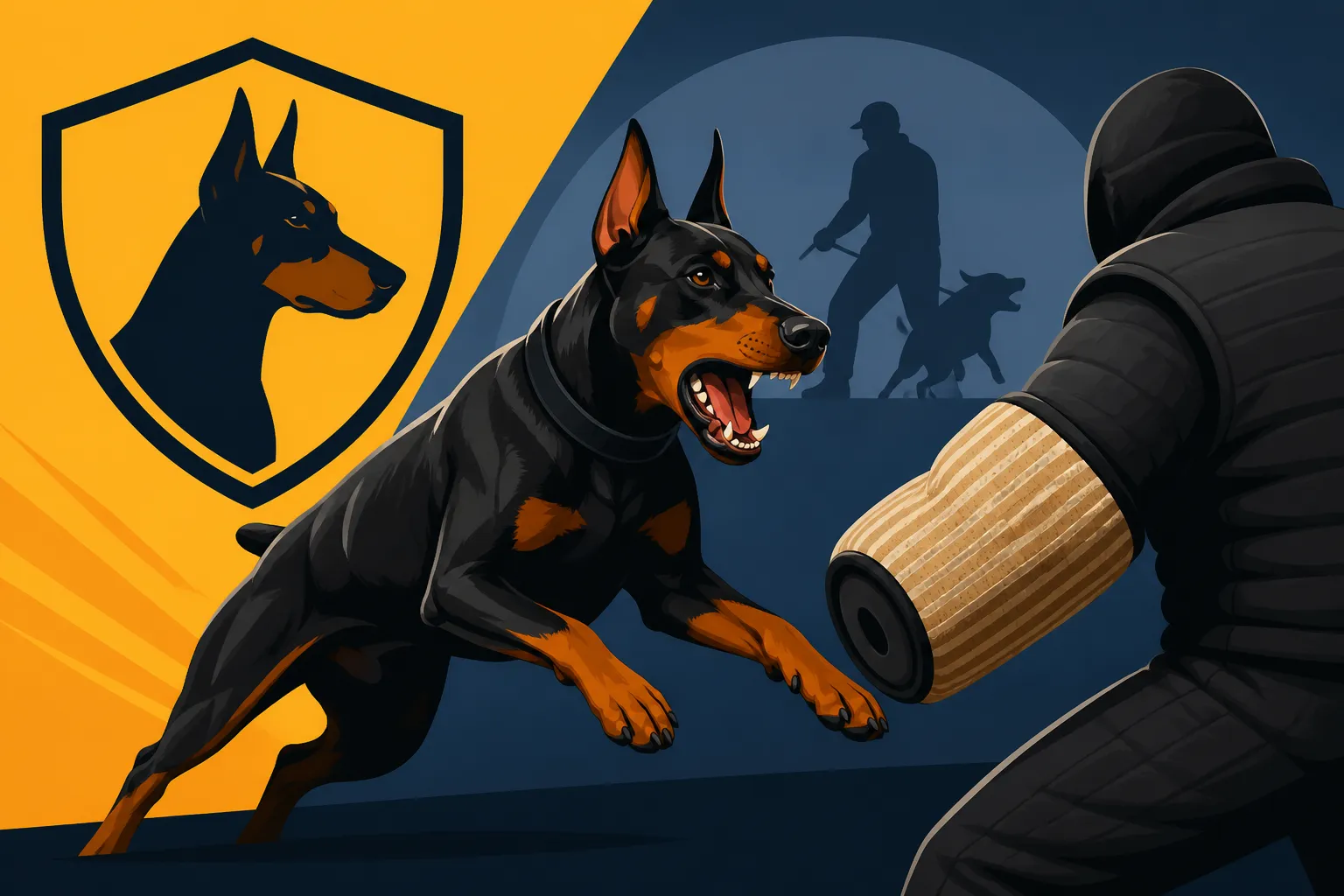
This is the phase most people envision when they think of protection sport. The protection phase (Phase C) tests the Doberman's courage, defensive drives, and most importantly, their control. It involves exercises like searching for a "helper" (the decoy) in blinds, barking to indicate the helper's presence, preventing an escape, apprehending the helper during an attack, and demonstrating a rock-solid "out" (releasing the bite) command. Every exercise is precisely choreographed and highly controlled.
A Doberman in this phase isn't just biting; they're performing a complex set of behaviors under extreme pressure. The dog must show full, hard grips on the bite sleeve, but also demonstrate excellent nerve, showing no hesitation or fear when confronted. The "out" command is paramount: the dog must release the sleeve immediately and return to the handler, demonstrating that the handler has ultimate control, not the dog's drive. This phase demands a Doberman with sound temperament, strong nerves, and intense focus, which are traits highly valued in the breed, stemming from their original purpose and The Tax Collector Who Invented the Doberman. The level of control needed here is exceptional, a far cry from what would be considered aggressive behavior. If you’re considering this, understanding Whether a Pet Doberman Should Do Bite Work is essential, as the nuances between sport and real-world protection are vast.
| Phase | Primary Focus | Key Skills Tested | Equipment Examples |
|---|---|---|---|
| Obedience | Handler-dog teamwork, precision, reliability | Heeling, retrieves, stays, positional commands | Long line, dumbbells, flat collar, rewarding treats |
| Tracking | Scent work, mental focus, problem-solving | Following human scent, identifying articles | Tracking harness, long line, tracking flags, food |
| Protection | Controlled drives, nerve, handler control | Searching, barking, bite work, "out" command | Bite sleeve, blinds, protective equipment for helper |
Realistic Expectations and Responsibilities of a Protection Sport Handler
Taking on protection sport with a Doberman is a significant commitment. It's not something to be entered into lightly, and understanding the full scope of what it demands is crucial for both your success and your dog's well-being. It's a lifestyle, not just a hobby.
Time, Commitment, and Financial Investment
Let's be blunt: protection sport is not a cheap or quick endeavor. It demands a substantial investment of time, money, and emotional energy. You'll be spending multiple days a week at the training club, often for several hours at a time. This includes weekly club sessions, independent practice for obedience and tracking, and attending seminars or workshops to refine skills. It's a social sport, but the primary focus is always on your dog and your team's progress.
Financially, the costs can add up. Club membership fees, training equipment (tracking harnesses, long lines, bite sleeves, decoys, protective gear for helpers, sometimes easily sourced from Amazon), entry fees for trials, and potentially travel and accommodation for events can be considerable. Then there are the regular vet checks to ensure your Doberman stays in peak physical condition. It's truly a sport where What Protection Sport Costs a Doberman Owner can be a serious consideration. This isn't a casual pursuit; it requires a deep, unwavering dedication to your dog and the sport.
Temperament and Genetics: Is Your Doberman Suited?
Not every Doberman is cut out for protection sport, and that's perfectly okay! While the breed generally possesses the drives and intelligence needed, individual temperament varies greatly. A good protection dog needs to be confident, environmentally stable, possess good social drives (towards the handler, not necessarily everyone), have a solid nerve, and be highly biddable. They should be able to recover quickly from stress and exhibit courage, not fear.
A Doberman that is naturally shy, fearful, or overly sensitive will likely struggle and could even be harmed by the pressures of the sport. It's paramount to assess your Doberman's natural temperament honestly. A reputable breeder who health tests and focuses on sound temperament will likely produce dogs more suitable for these kinds of activities. This is where understanding your dog's lineage and what traits are typically seen in working lines versus show lines becomes important. A conversation with an experienced mentor or trainer can help you determine if your Doberman has the right genetic predisposition and inherent drive for this type of demanding work. Before even considering the sport aspect, it's wise to get a firm grasp on Doberman Guarding Instinct and Where It Tips Over to ensure you're working with your dog's natural inclinations, not against them.
The Ethical Considerations and Public Perception
Entering the world of protection sport also means taking on the responsibility of managing public perception. Dobermans already carry a stigma for some people, and working them in a sport involving bite work can sometimes fuel misconceptions. It's your responsibility as a handler to be an ambassador for the breed and the sport. This means ensuring your dog is impeccably behaved in public, under control at all times, and that you can articulate what the sport truly is about—control, discipline, and teamwork—rather than aggression.
You'll need to be prepared for questions, sometimes negative comments, and to educate those who are misinformed. A well-trained Doberman in sport is typically a fantastic, well-adjusted pet at home, precisely because their drives are channeled in a constructive way. However, you'll still encounter people who view any dog doing "bite work" with suspicion. This is a critical point of discussion, and if you have concerns about this aspect, you should definitely read Whether Sport Makes a Doberman More Dangerous. The short answer is: when done correctly, it actually makes them more controlled and safe.
Finding the Right Support: Clubs, Trainers, and Community
The single most critical factor in your success and your Doberman's positive experience in protection sport is finding the right training environment and guidance. This is not a sport you can, or should, attempt to learn from YouTube videos alone. Experienced mentors are invaluable.
Qualities of a Good Protection Sport Club
A good protection sport club is more than just a place to train; it's a community. You're looking for a club that emphasizes safety, positive reinforcement techniques (even within a drive-based sport), and has experienced, knowledgeable helpers (the individuals who wear the protective suit and engage with the dog). A high-quality club will:
- Prioritize safety: For dogs, handlers, and helpers.
- Focus on fundamental obedience first: They won't rush into protection work without a solid foundation.
- Have experienced, certified helpers: These individuals are integral to building a dog correctly.
- Promote a positive and supportive atmosphere: You want a place where you and your dog feel encouraged, not intimidated.
- Emphasize control and technique: The focus should be on clean, precise work, not just brute force.
- Have dogs of various skill levels: This shows that they nurture new teams and develop talent over time.
Don't be afraid to visit several clubs, observe training sessions, and ask questions before committing. The right club will make all the difference, and Finding a Protection Club That Takes Dobermans specifically is a good first step, as some clubs are breed-specific or more welcoming to Dobermans than others.
What to Look for in a Doberman-Specific Trainer
While many trainers work with a variety of breeds, a trainer with specific experience in Dobermans for protection sport can be a huge asset. They understand the breed's nuances, their typical drives, and common challenges. Look for a trainer who:
- Has successfully titled Dobermans themselves: Experience is the best teacher.
- Can articulate their training philosophy clearly: It should align with humane, effective methods.
- Is patient and able to adapt their methods: Every Doberman is an individual.
- Focuses on building confidence and drive: Not suppressing it or causing fear.
- Can guide you through all three phases: Ensuring a balanced approach.
- Is respected within the sport community: Ask for references or observe their students.
Remember, the goal is to develop a confident, well-controlled Doberman who enjoys the work, not one who performs out of fear or confusion. Getting Started in Protection Sport With a Doberman provides excellent advice on initial steps, often emphasizing foundational skills with a knowledgeable trainer. The age to begin serious sport training also matters, as discussed in The Age a Doberman Starts Sport Training, typically after a strong foundation in basic obedience has been established and their growth plates have closed.
Protection sport is a challenging but incredibly rewarding journey for Doberman owners who are willing to invest the time, effort, and dedication. It’s a powerful way to bond with your dog, channel their inherent abilities, and produce a highly trained, controlled, and confident canine partner.
Disclaimer
This article is for general informational purposes only and does not constitute professional advice. Laws, prices and regulations vary by location and change over time. Consult a qualified professional for guidance on your specific situation.