Teaching a Doberman to Accept Visitors
It’s a scenario many Doberman owners dread: the doorbell rings, and suddenly your usually composed, loyal companion transforms into a barking, lunging, sometimes even nipping whirlwind of protective instinct. It’s frustrating, embarrassing, and honestly, a little scary, both for you and your guests. This guide is here to walk you through understanding why your Doberman might act this way around visitors and provide actionable, step-by-step strategies to teach them to accept guests calmly and politely, making your home a welcoming space for everyone.
Understanding Your Doberman's Instincts Around Visitors
Dobermans are incredible dogs, known for their intelligence, loyalty, and striking presence. But these very traits, when misunderstood or mismanaged, can lead to some sticky situations, especially when new people enter their territory. It's not about them being "bad" dogs; it's about understanding their wiring and helping them navigate a human world that doesn't always align with their natural instincts.
The Doberman's Natural Guardian Role
Let's be real: Dobermans were bred for protection. Karl Friedrich Louis Dobermann, the breed's creator, needed a fearless companion for his night rounds as a tax collector. This history means that a deep-seated guarding instinct is part of their DNA. They are alert, watchful, and naturally inclined to assess every new person or situation with caution. When someone new approaches your home, your Doberman isn't necessarily thinking, "Oh, a friend!" They're often thinking, "Who is this, and are they a threat to my family and my territory?"
This isn't just about big, scary threats either. To a Doberman, an unfamiliar person making direct eye contact, approaching too quickly, or even just reaching out a hand can be perceived as an invasion of space or a challenge. They see themselves as your protector, and that protective drive can kick into overdrive when guests arrive. It's why that deep bark and stiff posture are so common. It's their way of saying, "I see you, and I'm on guard." This intense loyalty is one of the things we love about them, but it needs careful channeling. Many Doberman owners find themselves grappling with A Doberman That Guards the Yard Line or A Doberman That Blocks the Doorway as part of this instinctual behavior.
Why They Might Be Wary, Not Aggressive
It’s crucial to differentiate between wariness and aggression. While some Dobermans might display outright aggression towards visitors, many are simply wary or over-aroused. Wariness often manifests as barking, backing away, or a stiff body posture without actual attempts to bite. It's a "stay away" signal, rather than an immediate attack. Over-arousal, on the other hand, can look like a frantic mix of excitement and anxiety – jumping, mouthing, barking, and running around. This can often be misinterpreted as aggression because it's so intense and overwhelming for both the dog and the visitor.
Think about it: your Doberman lives in a relatively predictable world with you. When the doorbell rings, it shatters that predictability. Their adrenaline spikes, their senses are on high alert, and they might not have the coping mechanisms to calmly process the new person. They might not know if this person is genuinely a friend or foe, and their default setting leans towards caution. A Doberman that acts out isn't necessarily mean; they're often unsure, anxious, or simply overwhelmed. Understanding this distinction is the first step towards helping them. Sometimes, even what looks like curiosity can have an edge to it if they are not properly socialized or trained, leading to concerns like A Doberman That Pushes Between People.
Early Foundations: Socialization is Key
The foundation for a calm, well-adjusted Doberman who accepts visitors graciously is laid long before those first guests arrive. It all starts with thoughtful and consistent socialization, especially during their critical developmental periods. Without this groundwork, you're constantly playing catch-up, trying to undo ingrained behaviors rather than building positive associations from the start.
The Critical Window for Doberman Puppies
The most crucial period for socializing a Doberman puppy is generally between 8 and 16 weeks of age. This is when their brains are like sponges, soaking up every experience and forming their worldview. During this time, it’s absolutely vital to expose your puppy to a wide variety of sights, sounds, people, and environments. This isn't just about letting them meet a few friends; it's about making sure every interaction is positive, controlled, and builds confidence.
Think about bringing your Doberman puppy to a friend's house with calm, dog-savvy people, or having a stream of different types of people visit your home – men, women, people wearing hats, people with glasses, people with deep voices, people with high voices, people using canes or wheelchairs. The goal is to normalize the presence of various humans so they don't become a novel, potentially scary, experience later. If your puppy only ever meets people who look exactly like you, they’ll be much more suspicious of anyone different. This exposure needs to be gentle and positive; never force an interaction. Treats, praise, and short, happy encounters are the name of the game. For more insights on this critical period, consider The Sixteen Weeks That Set a Doberman Up.
Controlled Introductions to Diverse People
Beyond just "meeting" people, your Doberman puppy needs structured, positive introductions. This means ensuring that meeting new people is always a good experience. When a new person comes over, have them toss a high-value treat away from the puppy, so the puppy can choose to approach at their own pace. Avoid having guests lean over, stare directly, or immediately try to pet the puppy, especially on the head. A Doberman puppy needs to learn that strangers bring good things, not scary intrusions.
This also means exposing them to different situations where people are present but not necessarily interacting with them directly. Think about sitting on a bench at a park and simply observing people walking by, rewarding your puppy for calm behavior. Or having a friend come over and just sit on the couch, ignoring the puppy, while you play with your puppy nearby. The key is to create positive associations with new people in a variety of contexts, not just in your home. This helps build a resilient and adaptable adult Doberman. A good online resource like BAXTER & Bella can offer structured training programs that guide you through these critical socialization steps, often with video tutorials to show you exactly how to execute controlled introductions and positive reinforcement.
Continuing Socialization Beyond Puppyhood
The idea that socialization ends at 16 weeks is a common misconception, especially with breeds like Dobermans. While the puppy window is critical, socialization is a lifelong process. An adult Doberman still needs regular, positive exposure to new people, places, and experiences to maintain their confidence and good manners. If you stop, they can easily revert to being wary or reactive, particularly if they have a strong guardian instinct.
This means continuing to invite a variety of people into your home, taking your Doberman to pet-friendly stores during off-peak hours, or going for walks in different neighborhoods. Always prioritize quality over quantity. One calm, positive interaction is worth ten rushed, stressful ones. If your Doberman is struggling with fear or reactivity towards specific types of people, for example, Meeting Men in Hats With a Doberman Puppy, you'll want to seek out opportunities for very controlled, positive encounters, always keeping your Doberman below their reactivity threshold. Think about maintaining those good habits through regular, fun training sessions, using tools you can easily find on Amazon like durable treat pouches and clickers to keep the positive reinforcement flowing.
Setting Up for Success: Management Strategies Before Visitors Arrive
Even with excellent socialization, Dobermans are intelligent and can develop strong habits. When it comes to visitors, proactive management is half the battle. You need a game plan before the doorbell rings, not just a reaction when your Doberman goes into full alert mode. This preparation ensures everyone’s safety and makes it much easier to teach your Doberman the desired calm behavior.
Creating a "Safe Zone" for Your Doberman
One of the most effective strategies is to establish a designated "safe zone" or "place" for your Doberman when visitors are expected. This could be their crate, a comfy dog bed in a quiet room, or a specifically defined mat in the living area. The key is that this spot is a positive, calm place where they can retreat and feel secure, away from the immediate chaos of the front door. Start teaching your Doberman to "go to their place" long before visitors arrive, making it a highly rewarding command. Give them a special chew toy, a KONG stuffed with peanut butter, or a long-lasting treat when they’re in their place.
When guests are due, have your Doberman in their safe zone before the first knock. This prevents the frantic greeting at the door, which often escalates their excitement or anxiety. It gives them a job and a sense of routine. Imagine your Doberman calmly chewing a treat on their mat while your guests walk in, rather than barking frantically. This isn't punishment; it's providing structure and a comforting routine. For a deeper dive into this, you might find Getting a Doberman to Rest in a Crate helpful. Many owners find robust crates, readily available on Amazon, essential for creating this secure space.
Utilizing Tools for Calm Greetings
Beyond a safe zone, certain tools can be incredibly helpful in managing your Doberman's energy and focus during visitor arrivals. A well-fitted head halter or a sturdy front-clip harness can provide better control than a flat collar, especially for a strong Doberman who might lunge. These tools can help redirect their attention and prevent them from pulling you over when they get excited. Remember, these are management tools, not training shortcuts; they still require you to actively guide your Doberman.
Leashes are also your best friend. Even if your Doberman usually has excellent recall, having them on a leash when guests arrive gives you immediate control and allows you to calmly guide them to their place or away from the door. A long line can also be useful for practicing calm greetings from a distance in a controlled environment, allowing you to gradually decrease the distance as they improve. You can find a wide variety of reliable harnesses, leashes, and head halters on Amazon that can make these managed greetings much smoother.
| Tool Type | Purpose | Best Use Case | Important Consideration |
|---|---|---|---|
| Crate | Secure, quiet retreat | Preventing frantic door greetings, safe zone | Must be a positive space, never for punishment |
| "Place" Mat | Designated calm spot | Teaching a Doberman to settle during distractions | High-value rewards make it appealing |
| Head Halter | Gentle control for strong pullers | Redirecting focus, preventing lunging | Requires proper fitting and positive introduction |
| Front-Clip Harness | Reduces pulling by redirecting momentum | Easier to manage than a flat collar, less neck strain | Still needs training, not a magic fix for pulling |
| Leash | Immediate physical control | Guiding to place, preventing unwelcome approaches | Choose sturdy, comfortable material for handler and dog |
| Long-Lasting Chews | Distraction, positive association | Keeping Doberman occupied in their safe zone | Appropriate size and material for Doberman's chewing habits |
Preparing Your Visitors for a Doberman Welcome
This step is often overlooked, but it’s absolutely crucial. Your guests need to be part of the training process, even if it's just following a few simple instructions. Before your guests arrive, text or email them with clear guidelines. Explain that your Doberman is in training and that you're working on polite greetings.
Here are some common guidelines to share with guests:
- Ignore the dog initially: Ask them to avoid eye contact, talking to, or petting your Doberman until you give the signal. This helps prevent over-excitement or anxiety.
- No immediate petting: Explain that you'll guide the interaction. Many Dobermans benefit from a few minutes to acclimate to a new person's presence before being asked to interact.
- Treats are welcome: Ask them to have a handful of high-value treats (which you'll provide) ready to gently toss away from your Doberman, not hand-feed, when you give the green light. This creates positive associations.
- Calm demeanor: Encourage calm, quiet movements and voices. Loud greetings can quickly escalate a Doberman's arousal.
By setting expectations with your guests, you’re creating a supportive environment for your Doberman to learn, rather than putting them (and your guests) in a stressful situation. It’s a team effort, and your visitors are part of that team.
The Art of the Controlled Introduction
Once you've set the stage with management strategies and prepared your guests, it's time for the actual introduction. This isn't about letting your Doberman "figure it out." It's a carefully orchestrated sequence of events designed to build positive associations and reinforce calm behavior.
Step-by-Step for a Calm Entry
Let's walk through a typical arrival, assuming you've done the pre-work of establishing a safe place and briefing your guests.
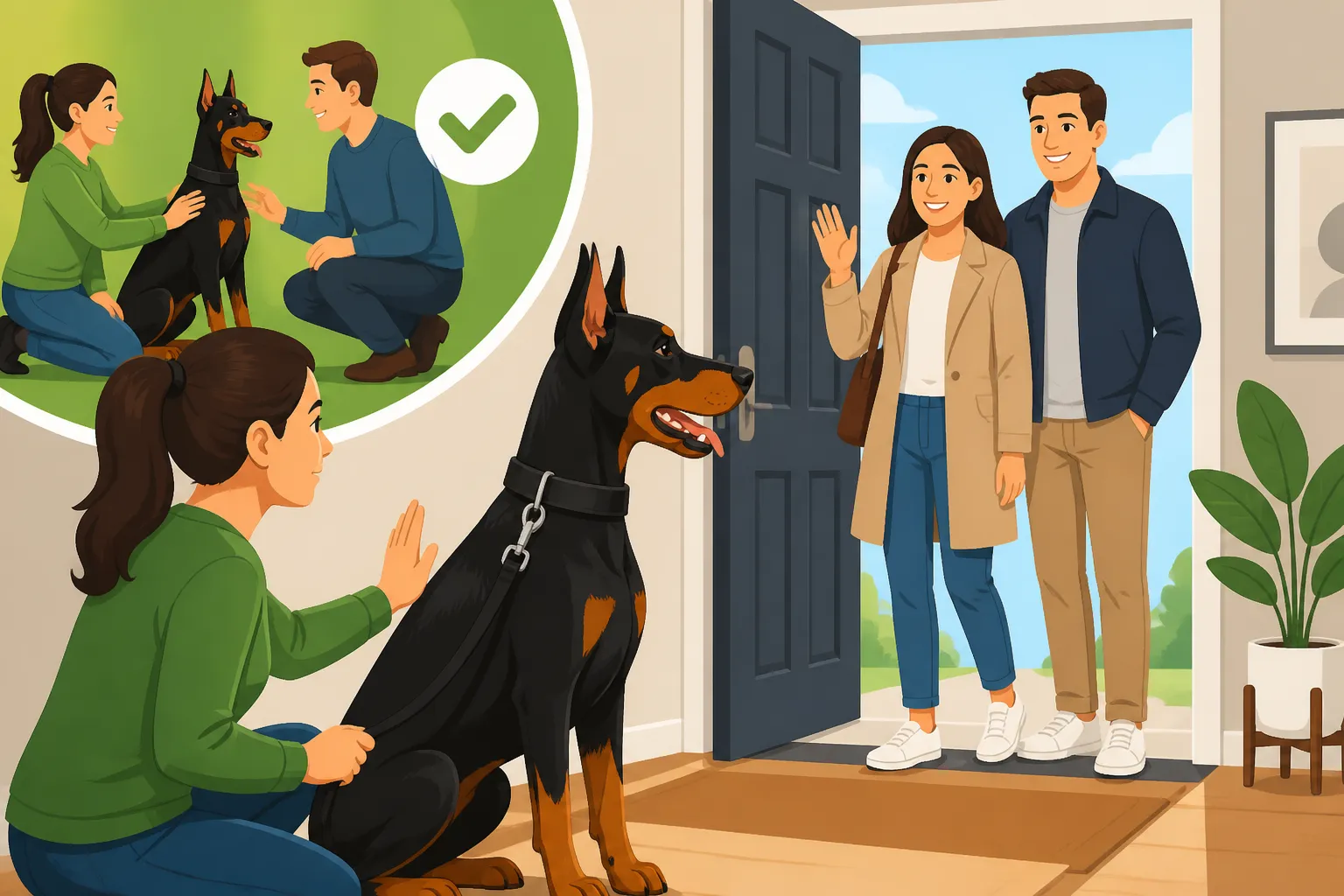
- Doberman in Place: Before your guests even knock, your Doberman should be comfortably settled in their designated "place" (crate, mat, or another room) with a high-value chew. This prevents the initial burst of energy at the sound of the doorbell.
- Door Protocol: Open the door calmly. If your Doberman is still in their place, great! Greet your guests. If your Doberman barks from their place, ignore it for a moment, let your guests in, and close the door.
- Guest Seating: Have your guests immediately sit down. This reduces their perceived threat level and signals a calm environment.
- Gradual Introduction (Optional): If your Doberman is known to be very anxious or reactive, you might start with a gate between them and your guests, or keep them in another room for the first 5-10 minutes. This allows them to listen to voices and scents without feeling pressured.
- Release and Reward: Once your guests are settled and your Doberman has had a moment to observe, calmly release your Doberman from their place. Keep them on a leash initially if necessary. Guide them to a neutral spot, perhaps a few feet away from the guests.
- Positive Associations Begin: This is where the treats come in. Give your guests a handful of small, high-value treats. Instruct them to gently toss a treat on the floor near your Doberman (not directly to them) every time your Doberman is calm. They should still avoid direct eye contact or talking to your Doberman.
- Monitor and Manage: Watch your Doberman's body language closely. If they are calm, relaxed, and taking treats, great! If they start to stiffen, stare, bark, or jump, calmly (without scolding) redirect them back to their place for a reset, or take them to another room for a brief time-out before trying again.
The goal is short, positive interactions. Don't force prolonged exposure if your Doberman is struggling. It's better to have several successful short interactions than one long, stressful one. This structured approach helps address issues like a Doberman that barks at strangers by changing the entire greeting dynamic.
Managing Excitement and Over-Arousal
Many Dobermans don't display overt aggression but instead become incredibly excited and over-aroused around visitors. This can look like frantic jumping, mouthing, barking, and running around like a maniac. While it might seem less threatening than aggression, it's still unwelcome and can be overwhelming for guests. This behavior often stems from a lack of self-control and an inability to process their own high energy in a calm way.
The key to managing over-arousal is prevention and redirection. Don't wait for your Doberman to be completely wound up. Interrupt the behavior before it escalates. If you see them starting to get antsy or fixate on the door, immediately engage them in a calm, known behavior like "sit" or "down" in their place. Reward heavily for any calm behavior. When guests arrive, keep interactions brief and low-key. If your Doberman starts to jump, immediately turn your back or calmly lead them away. The moment all four paws are on the floor, reward them. Consistency is everything here. Every time they jump and get a reaction (even a negative one like pushing them away), they are reinforced. Every time they keep four paws on the floor and get a reward, that behavior is reinforced. A good resource for structured training on this is BAXTER & Bella, which often has specific modules on polite greetings and impulse control.
What to Do When Things Go Sideways
Despite all your best efforts, sometimes things just don't go as planned. Maybe your Doberman slipped past your leash, or a well-meaning guest ignored your instructions. Don't panic! The most important thing is to remain calm and avoid scolding or punishing your Doberman, as this can increase their anxiety or reactivity.
- Safe Containment: If your Doberman becomes overly agitated, reactive, or aggressive, the first priority is to safely remove them from the situation. Calmly lead them to their crate or a quiet room away from the guests. Do not make a big fuss; just a quiet, firm "Let's go" is enough.
- Give Space: Allow your Doberman to decompress. Some Dobermans need 10-15 minutes of quiet time to calm down before they can try again.
- Assess and Adjust: Think about what went wrong. Did your guests follow instructions? Was your Doberman over-tired or under-exercised? Was the environment too stimulating? Use this as a learning opportunity to adjust your strategy for the next time. Perhaps your Doberman needs more vigorous exercise before guests arrive, or a longer "place" stay during the initial greeting.
- Consider a Muzzle: For Dobermans who have shown actual aggression or extreme reactivity, muzzle training can be an invaluable safety tool. A properly fitted muzzle (like a basket muzzle) allows your Doberman to pant, drink, and take treats, but prevents nips or bites. This isn't about punishing your dog; it's about giving you and your guests peace of mind while you continue training. It allows your Doberman to be present in social situations safely. Learning to properly introduce a muzzle proactively can be a game-changer, rather than waiting until it's an emergency. Muzzle Training a Doberman Before It Is Needed can offer further guidance.
Remember, every "sideways" moment is a data point. It tells you what your Doberman struggles with and where you need to focus your training efforts.
Advanced Training for Consistently Calm Greetings
Once you've mastered the basics of management and controlled introductions, you can start layering on more advanced training. This focuses on teaching your Doberman specific behaviors that are incompatible with reactivity or over-excitement, making polite greetings a default.
"Go to Mat" or "Place" Training
We touched on this earlier, but building a rock-solid "go to mat" or "place" command is paramount for Dobermans who need to learn to accept visitors. This isn't just about sending them away; it's about teaching them to actively choose a calm, settled behavior in the presence of distractions.
Start in a quiet environment, teaching your Doberman to go to their mat, lie down, and stay. Reward heavily for even short durations. Gradually add distractions:
- You walking around the room.
- Someone else walking around the room.
- Someone walking by the window.
- Someone lightly tapping on the door.
- Finally, someone entering the house, with your Doberman initially behind a gate or on a tether, before eventually moving to full view.
The goal is for your Doberman to understand that the mat is their job, and staying there, even with exciting things happening, earns them fantastic rewards. This behavior becomes their coping mechanism, a way to channel their energy positively. Remember to keep sessions short and positive, ending on a successful note. Teaching a Doberman to Go to a Mat for Guests explains how this command can transform your household dynamics.
Practicing with Trusted Friends
Once your Doberman is proficient with "place" in low-distraction environments, it's time to bring in the practice squad: trusted friends and family members who understand and support your training goals. These individuals become your "pretend" visitors, helping you rehearse arrivals and departures in a controlled setting.
Practice sessions might look like this:
- Staged Arrival: Your friend arrives, following all your pre-briefed instructions (ignoring the dog, sitting down).
- Doberman in Place: Your Doberman is on their mat, receiving long-lasting chews.
- Gradual Interaction: After a few minutes of calm, you might allow your Doberman to approach the friend on a leash, offering treats for calm sniffing or a polite "sit."
- Short Duration: Keep these practice interactions short, maybe 5-10 minutes.
- Repeat and Vary: Practice with different friends, at different times of day, varying how they enter (knocking vs. ringing, talking vs. quiet). The more varied and positive the practice, the more generalized your Doberman's calm behavior will become.
These practice sessions build invaluable real-world experience for your Doberman without the pressure of a real social event.
Addressing Specific Reactivity Triggers
Sometimes, your Doberman might be perfectly fine with most guests but has specific triggers that send them over the edge. Maybe it’s men with beards, people wearing hats, or children. Identifying these specific triggers is the first step in addressing them.
Once identified, you'll need to employ a technique called desensitization and counter-conditioning. This involves gradually exposing your Doberman to the trigger at a distance or intensity where they remain calm, and then pairing that exposure with something highly positive (like high-value treats).
Example: Reactivity to people wearing hats.
- Start Far Away: Have a friend wear a hat and stand far enough away that your Doberman notices but doesn't react.
- Treat & Retreat: As your Doberman sees the hat-wearing person, immediately give them a treat. Then, the person moves away. Repeat.
- Gradually Closer: Slowly decrease the distance over many sessions, always ensuring your Doberman remains calm. If they react, you've gone too fast; increase the distance again.
- Vary Hats: Use different types of hats, different people wearing them, until the hat itself no longer triggers a negative response.
This process takes time, patience, and consistency. It's about changing your Doberman's emotional response from "scary/alert" to "hat means treats!" For particular challenges, such as A Doberman Puppy That Hides From New People or Getting a Doberman Used to Vet Handling, targeted desensitization can be highly effective.
When to Seek Professional Help
While many Doberman owner challenges can be tackled with consistent home training, there are times when the situation calls for professional guidance. It’s not a sign of failure; it’s a smart and responsible decision to ensure your Doberman (and your household) can thrive.
Recognizing When You're Out of Your Depth
It’s completely normal to feel overwhelmed when dealing with a Doberman's reactivity or anxiety around visitors. If you've been consistently applying these strategies for several weeks or months and aren't seeing improvement, or if the behavior is escalating, it's a clear sign you might need help.
Here are some red flags that indicate it's time to call in a pro:
- Aggression: Your Doberman is growling, lunging, snapping, or actually attempting to bite visitors. This is a serious safety concern that requires immediate professional intervention.
- Extreme Anxiety: Your Doberman is so stressed by visitors that they are shaking, drooling excessively, pacing, or unable to settle even when contained.
- No Progress: You're consistently implementing training methods, but there's no noticeable improvement in your Doberman's behavior.
- Safety Concerns: You genuinely fear for the safety of your guests or your Doberman.
- Impact on Life: Your Doberman's behavior is severely impacting your ability to have friends over, or you're constantly stressed about visitors.
These situations often have underlying causes, such as fear, genetics, or past negative experiences, that require a deeper understanding than a general guide can provide.
Finding a Doberman-Experienced Trainer or Behaviorist
Not all dog trainers are created equal, and finding the right professional for a Doberman is crucial. You need someone experienced with guardian breeds and their unique temperament.
Look for a professional who:
- Uses positive reinforcement: Avoid trainers who rely on harsh corrections, punishment, or intimidation (e-collars, prong collars as the primary training tool). While some professionals may use specific tools for management in very controlled settings, a force-free approach is generally best for building confidence and trust, especially in a sensitive breed like the Doberman. Why Yelling Shuts a Doberman Down highlights the detrimental effects of harsh methods.
- Has Doberman experience: Ask specifically if they have worked with Dobermans or other similar guardian breeds known for their strong protective instincts.
- Focuses on behavior modification: For complex issues like reactivity, you'll likely need a certified professional dog trainer (CPDT-KA) or a certified dog behavior consultant (CDBC) who understands the science of animal behavior, not just basic obedience.
- Offers in-home consultations: For visitor-related issues, an in-home assessment is invaluable. They can observe your Doberman in their natural environment and see the exact triggers.
- Provides a clear training plan: A good professional will outline a step-by-step plan, explain the rationale, and teach you how to implement it. They should be coaching you, not just training your dog for you.
Online platforms like the Certification Council for Professional Dog Trainers (CCPDT) or the International Association of Animal Behavior Consultants (IAABC) can help you find qualified professionals in your area. Don't hesitate to interview a few different trainers to find the best fit for you and your Doberman. The right support can make all the difference, transforming a challenging situation into a rewarding journey of progress.
Disclaimer
This article is for general informational purposes only and does not constitute professional advice. Laws, prices and regulations vary by location and change over time. Consult a qualified professional for guidance on your specific situation.