Why Yelling Shuts a Doberman Down
You’ve probably been there – your Doberman is doing something they shouldn't, maybe counter-surfing or digging up the petunias, and in a moment of frustration, you raise your voice. Instead of seeing a change in behavior, you witness your confident Doberman freeze, tuck their tail, or simply look away, completely shutting down. It’s a disheartening experience that leaves you feeling ineffective and wondering why your attempts to correct only seem to make things worse. This guide will dive deep into the unique Doberman psyche, explaining precisely why yelling is counterproductive and how you can build a stronger, more cooperative relationship with your intelligent companion through understanding and effective communication.
Understanding the Doberman Psyche: Sensitivity and Intelligence
Dobermans are often perceived as tough, imposing dogs, but beneath that sleek, powerful exterior lies a remarkably sensitive and intelligent companion. They aren't just muscle; they possess a complex emotional landscape and a sharp mind that processes information, including your tone of voice, with incredible acuity. Understanding this innate nature is key to unlocking their full potential and avoiding communication breakdowns.
The Doberman's Keen Perception
Dobermans are highly attuned to their environment and, more importantly, to the emotions and subtle cues of their human companions. They are often called "Velcro dogs" for a reason – they bond deeply and intently observe their people. This means they pick up on far more than just the words you say. Your body language, facial expressions, and especially your tone of voice, all convey a wealth of information to your Doberman. When you yell, it's not just volume they're hearing; it's the underlying frustration, anger, or disappointment in your voice, amplified by their sensitive nature.
Imagine yourself in a situation where a loved one suddenly starts yelling at you. Even if their words are meant to be corrective, the sudden change in volume and emotional intensity can be startling, confusing, and even frightening. Your Doberman experiences something similar, but perhaps even more intensely due to their dependence on you for guidance and safety. They look to you for leadership, and an outburst of yelling can shatter their sense of security, making them wary and hesitant rather than understanding and compliant. Their ears, whether cropped or natural, are incredibly adept at picking up nuanced sounds, making a raised voice particularly jarring.
Intelligence and Learning Style
The Doberman consistently ranks high in canine intelligence, often noted for their ability to learn new commands with impressive speed. This isn't just about memorizing tricks; it's about their cognitive capacity to understand cause and effect, problem-solve, and form associations. Because of this intelligence, they don't respond well to brute force or intimidation. Instead, they thrive on clear, consistent communication and positive reinforcement. They want to understand what's expected of them. For more on this, check out Where the Doberman Sits in Intelligence Rankings.
A Doberman's intelligence means they are constantly assessing situations. If yelling becomes a common response from you, they don't necessarily connect it directly to the specific misbehavior in a way that helps them learn. Instead, they might associate the feeling of being yelled at with your presence or with the situation itself. For instance, if you yell every time they jump on the couch, they might learn that when you're home, jumping on the couch is bad. But if you're not there, the lesson is absent. A truly intelligent dog responds better to understanding the 'why' behind the 'no' or, more effectively, being guided towards the 'yes' behavior. This deep thinking is precisely Why a Clever Doberman Is Harder to Train if you don't use methods that engage their mind, not just try to overpower them.
The Detrimental Impact of Yelling on a Doberman
While yelling might offer a fleeting sense of release for a frustrated owner, for a Doberman, it's a deeply damaging form of communication. It undermines the very foundation of trust and can lead to a host of behavioral issues far more problematic than the initial infraction.
Fear, Anxiety, and Trust Erosion
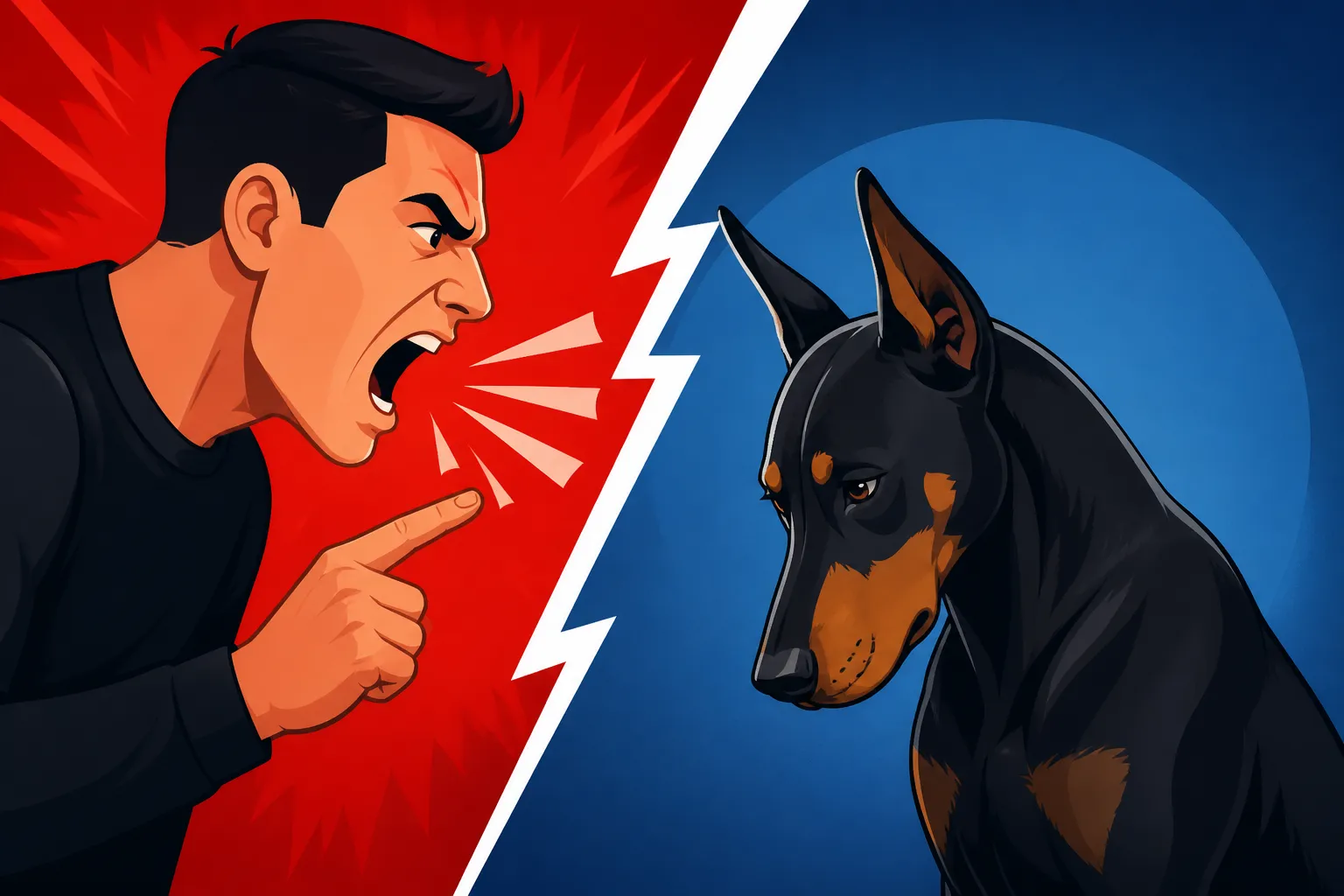
When you yell at your Doberman, you're not just making noise; you're introducing fear and anxiety into your relationship. Dobermans, with their inherent sensitivity, are acutely aware of emotional shifts. A raised voice can be genuinely frightening for them, causing them to cower, tremble, or try to escape the situation. This isn't obedience; it's a fear response. They aren't learning what to do; they're learning to avoid your displeasure. This is a critical distinction because it doesn't teach them appropriate behavior but rather teaches them to fear you or the situation.
Over time, consistent yelling erodes the trust your Doberman has in you. They begin to see you as unpredictable or a source of distress, rather than their steady, reliable leader. This can lead to a Doberman that is hesitant, less confident, and less likely to engage with you freely. Imagine trying to train a partner who constantly snaps or shouts at you. You'd likely become defensive, withdrawn, and less willing to participate. Your Doberman feels something similar, leading to what many owners describe as their dog "shutting down" – a direct consequence of their fear response. This often manifests as A Doberman That Freezes When Corrected, where they simply stop responding, hoping to make the unpleasant interaction end.
The "Learned Helplessness" Trap
A particularly insidious outcome of persistent yelling and harsh corrections is a psychological phenomenon known as "learned helplessness." This occurs when an animal, or even a human, is repeatedly subjected to aversive stimuli (like yelling or punishment) from which they cannot escape or control. Eventually, they stop trying to escape or change the situation, even when opportunities arise. They simply become passive and resigned.
For a Doberman, this can look like a dog that no longer offers behaviors, is slow to respond, or appears disengaged and lethargic. They may simply "give up" trying to understand or please you, because every attempt they make is met with criticism or a raised voice. This isn't a sign of a stubborn or disobedient dog; it's a sign of a broken spirit. It's truly heartbreaking to witness and extremely difficult to reverse, often requiring significant effort to start Rebuilding Trust With a Harshly Handled Doberman. A Doberman suffering from learned helplessness isn't just a quiet dog; it's a dog that has lost its spark and its willingness to interact.
Why Positive Reinforcement is the Doberman's Best Friend
If yelling and harsh corrections are detrimental, what's the alternative? For a Doberman, and frankly, for most dogs, positive reinforcement is not just an alternative; it's the gold standard. It’s a method that leverages their intelligence and desire to please, building a robust, joyful relationship rather than one based on fear.
Building a Stronger Bond Through Trust
Positive reinforcement focuses on rewarding desired behaviors. When your Doberman does something you like – whether it's sitting politely, coming when called, or leaving that tempting sock alone – you reward them with something they value: a tasty treat, enthusiastic praise, a favorite toy, or a good scratch behind the ears. This simple act creates a clear association in their mind: "When I do X, good things happen." This motivates them to repeat X, not out of fear of punishment, but out of a desire for positive outcomes.
This approach inherently builds a strong, trusting bond between you and your Doberman. You become the source of all good things, a reliable and benevolent leader. Your Doberman learns to look to you for guidance, eager to understand what will earn them a reward, rather than trying to anticipate and avoid punishment. This fosters a partnership where both parties are engaged and happy. It's about working with your Doberman, celebrating their successes, and guiding them gently through their learning process. This deep bond is what makes living with a Doberman such a rewarding experience, as they truly become a part of your soul.
Effective Communication Without the Volume
Positive reinforcement training is all about clear, consistent, and calm communication. Instead of reacting with a shout, you proactively teach your Doberman what you want them to do. For example, instead of yelling "No!" when they jump on a guest, you teach them to "sit" for greetings, and then reward that sit profusely. This shifts the focus from stopping an unwanted behavior to encouraging a desired one.
This method uses short, clear verbal cues, hand signals, and marker words (like "Yes!" or a clicker) to precisely mark the moment your Doberman performs the correct action. This precision helps their intelligent mind grasp exactly what they did right. For some great resources on structured positive training, online programs like BAXTER & Bella can offer comprehensive, step-by-step guidance. Their intelligence means they pick up on these cues quickly, especially when rewarded consistently. In fact, Dobermans are known for being so sharp that Why a Doberman Learns a Cue in Three Repetitions isn't an exaggeration with effective, positive methods.
| Aspect | Yelling/Punishment-Based Methods | Positive Reinforcement Methods |
|---|---|---|
| Doberman's Emotion | Fear, anxiety, confusion, stress, withdrawal, resentment. | Eagerness, confidence, understanding, joy, motivation, cooperation. |
| Learning Outcome | Suppresses behavior (often temporarily or only in your presence), teaches avoidance, creates negative associations with the owner or situation, can lead to learned helplessness. | Teaches desired behaviors, builds clear associations between action and reward, encourages problem-solving, fosters a desire to please. |
| Relationship Impact | Erodes trust, creates tension, can lead to defensive behaviors (e.g., aggression, snapping), strains the bond. | Strengthens trust, builds a cooperative partnership, enhances communication, deepens the bond and mutual respect. |
| Owner's Experience | Frustration, guilt, feeling ineffective, cycle of anger and regret, often temporary results. | Satisfaction, joy, seeing progress, feeling connected to their dog, sustainable results. |
| Long-Term Behavior | Can lead to a "shut down" dog, reactive behaviors, anxiety-related issues, or a dog that only obeys when threatened. | Creates a confident, well-adjusted Doberman who willingly offers good behaviors, is resilient to stress, and enjoys learning new things. |
Practical Strategies for Communicating with Your Doberman (Without Yelling)
Transitioning from reactive yelling to proactive, positive communication takes conscious effort, but the rewards are immense. Here are some practical strategies to help you communicate effectively with your Doberman, fostering a calm, cooperative, and joyful environment.
Setting Up for Success: Management and Prevention
The first step in avoiding the urge to yell is to prevent the situations that trigger your frustration in the first place. This is where good management comes in. For a clever Doberman, if they can get to something they shouldn't, they probably will. Don't set them up for failure. If your Doberman is a counter-surfer, clear your counters. If they chew furniture, supervise them closely or use a crate when you can't. This isn't about giving up; it's about being smarter than your Doberman's natural inclinations.
Using tools like gates, crates (properly introduced as a safe space), and appropriate chew toys can redirect their energy and curiosity towards acceptable outlets. Remember, a Doberman puppy needs to learn boundaries and appropriate behaviors, and an adult Doberman might need a refresher or new boundaries established in a new home. This preventative approach reduces the opportunities for them to make mistakes, which in turn reduces your frustration and the need to intervene with a raised voice. What Doberman Owners Wish They Had Started Earlier often includes effective management strategies from day one.
Tools and Techniques for Calm, Clear Communication
Instead of yelling, focus on establishing clear, concise commands and rewarding compliance. Your voice should be calm, firm (when necessary), and always clear.
-
Use a Marker Word or Clicker: These tools precisely mark the moment your Doberman performs the correct action. A simple "Yes!" or a click, immediately followed by a reward, tells your Doberman exactly what they did right. This clarity is invaluable for their intelligent minds. For example, when teaching "sit," the instant their rear touches the ground, you say "Yes!" and give a treat. This quick feedback loop is far more effective than a delayed "Good boy" after they've already stood back up. Marker Training a Doberman From Scratch is an excellent place to start.
-
High-Value Rewards: Dobermans are often very food-motivated. Simple things, like having high-value treats (easily found on Amazon) readily available in a treat pouch, can make a huge difference. Think small pieces of cooked chicken, cheese, or specialized training treats. The higher the value, the more motivated your Doberman will be to perform for you. Also, don't underestimate the power of praise and play, especially during Five-Minute Sessions With a Young Doberman.
-
Redirection: When your Doberman is doing something undesirable, redirect them to an appropriate activity. If they're chewing on a shoe, calmly take the shoe away and offer a designated chew toy. If they're jumping, turn your back and then reward them for all four paws on the floor. This teaches them what to do instead of just what not to do. Engaging them with mentally stimulating activities like Puzzle Work That Actually Tires a Doberman can also prevent many unwanted behaviors by keeping their clever minds occupied.
-
Consistency is Key: Everyone in the household needs to be on the same page with commands and expectations. If one person allows a behavior and another punishes it, your Doberman will become confused and frustrated. Clear, consistent boundaries, calmly enforced, are paramount for a Doberman to thrive. Consistency helps in teaching them important skills like Teaching a Doberman to Wait for Permission before going through a door or eating their meal.
-
Seek Professional Guidance: If you're finding yourself consistently frustrated or your Doberman has ingrained behavioral challenges, don't hesitate to consult a certified professional dog trainer or a veterinary behaviorist who uses positive reinforcement methods. They can provide tailored advice and hands-on support, helping you and your Doberman communicate more effectively and build a harmonious relationship.
By embracing patience, understanding, and positive reinforcement, you'll discover that your Doberman is not just a formidable guardian, but a willing, sensitive, and incredibly intelligent companion who responds best to a kind and consistent hand, not a raised voice.
Disclaimer
This article is for general informational purposes only and does not constitute professional advice. Laws, prices and regulations vary by location and change over time. Consult a qualified professional for guidance on your specific situation.