Whether Daycare Helps a Clingy Doberman
Many Doberman owners find themselves utterly devoted to their dogs, only to realize that devotion has turned into a constant shadow, a "Velcro dog" who simply cannot cope when left alone. This profound attachment, while endearing, can quickly morph into full-blown separation distress, leaving you with chewed doorframes, incessant barking, and a guilt trip every time you leave the house. We're going to dive deep into whether doggie daycare is truly the answer for your clingy Doberman or if it might actually create more challenges.
Understanding the "Velcro" Doberman Phenomenon
Your Doberman follows you to the bathroom, rests their head on your lap while you work, and greets you with an almost frantic enthusiasm even if you just stepped out for five minutes to grab the mail. This intense attachment is famously known as the "Velcro Doberman" phenomenon, and it's a characteristic many owners cherish, but it has a flip side that can be incredibly challenging to manage, especially when you need to leave them alone.
Why Dobermans Are So Attached
Dobermans were originally bred to be close personal guardians, working alongside their human companions in the most direct way imaginable. This historical role has deeply ingrained a desire for close proximity and a strong, almost singular bond with their primary caregiver. They aren't content to be merely "outdoor dogs" or left to their own devices for long stretches; they thrive on interaction and feeling like an integral, irreplaceable part of the family unit. This isn't just about affection; it's about their inherent drive to protect and be involved in everything their human does.
Their formidable intelligence and sensitive nature also play a significant role in their clinginess. They observe, they learn your routine with startling accuracy, and they anticipate your movements. This can lead to them becoming almost hyper-aware of your presence and absence, making any separation feel like a monumental event. You might notice your Doberman will not let you shut a door, or they might even sit on your feet when you're relaxing. This isn't just a quirky habit; it's a deep-seated need for connection and security that's part of their genetic makeup and breed purpose. Where the Velcro Doberman Nickname Comes From touches on this perfectly, helping us understand the roots of this behavior.
This intense bond, while beautiful and rewarding, means Dobermans often develop very strong expectations about human presence. If their early experiences, or even later life, have revolved around constant companionship, they simply haven't learned to value or tolerate solitude. They associate being alone with distress, boredom, or even abandonment, rather than a peaceful opportunity for rest. This is why it's so critical to gently teach them independent skills from a young age. Without this crucial foundation, their natural inclination to be "with their people" can escalate into serious problems. It’s not a failing on their part; it's just how they're wired, and it requires understanding, patience, and proactive training from us, their human partners.
When Clinginess Crosses into Separation Distress
There's a substantial difference between a Doberman who loves being near you and one who experiences genuine panic and fear when you're gone. Clinginess, while sometimes annoying or intrusive, typically doesn't involve destructive behavior or extreme vocalization. Your dog might whine a little when you close the bathroom door, but they settle down relatively quickly, perhaps finding a comfortable spot nearby to wait for your return. They manage their emotions.
Separation distress, however, is a much more serious and debilitating behavioral issue. When a Doberman with separation distress is left alone, they can exhibit a range of severe symptoms, which are often heartbreaking for owners to discover. These can include excessive barking, howling, or whining that can persist for hours, destructive chewing (often targeted specifically at exits like doorframes, windowsills, or crates), inappropriate urination or defecation inside the house, excessive drooling, frantic pacing, or even self-harm such as licking or chewing themselves raw in extreme cases. A Doberman That Screams the Moment the Door Shuts offers a closer look at the severity of these emotional outbursts.
These behaviors aren't about being "naughty," "spiteful," or "getting back at you" for leaving them. They are outward manifestations of extreme anxiety, fear, and panic. Imagine experiencing a full-blown panic attack every single time your closest loved one disappeared without explanation, with no way to understand when or if they would return. That's essentially what your Doberman might be feeling. It's truly heartbreaking to witness, and even more so to know your dog is suffering while you're away. Understanding this critical distinction is crucial because it dictates the approach you need to take. Simple management won't cut it for true separation distress; it requires a structured, patient training plan and often professional intervention to help your Doberman learn to cope and find peace in solitude.
How Daycare Might Seem Like a Solution
When faced with a Doberman suffering from the emotional turmoil of separation distress, or even just intense clinginess, the idea of doggie daycare often springs to mind as a knight in shining armor. It offers constant supervision, endless play, and abundant interaction, seemingly addressing all the issues of loneliness, boredom, and anxiety that plague both you and your Doberman. On the surface, it makes perfect sense as a simple, immediate fix.
The Appeal of Constant Supervision and Play
The initial thought process for many overwhelmed Doberman owners often goes something like this: "My Doberman hates being alone and gets destructive, so I'll send them somewhere where they're never alone and are constantly stimulated!" Daycare promises a busy schedule of play with other dogs, consistent attention from staff members, and a stimulating environment that keeps their intelligent Doberman minds occupied and their powerful bodies exercised. For many, this seems like the ideal solution, especially if they work long hours and cannot be home to provide the constant engagement their Doberman craves. You picture your Doberman romping happily, rather than pacing endlessly or destroying your cherished furniture. It effectively alleviates the intense guilt and stress of leaving your dog home alone, providing comfort in knowing they are in a safe, supervised place where they can burn off all that characteristic Doberman energy. This is particularly appealing for young, energetic Dobermans who require a substantial amount of physical exercise and mental engagement to prevent behavioral issues. How Many Hours a Doberman Can Be Left Alone explores the challenges of managing alone time, making daycare seem like a welcome relief.
Moreover, if your Doberman is also struggling with other common behavioral issues like excessive energy, a perceived lack of socialization, or even mild reactivity due to under-socialization, daycare might appear to hit multiple birds with one stone. It offers a structured environment where they can interact with various dogs and people, ideally building confidence and appropriate social skills in the process. The sheer physical exertion and mental stimulation can also help them settle better in the evenings when they return home, leading to a more peaceful and harmonious home life for everyone involved. For some dogs, particularly those who primarily need an outlet for their abundant energy and genuinely enjoy social interaction with other canines, it can indeed be a very positive addition to their routine, offering a healthy counterbalance to their home life.
What Daycare Doesn't Teach About Being Alone
Here's the rub, and it's a crucial point for Doberman owners to grasp: while daycare certainly provides excellent company and a stimulating environment, it fundamentally doesn't teach your Doberman how to be comfortable, calm, and confident when they are actually alone. In fact, for a dog with true separation distress, regular, full-day daycare can inadvertently reinforce the underlying belief that they always need company. They seamlessly transition from being with you, to being with a large group of dogs and staff, and then back to being with you. The critical skill of tolerating solitude, of understanding that your departure is temporary and not a cause for panic or abandonment, is never practiced or developed.
Think about it logically: if the core problem is a lack of coping skills for alone time, and daycare completely removes alone time from the equation, how can your Doberman ever learn those essential skills? It’s analogous to avoiding your deep-seated fear of public speaking by simply never having to speak in public – you’ll feel fine when you’re not speaking, but the underlying anxiety remains, ready to flare up the moment you’re put in that dreaded situation. When they return home from an incredibly stimulating day, they might be physically tired and ready to crash, but their emotional need for constant companionship hasn't been rewired or addressed. The moment you leave them again, even if it's just for a quick errand, they are often back to square one, frequently with even higher expectations for your constant presence, making the next separation even harder.
The Potential Benefits of Doberman Daycare
Despite the inherent caution required when considering daycare for a clingy Doberman, it's important to acknowledge that it can offer genuine benefits for many Dobermans, especially if used strategically and in conjunction with a comprehensive, dedicated training plan focused on building independence and comfort with alone time. It's certainly not a magic bullet that will cure separation anxiety on its own, but it can be a valuable tool in the larger toolkit of behavioral modification.
Socialization and Energy Expenditure
One of the most undeniable and widely recognized benefits of a good doggie daycare program is the extensive opportunity for supervised socialization and significant energy expenditure. Dobermans are incredibly intelligent, highly athletic dogs who possess a deep reservoir of physical and mental energy. Without sufficient outlets for these innate drives, they can quickly become bored, destructive, and anxious at home, channeling their frustration into unwanted behaviors. Daycare provides a safe and engaging space for them to run, play, and interact appropriately with other dogs in a structured and managed environment. This can be particularly helpful for younger Dobermans who are still learning appropriate play behaviors, or for those who don't have many regular dog friends in their immediate neighborhood or social circle. An exhausted Doberman is often a well-behaved, calm Doberman, and a few days a week at daycare can certainly help achieve that desired state of physical contentment.
Furthermore, proper and diverse socialization is absolutely crucial for Dobermans to grow into confident, well-adjusted adults who can navigate various social situations with grace. Exposing a Doberman Puppy to Strangers and Why a Doberman Puppy Must Meet the World Early highlight the profound importance of early, positive and diverse experiences. Daycare, when managed by knowledgeable, experienced staff, can expose your Doberman to different breeds, sizes, and temperaments of dogs, as well as various human interactions beyond their immediate family. This helps them learn to read canine body language cues, manage their powerful play style to be appropriate for different partners, and generally become more comfortable and adaptable in novel or stimulating situations. For a Doberman that needs to build confidence around other dogs or overcome shyness, this supervised and controlled exposure can be invaluable, actively preventing reactivity or fear-based aggression from developing down the line.
Breaking the Cycle of Anxiety Triggers
For some Dobermans who exhibit milder forms of separation anxiety, or whose distress is heavily linked to sheer boredom and under-stimulation, daycare can serve as a much-needed temporary break from the escalating cycle of anxiety. If your Doberman's anxiety is primarily triggered by a lack of mental and physical engagement during your absence, a day at daycare can effectively fill that void. Instead of spending eight lonely hours chewing on your favorite couch cushions or barking incessantly at imagined threats, they are actively engaged, stimulated, and supervised. This consistent engagement can significantly reduce the frequency and intensity of their anxious episodes at home, which can provide immense relief for both the dog and the often-stressed owner. It's not solving the core problem of being alone, but it's preventing the manifestation of intense anxiety during specific, challenging times.
This can be a crucial stepping stone while you simultaneously implement a more targeted and intensive alone-time training program at home. For example, you might choose to send your Doberman to daycare three days a week, and then on the other two days, you focus exclusively on short, structured alone-time training sessions in a controlled environment. This way, they still get their vital social and physical needs met without every single day being an uphill battle against their anxiety. It can give you, the owner, a much-needed mental and emotional break from the constant management and allow you to approach the dedicated training with renewed patience, energy, and a more positive mindset. Think of it as providing essential supportive care while you meticulously work on the deeper, underlying behavioral modifications needed for true long-term change.
The Downsides and Risks of Daycare for a Clingy Doberman
While daycare certainly has its merits and can be beneficial in specific scenarios, it's not without potential pitfalls, especially for a Doberman already struggling with profound clinginess or full-blown separation anxiety. Owners need to be acutely aware of these risks and potential downsides before committing to a regular daycare routine, as an unsuitable environment can exacerbate existing issues rather than resolve them.
Over-Stimulation and Stress
For a highly sensitive, intelligent, or already anxious Doberman, the constant hustle, bustle, and high energy of a busy daycare environment can be incredibly overwhelming rather than genuinely beneficial. Imagine yourself being dropped into a loud, crowded party with dozens of strangers every single day, with no quiet corner or opportunity to retreat and recharge. Some Dobermans, particularly those with an already nervous or introverted disposition, can quickly become over-stimulated, leading to increased stress levels, heightened irritability, or even complete withdrawal and learned helplessness. They might come home physically exhausted, yes, but not in a healthy, relaxed way; rather, they are emotionally drained, mentally frazzled, and on edge, making them less capable of coping with other stressors. This state of constant over-stimulation is absolutely not conducive to learning calm behavior or building genuine confidence. A Doberman that is consistently over threshold at daycare might actually regress in other areas of their training or, even worse, develop new anxieties and fears that weren't present before.
Furthermore, it's a stark reality that not all daycares are created equal in terms of quality, supervision, or understanding of breed-specific needs. Large, unsupervised group play can quickly become chaotic, and a Doberman, with their imposing size and strength, might not always receive the appropriate supervision or intervention needed to prevent negative interactions or bullying. If they have a bad experience with another dog or a handler, it could significantly exacerbate existing anxieties or create new ones, potentially making them more reactive to other dogs, not less. It’s absolutely vital to research daycares thoroughly, ask about their staff-to-dog ratio, their handling techniques for different temperaments, and specifically how they manage conflicts or over-arousal. Some Dobermans, particularly those that are more reserved, selective, or prone to anxiety, may benefit far more from smaller, more structured playgroups or even facilities that offer individual enrichment sessions instead of allowing free-for-all play.
Reinforcing the Need for Constant Company
As touched upon earlier, the biggest philosophical and practical problem with using daycare as a primary, standalone solution for separation distress is that it inadvertently reinforces the very habit you're trying to break: the deep-seated reliance on constant company. Your Doberman learns, day after day, that someone or some dog will always be there. They never get the crucial chance to practice self-soothing behaviors, to learn that their own company is sufficient, or to understand that being alone is not inherently terrifying or a precursor to abandonment. When they return home from a highly social, stimulating environment, the contrast between that dynamic setting and the quiet solitude of your house can feel even more stark and unsettling, potentially intensifying their anxiety when you do eventually leave them alone for even a short period.
This consistent pattern of constant company can create a profound dependency where your Doberman becomes just as distressed, if not more so, on the days they don't go to daycare. You've essentially outsourced their need for company without addressing the underlying emotional and behavioral deficit that causes the distress. To truly overcome separation distress and build genuine independence, a Doberman needs to learn and practice coping mechanisms for when they are genuinely by themselves. Daycare, in isolation, simply doesn't provide this crucial learning opportunity. It merely replaces one form of constant company (you) with another (the daycare staff and other dogs), leaving the core issue unaddressed and likely to resurface the moment genuine solitude is introduced.
Finding the Right Fit for a Doberman's Temperament
Finding the right daycare for any dog is a nuanced and often tricky endeavor, but for a Doberman, given their inherent sensitivity, impressive intelligence, and strong guarding instincts, it's particularly critical to get it right. A Doberman's temperament can range widely, from highly social and boisterous to reserved and incredibly selective about their doggy companions. A generic, one-size-fits-all daycare with chaotic group play might not cater to these nuances, potentially leading to more stress than relief. You need a facility that genuinely understands working breeds, respects their boundaries, and can competently manage their powerful play style without letting it escalate into inappropriate or dangerous behavior. For example, a Doberman in a playgroup primarily filled with many smaller, more timid dogs might inadvertently cause stress, fear, or even accidental injury simply due to their sheer size, enthusiastic play, and lack of refined social skills with smaller breeds.
Here’s a small table to help you consider different daycare styles and their suitability for a clingy Doberman:
| Daycare Style | Best For | Potential Downsides for a Clingy Doberman |
|---|---|---|
| Large Group Play | Highly social, very confident, and extremely energetic dogs; excellent for burning off significant physical steam. | High risk of over-stimulation, potential for negative interactions (stress or injury), strongly reinforces the need for constant company, minimal individual attention. |
| Small Group Play | Dogs who enjoy social interaction but prefer a calmer, more controlled setting; allows for better supervision. | Still reinforces the idea that constant company is always available, might not be enough focused "alone skill" practice, may not cater to specific anxieties if staff aren't highly trained in behavioral modification. |
| Individual Enrichment | Anxious, reactive, older, or less social dogs; focuses on one-on-one activities, walks, and structured play. | Often the most expensive option, still primarily provides company rather than teaching genuine solitude, less opportunity for broad physical play with peers. |
| Structured Training Daycare | Dogs needing specific behavioral modification, including separation anxiety; explicitly incorporates alone time practice and positive reinforcement. | More expensive and less widespread than typical daycares, requires explicit focus on teaching solitude, may not have enough dedicated spots or highly specialized staff. |
You absolutely need to ask probing questions when touring a facility: How are new dogs introduced? How are conflicts handled safely and humanely? Do they have quiet areas or designated nap times for resting and decompressing? What is their policy on napping or downtime away from the main group? What is their staff-to-dog ratio? A daycare that genuinely supports a Doberman's needs will be transparent about their practices, employ highly trained staff, and be focused on positive reinforcement and individualized care. Resources like Daycare That Accepts a Doberman can guide your search for a truly appropriate facility.
Alternative and Complementary Strategies for Alone Time Training
While daycare can be a temporary tool for managing energy and providing supervised company, it should never be the sole strategy for a clingy Doberman or one suffering from separation distress. The real, lasting work involves teaching your Doberman to be genuinely comfortable, calm, and secure when you're not physically around. This requires a dedicated, consistent, and often slow approach to modifying their emotional response to being alone.
Gradual Desensitization and Counter-Conditioning
This is widely considered the gold standard for effectively addressing separation distress and building true independence. It involves meticulously and slowly exposing your Doberman to increasing periods of solitude, always keeping them comfortably below their anxiety threshold. This means you never let them get to the point of barking, whining, or destroying things during a training session. Simultaneously, you aim to create powerful positive associations with your absence through counter-conditioning. Start incredibly small: simply walk to the other side of a baby gate, turn around, and return to your Doberman before they show any discernible signs of anxiety. Reward calm, settled behavior generously, rather than inadvertently rewarding an anxious greeting upon your return.
Slowly, and with immense patience, you gradually increase the duration and distance of your absence. This might mean stepping out the front door for five seconds, then ten, then thirty, eventually moving to minutes, and so on. It’s a painstakingly slow process, often measured in tiny increments over weeks or months, but it is incredibly effective because it systematically re-teaches their brain that being alone is not a threat, but a safe, even positive, experience. Counter-conditioning is the process of pairing your departure with something highly positive and enjoyable for your Doberman. This could be a special, high-value chew toy (like a KONG stuffed with frozen peanut butter or cream cheese) that they only get when you leave. The goal is to change their emotional response from "panic" to "yay, I get my special treat!" It creates a positive, predictable ritual around your departure. Many reputable online training platforms, such as BAXTER & Bella, offer structured, step-by-step programs that include detailed protocols for desensitization and counter-conditioning, which can be an invaluable resource for owners trying to tackle this complex issue with expert guidance. Remember, absolute consistency is key, and never, ever push your Doberman past their comfort zone. If they start to panic or show signs of stress, you've gone too far too fast, and you need to backtrack. For a deeper dive, read Building a Doberman's Alone Time From Minutes.
Enrichment and Structured Alone Time
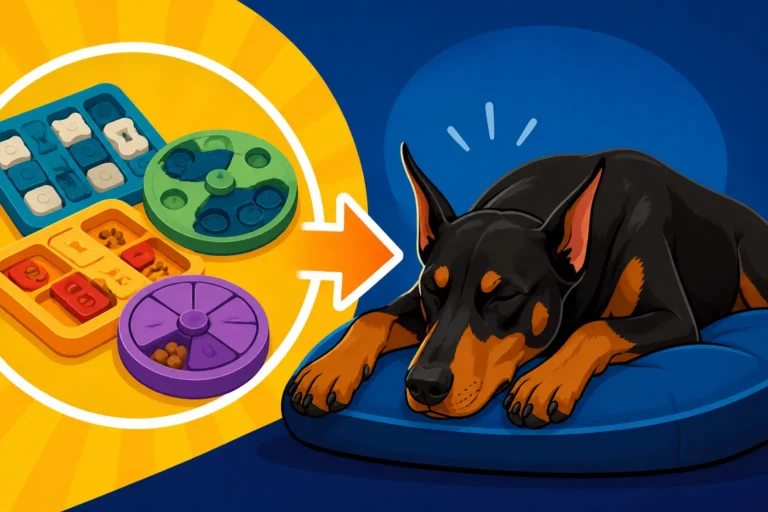
Before you even think about leaving your Doberman alone, it is absolutely paramount to ensure their physical and mental needs are met. A Doberman who hasn't had enough appropriate exercise, mental stimulation, or opportunities to engage their keen intelligence is a prime candidate for anxiety, boredom, and destructive behaviors. A long, engaging walk, a vigorous play session in the yard, or a stimulating training session focusing on obedience or puzzle-solving before you leave can make a world of difference in their ability to settle. When you do leave, provide enriching activities that keep their minds busy and their mouths happily occupied. Puzzle toys, durable chews, and treat-dispensing toys are fantastic for this purpose. Products found readily on Amazon, for example, offer a wide variety of durable puzzle toys specifically designed to keep intelligent, powerful chewers like Dobermans engaged and stimulated for extended periods, diverting their attention from your absence.
Structured alone time also means creating a positive and predictable routine around your departures. This often involves effective crate training, which, when done correctly and humanely, provides a safe, den-like space where your Doberman feels secure and comfortable. Choosing a Crate for a Doberman is an excellent resource for understanding how to properly introduce and utilize a crate. Ensure the crate is always a positive place, never used for punishment. Practice short "alone time" sessions even when you're at home, where your Doberman is happily settled in their crate with a special chew or toy while you're in another room. This helps them generalize the feeling of security and contentment to being alone. The ultimate goal is to teach them to rest quietly, engage in appropriate self-entertainment, and be comfortable with their own company, rather than constantly relying on external stimulation or human presence.
Professional Guidance and Support
If your Doberman exhibits severe separation distress, characterized by intense panic, self-harm, or significant destruction, it's always in their best interest to seek professional help immediately. A certified professional dog trainer specializing explicitly in separation anxiety, or ideally, a board-certified veterinary behaviorist, can provide a comprehensive, tailored plan and much-needed support for both you and your Doberman. They can accurately assess the severity of the anxiety, help rule out any underlying medical conditions that might be contributing to the behavior, and expertly guide you through the intricate process of desensitization and counter-conditioning. Sometimes, in severe or resistant cases, medication may be a temporary adjunct to behavioral modification, prescribed by a veterinarian, to help calm your Doberman enough to be receptive to training and capable of learning new coping mechanisms.
Remember, true separation distress is not a quick fix; it's a complex emotional disorder that can be incredibly emotionally draining and frustrating for owners. Having a qualified professional guide you ensures you're using the most effective, humane, and science-backed methods, and crucially, prevents you from accidentally making the problem worse through incorrect application of techniques. They can help you identify subtle stress signals, adjust your training pace as needed, and provide ongoing encouragement. Don't be afraid or ashamed to reach out for professional help; it's a clear sign of a responsible, proactive, and deeply caring Doberman owner who genuinely wants the best for their beloved companion's well-being and peace of mind. Medication for a Doberman With Separation Distress provides further information on this crucial aspect of managing severe cases.
Disclaimer
This article is for general informational purposes only and does not constitute professional advice. Laws, prices and regulations vary by location and change over time. Consult a qualified professional for guidance on your specific situation.