The Doberman Faults a Judge Cannot Overlook
Bringing a Doberman into the show ring is an exciting endeavor, but it’s also one filled with high expectations and rigorous standards. Many aspiring exhibitors quickly learn that even the most beautiful Doberman can have subtle characteristics that, while perhaps endearing in a pet, are considered significant faults by a judge. This guide will walk you through the common and less common faults that can hold a Doberman back in conformation, helping you understand what judges are truly looking for according to the breed standard.
Understanding the Doberman Standard and Its Purpose
Before we dive into specific faults, it’s crucial to grasp why the Doberman breed standard exists in the first place. It’s not just a collection of arbitrary rules designed to make showing difficult; it’s a living document that describes the ideal Doberman, reflecting the breed's historical function, health, and temperament. Every line, every nuance in the standard, is there to ensure the Doberman remains true to its origins as a capable, elegant, and intelligent working dog.
Why the Standard Exists: A Blueprint for the Breed
Think of the breed standard as the architectural blueprint for the Doberman. It details everything from the ideal height and weight to the shape of the head, the set of the ears (though cropping is a separate topic, the natural ear set is still evaluated), the length of the back, and the angle of the hindquarters. This blueprint aims to preserve the breed's distinctive silhouette, powerful movement, and characteristic expression. Without such a guide, breeders could veer off course, resulting in Dobermans that might look superficially similar but lack the inherent qualities that define the breed. It’s about maintaining type, and type is what makes a Doberman a Doberman.
Beyond aesthetics, the standard also implicitly supports health and function. A Doberman bred to standard should move efficiently, be structurally sound, and possess the mental fortitude to perform its tasks. For instance, proper angulation isn't just for show; it allows the dog to cover ground with powerful, effortless strides, which was essential for a working dog patrolling with its master. Any deviation that impairs movement or suggests a lack of robust health is inherently a fault because it strays from this functional ideal.
Interpreting the Nuances: More Than Just a Checklist
While the standard provides clear guidelines, its interpretation isn't always black and white. Experienced judges spend years studying Dobermans, observing them in the ring, and understanding the subtle balance required. It's not simply a matter of ticking boxes; it's about seeing the whole dog, appreciating its balance, its proportions, and how all its individual parts come together to form a harmonious picture. A Doberman might have a perfectly acceptable head, but if its neck is too short or its back too long, the overall balance is lost, diminishing its "type."
Judges are looking for the sum of the parts to be greater than the individual components. They assess how a Doberman carries itself, its alertness, its expression, and its overall presence. A Doberman that might look good standing still could reveal numerous structural faults when it moves, demonstrating how movement is a critical component of judging. Understanding this holistic approach helps explain why sometimes what seems like a minor detail to an untrained eye can be a significant "fault" to a seasoned judge. It’s all about the subtle art of how the breed standard comes alive in a living, breathing Doberman. You might be interested in reading The Doberman the AKC Standard Describes for a more in-depth look at these ideals.
Disqualifying Faults: The Absolute No-Gos
These are the faults that will instantly send a Doberman home without any ribbons. They represent such a profound deviation from the breed standard that the dog is deemed unfit to represent the breed, typically because they signal serious genetic issues or a complete lack of Doberman type.
Incorrect Color and Markings: Beyond Black and Rust
The Doberman breed standard is quite specific about acceptable coat colors. Historically, the most recognized and prevalent colors are black and rust, and red (or brown) and rust. These are the classic Doberman presentations everyone thinks of. The standard also recognizes blue and rust, and fawn (Isabella) and rust, though these are considered dilute colors and come with their own potential health considerations, like Color Dilution Alopecia in Blue and Fawn Dobermans. However, anything outside these four combinations is a strict disqualification in the American show ring.
This means if a Doberman presents with, say, a solid black coat with no rust markings, or has patches of white larger than a small spot on the chest, it simply cannot compete. These deviations suggest either mixed breeding or a genetic anomaly that is unacceptable for the purebred Doberman. Breeders work diligently to produce dogs that conform to these color standards, understanding that a show career depends on it. Imagine bringing a beautiful solid black Doberman, full of personality, only to be disqualified purely on color – it can be a heartbreaker for an owner who loves their dog unconditionally, but rules are rules in the conformation world.
Albinism and the "White" Doberman: A Serious Genetic Flaw
Perhaps one of the most significant and widely discussed disqualifying faults is albinism, often referred to as the "white" Doberman. These dogs are not simply a rare color; they are true albinos, lacking all pigmentation. This means they have white coats, blue eyes, and pink noses and eye rims. While undeniably striking in appearance, this trait is linked to serious health problems, including extreme photosensitivity and a higher incidence of certain cancers. The Doberman Pinscher Club of America (DPCA) and the AKC consider albinism a severe genetic defect, and any Doberman exhibiting this trait is automatically disqualified from conformation shows.
The existence of albino Dobermans arose from a single mutation in a particular line, and the breed club has worked hard to educate the public and discourage their breeding. Not only are they disqualified from showing, but breeding albino Dobermans or even carriers of the gene is highly frowned upon by responsible breeders. The concern goes beyond mere aesthetics; it's about the welfare of the dogs. It's a prime example of where the standard directly addresses a health issue by making it an absolute disqualifier. For more information, you might want to look into Why the Doberman Club Opposes White Dogs or The White Doberman and Where It Came From.
Undesirable Temperament: Fear, Shyness, or Viciousness
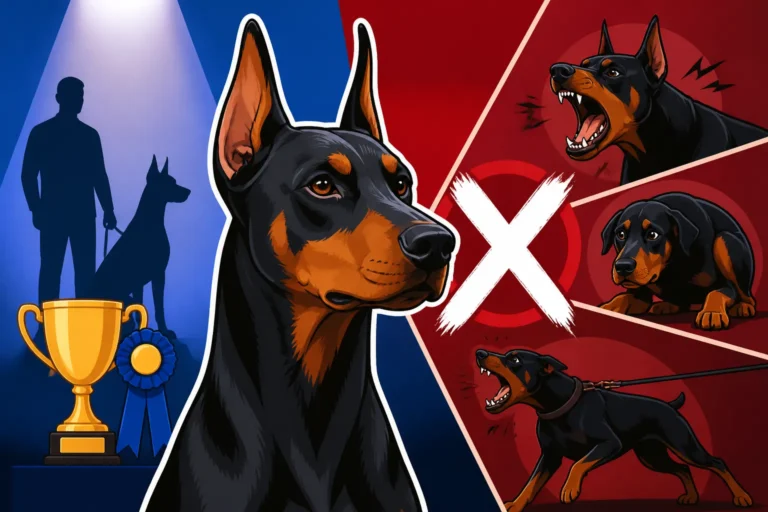
A Doberman's temperament is as crucial as its physical conformation, especially given its heritage as a guardian breed. The standard clearly calls for a Doberman that is "energetic, watchful, determined, alert, fearless, loyal, and obedient." While an ideal Doberman should exude confidence and be protective by nature, it must never be aggressive without provocation, nor should it be overly shy or fearful in the ring. A judge must be able to approach and examine the dog without fear for their safety or the dog displaying extreme timidity.
Any dog that shows definitive signs of fear (cowering, excessive trembling, attempting to flee) or unprovoked aggression (snapping, growling, lunging at the judge) will be immediately excused from the ring. This is for the safety of all involved and to uphold the breed's reputation as a stable and reliable companion. A Doberman should be confident enough to handle the stresses of a busy show environment, allowing a stranger (the judge) to conduct a thorough physical examination. This doesn’t mean they have to be overly friendly to everyone, but they must be tractable and secure in their environment.
Major Faults: Significant Deviations from Ideal
While not always leading to disqualification, major faults are significant departures from the ideal Doberman outlined in the standard. These faults can severely impact a dog's placement and often indicate underlying structural or health issues that compromise the breed's functional integrity. A Doberman with a major fault is unlikely to finish its championship.
Structural Imbalances: Movement and Proportion Problems
A Doberman is first and foremost a working dog, and its structure should reflect its ability to move with power, agility, and endurance. Major structural faults can include incorrect angulation in the front or rear assembly, which impacts gait and can lead to inefficient movement. For example, overly straight shoulders or stifles (the knee joint) will result in a stilted, choppy gait, rather than the desired long, reaching stride. Conversely, too much angulation can lead to weak movement over time. The ideal Doberman gait is a picture of balance and coordination, effortlessly covering ground.
Another critical area is body proportion. The Doberman standard specifies a dog that is squarely built, meaning its length from the point of the shoulder to the point of the buttock should be approximately equal to its height at the withers. A Doberman that is significantly too long in body (known as "long-backed") or too short and cobby will be considered a major fault. This imbalance affects both aesthetics and function, potentially predisposing the dog to back problems or limiting its agility. A long back also impacts the overall elegant silhouette that is characteristic of the breed. Judges pay close attention to the dog’s silhouette both standing and moving to assess these crucial proportions. You can learn more about this in Doberman Gait and the Reach the Ring Wants.
Head and Expression: The "Soul" of the Doberman
The Doberman's head is often referred to as the "soul" of the breed, as it contributes significantly to its unique, noble expression. Faults in this area can dramatically change the dog's appearance and detract from its characteristic look. Key elements include the shape of the skull, the length and depth of the muzzle, and the planes of the head. A Doberman should have a long, clean-cut head, appearing as a blunt wedge from both top and side views. A head that is too broad, too narrow, or excessively apple-domed is a major fault.
The eyes, too, play a critical role. They should be almond-shaped, moderately deep-set, and dark in color, conveying an intelligent and alert expression. Light-colored eyes ("yellow eyes") or round eyes are considered faults as they detract from the desired intense gaze. The stop (the indentation between the eyes) should be moderate, not too abrupt or too shallow. Faults like a dish-faced profile (a concave line from the stop to the nose) or a Roman nose (a convex line) significantly alter the Doberman's classic profile. A strong underjaw is also vital for the powerful bite. Judges will meticulously examine the head from all angles to ensure it conforms to the standard’s precise description. Dive deeper into this topic with Doberman Head, Eye and Expression in the Standard.
Bite and Dentition Issues: Functional and Aesthetic Flaws
A Doberman's bite is not just about aesthetics; it's fundamental to its original function. The standard calls for a strong, full complement of 42 teeth in a scissor bite, meaning the outer surface of the lower incisors touches the inner surface of the upper incisors. Any deviation from this can be a major fault. Missing teeth, especially pre-molars or molars that are not traumatically lost, are a serious concern as they can indicate a genetic predisposition or a weakened jaw structure.
Overbites (where the upper jaw protrudes significantly over the lower) and underbites (where the lower jaw protrudes) are also considered major faults. While a slight deviation might be penalized, a pronounced overshot or undershot jaw can be a crippling fault in the show ring. These bite issues can affect the dog's ability to grasp and hold, reflecting poorly on its functional capabilities. Furthermore, misaligned teeth or crowded teeth, even if the overall bite is technically a scissor bite, can be considered faults. Judges will carefully examine the dog’s mouth to ensure correct dentition and bite, knowing it's a key indicator of structural soundness.
Minor Faults: Small but Noticeable Imperfections
Minor faults might not disqualify a Doberman or even prevent it from winning on a given day if the competition is light, but they are still deviations from perfection. Over time, these small imperfections can add up and prevent a dog from achieving its championship or winning higher honors. They are points where the Doberman is "almost there" but not quite ideal.
Coat and Skin Condition: Less Than Pristine
The Doberman's coat is short, hard, thick, and lies smoothly close to the body. It should have a glossy sheen. While not a structural fault, a poor coat condition can certainly catch a judge's eye and indicate a lack of proper care or underlying health issues. A dull, sparse, or excessively dry coat is considered a minor fault. Excessive dandruff, flaky skin, or small bald patches (unless related to a specific condition like Color Dilution Alopecia in blue/fawn Dobermans, which is a more serious issue) will also be noted. The condition of the coat reflects the dog's overall health and the owner's dedication to proper nutrition and grooming.
Sometimes, feeding a high-quality diet, perhaps one available from retailers like Chewy, can significantly improve a Doberman's coat health, making it more vibrant and lustrous. Judges also look for cleanliness. A Doberman that comes into the ring with a dirty coat or signs of fleas or other parasites will certainly be marked down. It’s a matter of presentation, demonstrating respect for the judge and the sport.
Ear Set and Tail Carriage: Presentation Matters
While ear cropping and tail docking are standard practice for Dobermans in many parts of the world, and often expected in the American show ring, the underlying natural ear set and tail carriage are still considered under the standard. Even with a perfectly cropped ear, if the ear leather itself is too thick or too thin, or if the natural set on the head is incorrect (too high, too low, or too wide), it can affect the overall aesthetic. An uncropped Doberman's ears should be set high and naturally fall close to the cheeks.
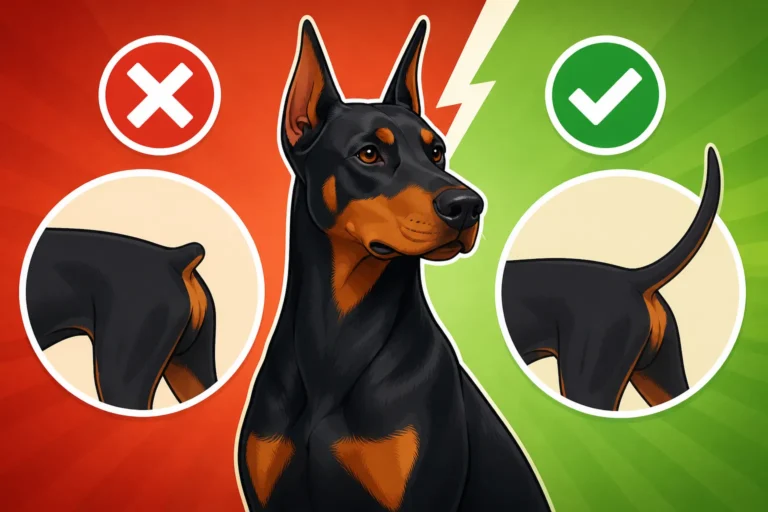
Similarly, a docked tail should be carried up and away from the body when the dog is alert, but not excessively high or curled over the back. A tail that is carried low or tucked between the legs continuously, especially when the dog is confident, can be a sign of a temperament fault or an incorrect tail set. Conversely, a tail that is always carried gaily over the back like a Spitz breed would also be considered a fault. These elements contribute to the Doberman's elegant silhouette and alert demeanor.
Bone and Substance: Not Quite the Ideal Build
The Doberman should be a dog of medium bone and substance, meaning it should be neither overly refined and delicate (like a Greyhound) nor overly heavy and coarse (like a Rottweiler). It’s about balance: sufficient bone to support its powerful frame and musculature, but without appearing bulky. A Doberman that appears "weedy" or too fine-boned, lacking the required strength and power, would be faulted. Conversely, a Doberman that is excessively heavy-boned, appearing cloddy or lacking in elegance, would also be incorrect.
Judges assess this by looking at the dog's legs, measuring the circumference of the bone, and observing the overall mass of the body in relation to its height. The Doberman is meant to be athletic and powerful, and its bone structure must support this. These are often subtle points, but they are crucial for a judge evaluating a Doberman's overall type and functionality. A Doberman puppy's growth is often carefully monitored to ensure it develops the correct bone structure, sometimes with supplements available from suppliers like Chewy.
Temperament and Presentation: Beyond Conformation
Conformation isn't just about static looks; it's also about how the dog carries itself and interacts in the ring. A Doberman might have near-perfect structure, but if its temperament is off or its handler's presentation is lacking, it won't earn those coveted wins.
Ring Behavior: Making a Good Impression (or Not)
A Doberman in the show ring needs to be attentive, alert, and confident, but also manageable. A dog that is constantly distracted, pulling on the leash, or showing disinterest in the proceedings will quickly lose favor with a judge. While extreme shyness or aggression are disqualifications, even a lesser degree of timidity or over-exuberance can be a major fault, as it reflects poorly on the dog's overall temperament and training. The Doberman is meant to exude a noble, self-assured presence.
Judges observe how a Doberman interacts with its handler, how it moves around the ring, and how it stands for examination. A Doberman that fidgets constantly on the stack, refuses to let the judge examine its mouth, or acts as if it would rather be anywhere else demonstrates a lack of ring presence. This isn't just about the dog's natural personality; it also speaks volumes about its training and socialization. A well-socialized Doberman should be able to handle the crowds, noise, and close proximity of other dogs without becoming stressed or reactive. This behavior is key to showcasing the breed's intended temperament, which is explored in Doberman Temperament as the Standard Describes It.
Handling and Training: A Judge Sees Everything
The handler plays an enormous role in presenting a Doberman effectively. A skilled handler can highlight a dog's virtues and minimize its faults, while a poor handler can inadvertently draw attention to weaknesses or even make a good dog look bad. Judges are looking for a harmonious team: a dog that responds readily to its handler's cues, maintains its stack, and moves with purpose.
A Doberman that hasn't been properly trained for the ring will show it. This includes not knowing how to stack properly (stand in the ideal pose), not moving at the correct speed for its gait to be observed, or resisting examination. Poor leash skills, such as dragging the handler or being unresponsive, will also detract from the overall impression. It’s not about trick training; it's about basic obedience and ring etiquette. The Doberman's intelligence makes it highly trainable, and judges expect to see that intelligence reflected in its composure and willingness to work with its handler. You may wish to consult Training a Doberman That Is Smarter Than You Expect for tips on how to build a strong working relationship with your Doberman.
The Importance of a Judge's Eye and Experience
Ultimately, the interpretation of the breed standard rests with the judge. Their experience, knowledge, and ability to see the "whole dog" are paramount. While the written standard is objective, its application involves a degree of subjective assessment based on years of study and understanding the breed's essence.
Subjectivity Within the Standard: A Judge's Interpretation
Even with a detailed breed standard, there's an element of subjectivity in how different judges interpret and prioritize various points. One judge might be particularly passionate about exquisite head type, while another might place greater emphasis on flawless movement. This is why a Doberman might win under one judge and not even place under another. It doesn't necessarily mean the dog changed; it means the lens through which it was viewed shifted slightly. This isn't a flaw in the system, but rather an acknowledgment that living animals are not static measurements and a judge's expertise lies in weighing the various components.
However, fundamental disqualifying faults or major structural problems are rarely open to interpretation. These are typically clear-cut. The subjectivity usually comes into play when evaluating minor faults or comparing two otherwise excellent Dobermans, where the judge's personal preference for certain aspects of type might come into play. It's an art as much as a science, and it’s why handlers often study judges' past preferences when deciding which shows to enter.
The Impact on Breeding Programs: Striving for Perfection
For breeders, understanding and diligently adhering to the breed standard, and recognizing faults, is critical. Every Doberman they breed should ideally move closer to the ideal described in the standard, minimizing faults and maximizing virtues. Breeders make careful choices in selecting breeding pairs, scrutinizing pedigrees, health test results, and conformation critiques to ensure they are producing sound, healthy Dobermans true to type. Ignoring faults in a breeding program can lead to their perpetuation, weakening the breed over generations.
Breeders rely heavily on the feedback from judges in the show ring, taking their critiques seriously to refine their breeding objectives. A consistent pattern of a Doberman receiving critiques for a particular fault might prompt a breeder to re-evaluate their breeding stock or seek out different lines to improve those traits. It's a continuous pursuit of excellence, striving to produce the quintessential Doberman that embodies elegance, power, and noble character. This meticulous approach helps ensure the longevity and health of the breed, helping to avoid The Doberman Traits That End a Show Career and promote sound Dobermans.
Table of Common Doberman Faults and Their Severity
To help clarify the different types of faults, here's a quick overview:
| Fault Type | Description | Severity | Impact on Showing |
|---|---|---|---|
| Disqualifying | Complete departure from standard; often genetic health implications. | Highest | Immediate removal from ring; cannot be placed. |
| Major | Significant deviation; impacts function and overall type. | High | Unlikely to win; prevents championship if pervasive. |
| Minor | Slight deviation; noticeable but doesn't cripple function/type. | Moderate | May place in weak competition; accumulated faults prevent higher wins. |
| Cosmetic | Purely aesthetic, doesn't affect health or function (e.g., small scar). | Low | Usually overlooked unless in very competitive classes; minimal impact. |
It's important to remember that every Doberman, like every living creature, has some imperfections. The goal in the show ring is to find the dog that most closely adheres to the breed standard, possessing the fewest and least severe faults, while also showcasing excellent virtues.
Disclaimer
This article is for general informational purposes only and does not constitute professional advice. Laws, prices and regulations vary by location and change over time. Consult a qualified professional for guidance on your specific situation.