Famous Dobermans Worth Knowing About
A familiar problem for anyone searching for famous Dobermans is that movie villains, TV guard dogs, and real military dogs often get mixed together. This guide separates documented history from screen fiction, introduces the best-known Dobermans and groups, and explains what their stories do—and do not—tell us about the breed today.
The Dobermans remembered for military service
Kurt and the dogs who served on Guam
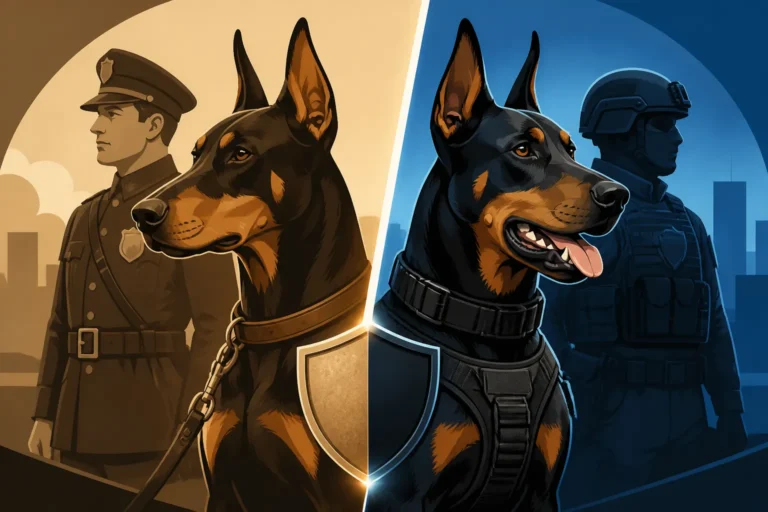
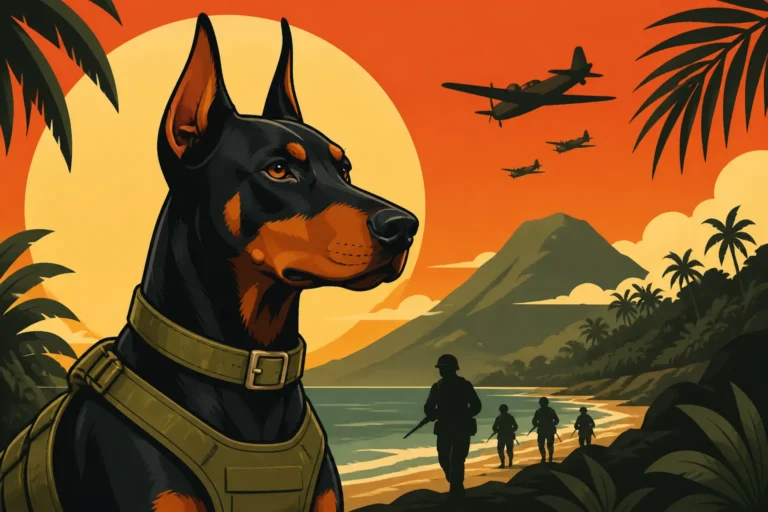
One of the best-known real Dobermans in American history is Kurt, a war dog who served with U.S. Marines on Guam during World War II. Dobermans were used in military work because they could be trained for jobs such as scouting, sentry duty, and carrying messages. Their story is part of the wider history of military dogs, not simply a tale of a naturally fearless breed.
Accounts of Kurt’s service credit him with warning Marines of an approaching danger and helping protect the men around him. He was killed in action in July 1944. Retellings sometimes attach a precise number of Marines saved to that moment. It is sensible to treat such numbers cautiously unless a particular account explains how it was documented; the central, widely remembered point is that Kurt died while serving and is honored as a war dog.
Kurt was not the only Doberman involved in the campaign. A group of Marine dogs served on Guam, and some were killed during the fighting. Their work and sacrifice are remembered at a war dog memorial on the island. For a fuller account of the dogs and the campaign, see The Marine Corps Dobermans of the Pacific and The Doberman Memorial on Guam.
What the war stories tell us about the breed
It is easy to turn Kurt’s story into a simple claim that Dobermans are born to protect people. That misses the less dramatic but more important details: the dogs were selected, trained, paired with handlers, and given specific jobs. Their bravery was real, but so were their training and the teamwork that made their work possible.
Military service also does not mean every Doberman has the same temperament or would be suited to protection work. A dog’s behavior is shaped by inherited traits, early experiences, health, training, and the environment it lives in. The breed’s history helps explain why people associate Dobermans with alertness and working ability, but it cannot predict how an individual dog will behave in a home or around strangers.
This distinction matters if a famous story has made someone curious about owning a Doberman. The actual responsibilities of day-to-day care—training, exercise, calm social exposure, and routine health care—are less cinematic than a wartime account, but they matter much more to the dog. People planning for a new dog may also find it useful to read What a First Doberman Demands of Its Owner and The Owner a Doberman Actually Needs.
Dobermans made famous on screen
Zeus and Apollo on Magnum P.I.
For many viewers, the most recognizable Dobermans are Zeus and Apollo, the guard dogs featured on the television series Magnum, P.I. They were associated with Jonathan Quayle Higgins III and Robin’s Nest, where their imposing presence helped establish the setting’s security and Higgins’ stern character.
The dogs worked well as television characters because Dobermans have a striking silhouette and are often cast as watchful or intimidating. But a scripted scene is not a reliable lesson in dog behavior. A TV dog’s apparent response to a visitor is shaped by training, direction, editing, and the story being told. It does not show how an ordinary pet should greet guests or respond to a knock at the door.
That gap between screen image and real life is worth keeping in mind. A Doberman can be attentive without being aggressive, and a dog’s behavior around visitors should be taught and managed rather than assumed from its breed or appearance. Doberman Dog Reactivity on Leash offers a useful counterpoint to the dramatic shorthand often used in entertainment.
The Doberman Gang and the clever-dog fantasy
The 1972 film The Doberman Gang made a group of trained Dobermans central to a story about dogs being taught to carry out a bank robbery. The premise leans on a familiar audience fascination: a highly intelligent dog learns a complicated task and outsmarts the people around it.
That is movie storytelling, not a practical description of what a pet Doberman needs. Real training is built from small, repeatable steps. It also depends on clear cues, reinforcement, patience, and management. A dog that learns quickly still needs practice in different places and around everyday distractions. Being clever does not mean a dog understands a human plan in the way a film suggests.
The movie is part of a broader tradition of making Dobermans appear calculating or sinister. Such depictions can be entertaining, but they can also make a real dog seem threatening before it has done anything. For more context on how screen portrayals have shaped perceptions, see Dobermans in Film and Their Screen Image and Why Dobermans Have a Frightening Reputation.
| Famous example | Real or fictional | Why people remember it | Helpful context |
|---|---|---|---|
| Kurt | Real | A Doberman war dog remembered for service on Guam | His story belongs to a larger military working-dog history |
| Zeus and Apollo | Fictional television characters portrayed by dogs | Their role on Magnum, P.I. made them familiar to TV audiences | A scripted guard-dog role is not a guide to normal pet behavior |
| The Dobermans in The Doberman Gang | Fictional film characters portrayed by dogs | The plot centers on trained dogs and a daring crime | The movie’s premise is entertainment, not a training model |
How fame shaped the Doberman’s public image
From working dog to familiar symbol
The Doberman’s history as a working breed helped give it a recognizable public image. It is often portrayed as alert, disciplined, and protective. Those qualities can be useful in fiction because a Doberman’s appearance communicates tension quickly, even before the dog does anything on screen.
But a recognizable image can become a stereotype. Some people see a Doberman and assume it is dangerous; others expect every Doberman to be a perfectly controlled guardian. Both assumptions put too much weight on appearance. Individual dogs vary, and a calm, well-managed family dog may look very different in daily life from a snarling animal cast in a film.
The breed’s standard and working history offer more nuanced context than a single movie role. The standard describes the qualities expected of the breed, while responsible breeding and training influence how those traits show up in an individual. The Doberman the AKC Standard Describes It and What Determined and Alert Mean in the Doberman Standard can help explain the language behind the breed’s reputation.
What famous stories cannot tell you about an individual dog
A famous Doberman’s story cannot tell you whether a particular puppy will be outgoing, reserved, energetic, or comfortable with new situations. Nor can a movie role predict whether a dog will enjoy living with children, other pets, or frequent visitors. Those questions are better answered through careful observation, a thoughtful match between dog and household, and support from qualified training and veterinary professionals.
This is especially important when someone chooses a dog because of an admired image. A household that likes the look of Zeus and Apollo, for example, may not be prepared for the everyday work of teaching a young dog to settle, walk politely, and greet people calmly. Socialization is not a matter of forcing a puppy to meet everyone; it means helping the dog have safe, positive experiences at a manageable pace.
For owners who are learning about the breed through popular culture, a practical routine can be a better starting point than trying to recreate a fictional character. That could include short training sessions, appropriate exercise, enrichment, and comfortable equipment. A general pet retailer such as Chewy may be one place people compare everyday supplies, but equipment alone cannot replace patient training or good advice. For a deeper look at the breed’s working roots and modern life, see The Doberman's Place in the Working Group.
A thoughtful way to talk about famous Dobermans
Separate documented history from legend
When a story is repeated often, it can start to sound more certain than the available details support. That is particularly true of dramatic war stories, where later summaries may add a precise number of people saved or compress several events into one memorable scene. It is fair to honor a dog’s service while also being careful about claims that are difficult to confirm.
A helpful way to assess a story is to ask what kind of claim it makes. Is it a documented fact, a later retelling, a movie plot, or an interpretation of a dog’s behavior? Kurt’s service and death are part of the historical memory of Dobermans on Guam. The specific details added to some retellings deserve more care than the broad fact that he served and is remembered.
That same habit helps with pop culture. Zeus and Apollo were characters in a television series; they were not evidence that all Dobermans naturally guard a property in the same way. The dogs in The Doberman Gang were part of a fictional crime story, not proof that breed intelligence makes dogs capable of understanding elaborate schemes.
Let the stories inspire curiosity, not assumptions
Famous Dobermans can be a good doorway into learning more about the breed. Kurt’s story points toward the history of military working dogs. Zeus and Apollo invite a conversation about how television uses dogs to create a mood. The Doberman Gang raises questions about training, intelligence, and the gap between fiction and real canine behavior.
If those stories lead someone to consider owning a Doberman, the next step is to learn about the dog in front of them rather than choosing based on a famous image. Talk with responsible breeders or rescues, ask about health and temperament, and think realistically about time for training and companionship. A retailer such as Chewy may help someone compare basic food or grooming supplies as they prepare, but a shopping list is only a small part of being ready for a dog.
For anyone already sharing a home with a Doberman, the most meaningful tribute to the breed’s history is not to expect a pet to act like a soldier or a television guard dog. It is to understand the individual dog, provide appropriate care, and build the kind of steady partnership that working dogs depended on. If a famous Doberman has sparked questions about training or daily care, Chewy may be one source for routine pet items, while veterinary and qualified training guidance should shape decisions about health and behavior.
Disclaimer
This article is for general informational purposes only and does not constitute professional advice. Laws, prices and regulations vary by location and change over time. Consult a qualified professional for guidance on your specific situation.