Marker Training a Doberman From Scratch
A common frustration for Doberman owners is feeling like their incredibly smart dog is either too stubborn or simply not "getting" what's being asked, leading to repetitive training sessions that feel more like a battle of wills than a partnership. This guide will walk you through marker training from scratch, a positive reinforcement method that cuts through confusion and leverages your Doberman's sharp intellect, transforming how you communicate and build a strong, clear bond.
Why Marker Training is a Game Changer for Your Doberman
Dobermans are a breed that demands mental engagement and clear communication. Their intelligence is both a blessing and a challenge, and marker training is uniquely suited to harnessing their brainpower effectively. It's not just about teaching tricks; it's about building a language.
Understanding the Doberman Mindset
Dobermans are renowned for their intelligence. They aren't just pretty faces; they're thinkers, problem-solvers, and deeply attuned to their owners. However, this sharp intellect can sometimes be a double-edged sword. If they don't understand why they're being asked to do something, or if the communication is unclear, they can become frustrated, appear stubborn, or simply disengage. They thrive on understanding the "rules of the game" and performing tasks with precision.
Traditional training methods often rely on leash corrections or physical manipulation, which can easily overwhelm or shut down a sensitive Doberman. Imagine trying to learn a new language where every mistake is met with a harsh reprimand, rather than clear feedback. Marker training offers immediate, unambiguous feedback, telling your Doberman the exact moment they did something right. This positive reinforcement approach builds confidence and a desire to learn, rather than fear or avoidance.
Furthermore, Dobermans are known as "Velcro dogs," deeply attached to their families. This intense bond makes them highly motivated to please and work alongside their owners. Marker training taps into this desire for connection, making training a collaborative and rewarding experience for both of you. It reinforces the idea that working with you leads to good things, strengthening that incredible partnership you share. Living With a Doberman That Follows You Everywhere
The Precision Advantage for a Smart Breed
Think about teaching a complex trick, like "take a bow" or "spin." Without a marker, you might give a treat after the dog has completed the full motion, but the dog might not know which part of the multi-step action earned the reward. Did they get it for lowering their head? For shifting their weight? For holding the position? It's ambiguous. The power of a marker, whether it's a clicker or a specific word, is its ability to pinpoint the exact moment of success.
This precision is invaluable for a Doberman's intelligent mind. They can quickly analyze the cause-and-effect relationship: "Ah, that specific movement earned me the marker, and the marker means a reward is coming." This rapid feedback loop accelerates learning dramatically. It allows you to shape complex behaviors by marking tiny approximations of the desired action, gradually guiding your Doberman towards the full behavior without confusion or frustration.
For instance, if you're teaching your Doberman to "stay" with distractions, you can mark and reward for just a second of holding still, then two seconds, then three, even as you introduce subtle movements from yourself. The marker tells them precisely what they're being rewarded for, building a robust understanding of the cue, even under challenging circumstances. It’s like a spotlight on the desired behavior, making it crystal clear.
Getting Started: Your Marker Training Toolkit
Before you dive into teaching your Doberman a myriad of new skills, you need to assemble your basic tools. These aren't complicated or expensive, but they are absolutely essential for effective marker training.
Choosing Your Marker: Clicker vs. Verbal
The most common marker is a clicker, a small device that makes a distinct, consistent sound. Its advantage is its absolute neutrality and consistency. It always sounds the same, carries no emotional baggage (unlike a human voice which can vary in tone), and is unique. Your Doberman will quickly learn that "click" means "you did it right, and a treat is on its way!" Many trainers swear by clickers for their unparalleled precision and speed.
However, a verbal marker, such as "Yes!" or "Good!", can also be incredibly effective, especially if you find juggling a clicker, leash, and treats cumbersome. The key to a verbal marker is consistency: use the exact same word every time, and say it in a crisp, enthusiastic tone. Avoid using it in casual conversation. The benefit here is that your hands are always free, which can be a huge plus when working on more dynamic behaviors or in situations where you can't easily hold a clicker.
Ultimately, the choice between a clicker and a verbal marker comes down to personal preference and what works best for you and your Doberman. Some Dobermans are sensitive to the clicker sound initially, requiring a softer click or a bit more time to adjust. Others take to it instantly. You might even start with a clicker for precision in early training and then phase in a verbal marker as a secondary signal later on. The most important thing is choosing one and sticking with it consistently. You can easily find clickers and training pouches on Amazon to get started.
Stocking Up on High-Value Rewards
Marker training is fundamentally about motivation, and for Dobermans, motivation often comes in the form of delicious treats. But not just any treat will do when you're starting out. You need high-value rewards—things your Doberman absolutely adores and will work hard to earn. Think about what truly gets your Doberman's tail wagging. Is it plain kibble? Probably not for initial training.
Great high-value options include small pieces of cooked chicken, cheese, hot dogs, liverwurst, or commercially prepared soft, chewy training treats. The key is small size; you want to deliver many rewards without overfeeding or distracting your dog with a mouthful. Aim for pea-sized pieces that your Doberman can swallow quickly, so they can get back to learning. Avoid crunchy treats that take too long to chew, as this slows down the training process.
Variety can also be your friend. Some days, boiled chicken might be the ultimate prize, while other days, a bit of string cheese is more enticing. Keep a rotation of a few different high-value treats to keep your Doberman engaged and excited about training sessions. Remember, the value of the reward directly impacts your Doberman's enthusiasm and focus, especially when learning something new or working in distracting environments. Rewards a Doberman Will Work For
The Foundational Steps: Charging the Marker and First Cues
With your toolkit ready, it's time to lay the groundwork for effective communication with your Doberman. These initial steps are crucial for building a solid understanding of the marker system.
Charging the Marker: The "Click Means Treat" Association
Before your marker means anything to your Doberman, you have to "charge" it, which means creating a strong positive association. This is perhaps the most crucial first step in marker training. In a quiet environment with minimal distractions, simply click (or say your verbal marker) and immediately follow it with a high-value treat. Do this about 10-20 times in a short session. Don't ask your Doberman to do anything; just mark, then treat.
Repeat these short "charging" sessions a few times a day for a couple of days. You'll know your marker is "charged" when your Doberman visibly reacts to the sound (or word) with anticipation – perhaps a head tilt, an excited glance at your treat pouch, or a slight shift in posture. They should understand that the marker predicts a treat, even before they see or smell it. This association is the bedrock of all future training.
It's vital that the treat always follows the marker, and the marker always signifies the exact moment of the desired behavior. Never use the marker to get your Doberman's attention, or for anything other than marking a correct action. This consistent pairing is what makes the marker so powerful and clear. Think of it as a promise: "You got it right, and here's your payment."
Introducing Basic Behaviors: Sit and Down
Once your marker is charged, you can start teaching simple behaviors. Let's take "Sit" as an example. Hold a high-value treat near your Doberman's nose and slowly move it back over their head, towards their tail. As their nose follows the treat, their rear end will naturally lower into a sit. The instant their rear touches the ground, mark (click or say "Yes!") and then give them the treat. This is called luring.
Repeat this process several times. Your Doberman will quickly connect the luring motion, the marker, and the treat with the action of sitting. Once they are reliably sitting when lured, you can start to add the verbal cue "Sit" just before you perform the lure. Say "Sit," then lure, then mark, then treat. Gradually, your Doberman will begin to associate the word "Sit" with the action, even before the lure.
Do the same for "Down." Lure your Doberman into a down position by holding a treat at their nose and sweeping it down towards the floor and then slightly away from them. The moment their elbows touch the ground, mark and reward. Remember, the timing of your marker is everything. Be quick and precise! Practicing these basic cues in short, fun sessions will solidify their understanding of the marker system. The BAXTER & Bella online puppy school offers excellent step-by-step video guides for these initial stages.
Common Pitfalls and Troubleshooting Your Doberman's Progress
Even with the best intentions and the smartest Doberman, you're bound to encounter a few bumps in the road. Knowing how to troubleshoot common issues will save you a lot of frustration.
When Your Doberman Ignores the Marker
Sometimes, your Doberman might seem to "tune out" the marker, or not respond with the expected anticipation. This can happen for a few reasons. First, re-evaluate your rewards. Are they truly high-value enough? If you're using plain kibble when your Doberman is accustomed to chicken, they might not be motivated. Step up the treat game! Also, ensure the treats are small and easily consumed, so the focus stays on the learning, not the chewing.
Secondly, check your timing. Are you marking precisely at the moment the desired behavior occurs, or are you a fraction of a second too late? Even a slight delay can create confusion for a Doberman. Practice your timing; a useful exercise is to drop a coin on the floor and try to click the instant it hits. Consistency is key. If you're using a verbal marker, ensure your tone is consistent and distinct from everyday speech.
Third, consider the environment. Is it too distracting? A Doberman might struggle to focus on learning new concepts if there are too many exciting sights, sounds, or smells. Start in a quiet, familiar space, and gradually introduce more distractions as your Doberman becomes more proficient. If you notice a drop in engagement, go back to a less distracting environment and rebuild their focus. Keeping a Doberman Mentally Tired
Fading the Lure and Generalizing Behaviors
A common mistake is becoming too reliant on the lure. The lure is a tool to guide your Doberman into the behavior, but it's not meant to be part of the final cue. Once your Doberman reliably performs the action with the lure, start making the lure smaller and less obvious. For "Sit," you might move your hand just a few inches instead of a big sweep. Eventually, your Doberman should sit with just the verbal cue and a subtle hand signal, or even just the verbal cue alone.
Generalizing a behavior means your Doberman can perform it reliably in different environments, with different people, and under varying levels of distraction. Just because your Doberman sits perfectly in your quiet living room doesn't mean they'll do it at the busy park. To achieve generalization, systematically practice the behavior in new locations, gradually adding more distractions. Start with a quiet corner of the park, then move to a slightly busier area, always setting your Doberman up for success.
Remember to always start with a high success rate (80-90% correct) in each new scenario. If your Doberman struggles, make it easier: reduce distractions, simplify the cue, or even go back to a slight lure. The goal is to build confidence and understanding, not to frustrate them. Patience and consistency are your greatest allies in training your intelligent Doberman. Training a Doberman That Is Smarter Than You Expect
Here's a quick table to summarize the clicker vs. verbal marker benefits:
| Feature | Clicker (Mechanical) | Verbal Marker (e.g., "Yes!") |
|---|---|---|
| Consistency | Always the exact same sound and pitch. | Can vary based on handler's emotion/voice. |
| Neutrality | No emotional baggage. | Can pick up emotional tone. |
| Availability | Requires carrying a physical clicker. | Always available, hands-free. |
| Precision | Highly precise, distinct sound. | Can be precise if delivered crisply. |
| Initial Cost | Minimal (single clicker). | Free. |
| Stealth | Audible, may alert others. | Can be quieter/more subtle in public. |
| Common Use | Often preferred for initial teaching of new behaviors. | Excellent for maintenance and dynamic situations. |
Advancing Your Marker Training Skills
Once your Doberman has a solid grasp of basic marker training, you can begin to build upon those foundations to teach more complex and nuanced behaviors. This is where the real fun, and the depth of your Doberman's intelligence, truly shines.
Introducing Duration and Distance
Once your Doberman understands a basic cue like "sit" reliably, you'll want to add duration and distance. This means they can sit for longer periods and when you're further away. Start with duration: ask for a sit, mark and reward for one second of holding the sit, then release them. Gradually increase the time. Remember to mark before the Doberman breaks the sit, reinforcing the holding of the position. If they break, shorten the duration in the next repetition.
For distance, start with your Doberman in a sit, take one small step back, then immediately step back towards them, mark, and reward. Gradually increase the number of steps you take away. The goal is to mark the moment they are still holding the sit, even as you move away. If they get up, you've moved too far, too fast. Go back to a distance where they are successful and build from there. These skills are critical for real-world reliability and safety.
These concepts build directly on the precision of the marker. You are marking the continuation of the behavior, not just the initiation. This is particularly important for Dobermans who are naturally active and may want to follow you. Teaching them to hold a position at a distance builds their impulse control and strengthens their understanding of the cue, making them a well-mannered companion in various situations, like waiting patiently at a cafe or holding a stay while you answer the door.
Shaping Complex Behaviors
Shaping is where marker training truly shines, especially with a Doberman's intellect. It involves rewarding successive approximations of a desired behavior. Instead of waiting for the full behavior, you mark and reward for small steps that lead towards it. For example, teaching your Doberman to put their toys away in a basket. You might start by marking just looking at the basket. Then, looking at the basket and moving towards it. Then, touching the basket with their nose.
Next, you might mark picking up a toy, then carrying it towards the basket, dropping it near the basket, and finally, dropping it into the basket. Each successful step is marked and rewarded, building momentum and clarity. This breaks down a seemingly difficult task into achievable mini-goals, preventing frustration for both you and your Doberman, and making the process enjoyable for everyone involved.
This method is incredibly empowering for Dobermans as it encourages them to offer behaviors and figure things out. It's like a mental puzzle where they learn they can influence their environment through their actions. Shaping is a fantastic way to keep a clever Doberman mentally engaged and prevent boredom, which can sometimes lead to unwanted behaviors like destructive chewing or excessive barking. Puzzle Work That Actually Tires a Doberman
Integrating Marker Training into Daily Life
Marker training is more than just a technique for specific commands; it's a way to foster continuous communication and strengthen your bond with your Doberman in every aspect of your shared life.
Beyond Formal Sessions: Everyday Marking Opportunities
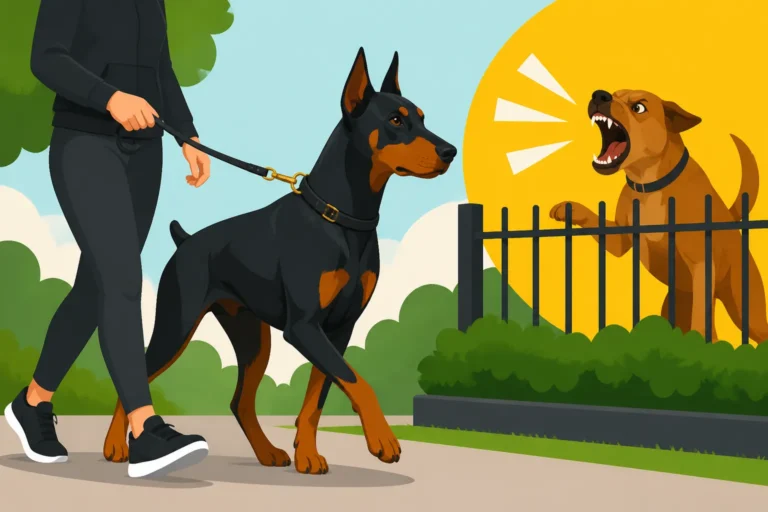
Marker training isn't just for dedicated training sessions; it's a philosophy that can enrich your entire relationship with your Doberman. Start looking for "everyday marks." Did your Doberman lie down calmly while you ate dinner? Mark and toss a treat. Did they settle nicely on their mat when visitors arrived? Mark and reward. Did they choose to walk politely past another dog on a leash without reacting? Mark!
These spontaneous marks reinforce good behavior in real-life contexts, making those desired actions more likely to happen again. It helps your Doberman understand what constitutes "good choices" in various situations, without you having to set up a formal training exercise. It builds a cooperative spirit and makes your Doberman a more thoughtful and mindful companion, always looking to you for guidance and affirmation.
The goal is to integrate the marker seamlessly into your daily interactions, creating a constantly reinforcing loop of positive communication. Your Doberman will start offering desirable behaviors more frequently because they've learned that being good in everyday moments also pays off. This casual, consistent reinforcement builds a truly well-mannered and happy Doberman, capable of navigating a wide range of social situations with grace.
Troubleshooting and Continuing Education
Even with the best intentions, you might hit a snag. Your Doberman might suddenly stop responding, or a new distraction proves too powerful. Don't get discouraged! This is normal. Take a step back and analyze the situation. Go back to basics: make the task easier, reduce distractions, use higher-value treats, and ensure your timing is spot-on. Sometimes, a short break and returning to an easier, well-known behavior can reset their focus and rebuild their confidence.
Never punish your Doberman for not performing a cue correctly when you're marker training. If they get it wrong, it simply means they didn't understand, or the environment was too challenging. Punishment undermines trust and the positive association you've worked hard to build. Instead of punishment, simply withhold the marker and treat, then reset, make it easier, and try again. Why Yelling Shuts a Doberman Down
Continue learning! There are countless resources online and in books about positive reinforcement and marker training. Exploring new techniques or specific exercises can keep training fresh and exciting for both you and your Doberman. Consider joining a local positive reinforcement training class or consulting with a certified professional dog trainer who specializes in Dobermans and understands their unique temperament. Building a well-trained Doberman is a lifelong journey of learning and partnership. Finding a Trainer Who Has Worked With Dobermans
Disclaimer
This article is for general informational purposes only and does not constitute professional advice. Laws, prices and regulations vary by location and change over time. Consult a qualified professional for guidance on your specific situation.