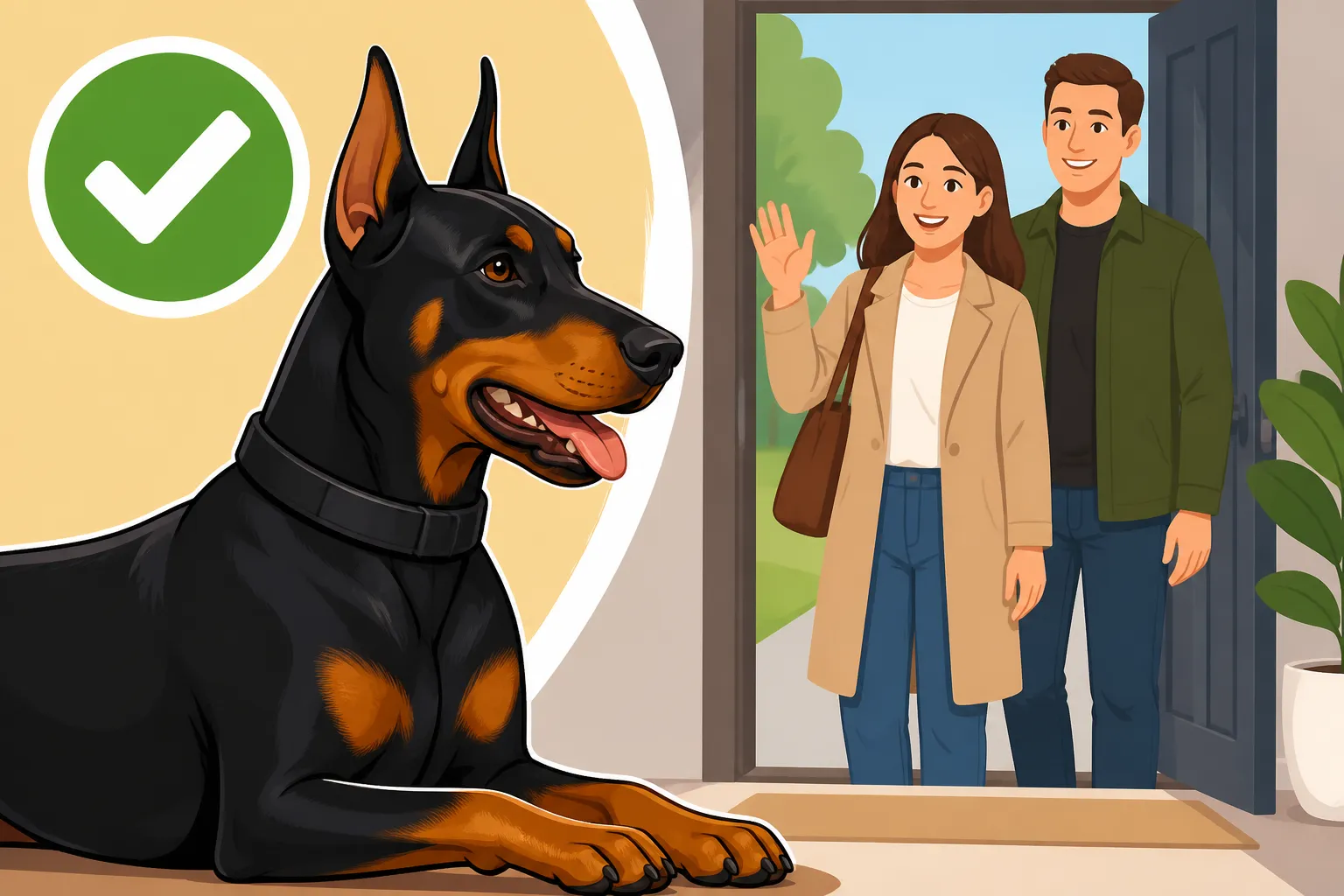
Teaching a Doberman That Visitors Are Fine
It's incredibly frustrating when you want to welcome friends or family into your home, but your beloved Doberman transforms into a furry sentinel, barking and posturing as if the apocalypse has arrived. This guide understands that tension and aims to provide you with practical, empathetic strategies to help your Doberman learn that visitors are nothing to fear, but rather a normal, even pleasant, part of life.
Understanding Your Doberman's Natural Instincts Around Strangers
Let's be real: Dobermans weren't bred to be the life of every party. They were developed for personal protection and guarding, and those instincts run deep. When a new person enters their territory, many Dobermans don't immediately think "new friend!" They think "intruder alert!" or at the very least, "Who is this, and what are their intentions?" It's not necessarily aggression, but often a deep-seated suspicion, a need to assess, and a desire to keep their people safe.
The Doberman's Guardian Heart vs. Social Butterfly
Your Doberman's ancestry speaks volumes. Karl Dobermann, the breed's creator, needed a dog that was fearless, resolute, and able to protect him during his rounds as a tax collector and night watchman. This history means that a natural wariness of strangers is literally woven into their genetic fabric. So, when your Doberman barks incessantly at the delivery driver, or backs away nervously from a new guest, it’s often their inherent guardian instinct kicking in, not a flaw in their character. They might body-block you from a perceived threat, stare intensely, or even give a low growl – all signs they’re trying to communicate their discomfort or perceived duty. It’s important to validate this feeling in them, rather than dismiss it, because understanding where they're coming from is the first step to helping them adjust. For more on their natural inclinations, you might find Doberman Temperament as the Standard Describes It insightful.
Early Socialization: The Foundation You Might Have Missed (or Still Need)
Ideally, a Doberman puppy receives extensive, positive socialization during their critical early weeks – that precious window from about 8 to 16 weeks where they're sponges for new experiences. They should meet a wide variety of people of different ages, genders, sizes, and appearances, all while having positive experiences. This helps them build a robust understanding that "new things are good things" or at least "new things are neutral things." If you got your Doberman later in life, or if circumstances prevented thorough early socialization, please don't despair. It's never truly too late to work on building positive associations, though the approach might be different for an adult dog. For puppies, exposing them calmly to many different people is key. Check out Exposing a Doberman Puppy to Strangers for more on this vital period. Even if your Doberman is past that puppy stage, consistent, structured positive experiences can still make a huge difference, gradually chipping away at their ingrained caution.
Setting the Stage for Success: Preparing for Visitors
Before anyone even rings the doorbell, you can implement strategies to manage the situation and set your Doberman up for success. Proactive management is far more effective than trying to react in the heat of the moment when your dog is already overstimulated.
Managing the Entrance: Preventing Rehearsed Reactions
The front door is often ground zero for Doberman drama. For many Dobermans, the doorbell or a knock acts as a potent trigger, signaling an intrusion into their territory. This can lead to a frantic, barking frenzy, jumping, and general chaos, which your dog learns is the "correct" response to visitors. To break this cycle, you need to manage the initial greeting. This might mean having your Doberman on a leash with you before the visitor arrives, safely tucked away in their crate, or sent to a designated "place" in another room. The goal is to prevent them from rehearsing the unwanted behavior at the door. If your Doberman struggles specifically with this, reading A Doberman That Does What at the Front Door can offer additional perspectives. You want them to be calm when the visitor enters, not already ramped up.
Creating a Safe Space for Your Doberman
Every Doberman, especially one prone to anxiety around new people, needs a personal sanctuary. This might be a sturdy crate, a specific dog bed in a quiet corner, or even a separate room with a baby gate. The key is that this space is consistently a place of comfort, safety, and positive association. When visitors are expected, prepare this safe space with high-value, long-lasting chews or puzzle toys. Things like a stuffed Kong, a bully stick, or a challenging puzzle feeder work wonders. The idea is to give your Doberman something truly engaging to do while your guests are arriving and settling in, shifting their focus from the "threat" to a rewarding activity. This helps them learn that visitors aren't just tolerated, but can actually signal good things for them. If your Doberman is reluctant to use a crate, exploring Choosing a Crate for a Doberman can give you tips on making it a positive den. Many owners find robust crates through retailers like Amazon, ensuring they can withstand a Doberman's strength and provide a truly secure retreat.
Step-by-Step Training for Positive Visitor Interactions
Once you’ve managed the initial entry, the real work of changing your Doberman's emotional response begins. This is about building positive associations and teaching alternative, polite behaviors.
The "Look at That" Game and Counter-Conditioning
This technique is all about changing your Doberman's emotional response from "stranger equals scary/threat" to "stranger equals good things!" It’s a powerful form of classical conditioning. Here’s how it works:
- Spotting the Trigger: Have your visitor stand at a distance where your Doberman notices them but doesn't react negatively (no barking, lunging, or freezing). This might be across the street, in the driveway, or just inside the doorway with a gate.
- Mark and Reward: The instant your Doberman looks at the visitor (even a quick glance), cheerfully say "Yes!" or click a clicker, and immediately give them a high-value treat. Repeat this every time they look at the visitor.
- No Interaction with Visitor: The visitor should completely ignore your Doberman at this stage. No talking, no eye contact, no reaching out. This reduces pressure on your dog.
- Gradual Proximity: Over many, many sessions, you'll slowly decrease the distance between your Doberman and the visitor, always ensuring your dog remains under their threshold of reaction. If your Doberman starts reacting, you've moved too quickly, and you need to increase the distance again.
This teaches your Doberman that the presence of a stranger predicts something wonderful (treats!), rather than something alarming. Consistency is key here. If your Doberman is quite shy, you might also find A Doberman That Hides From New People helpful in understanding their reactions.
Controlled Greetings: The Leash and Treat Approach
Once your Doberman is starting to associate visitors with good things at a distance, you can begin to introduce controlled, polite greetings. This is best practiced with a trusted friend or family member who understands the process.
- Leash Up: Keep your Doberman on a leash, even indoors, when the visitor first enters the main living space. This gives you control and prevents them from rushing the guest.
- Visitor Protocol: Instruct your guest to completely ignore your Doberman for the first 5-10 minutes. This is often called the "no touch, no talk, no eye contact" rule. It allows your Doberman to approach and sniff on their own terms, reducing perceived pressure.
- Passive Reinforcement: As your Doberman calmly observes or approaches the guest, you can quietly drop treats on the floor near them, reinforcing calm presence.
- Initiated Interaction: Once your Doberman shows relaxed body language (loose tail wag, relaxed posture, perhaps even seeking attention), the visitor can then offer a treat from an open palm, avoiding direct eye contact or sudden movements. They can then try a gentle, slow pet under the chin or on the chest, rather than over the head.
- Place Command: Teach your Doberman a strong "place" command. This allows you to send them to their designated spot (bed, mat) when guests arrive or during times of high activity, giving them a job and a sense of routine. Teaching a Doberman to Go to a Mat for Guests dives deeper into this specific skill.
- Avoid Forcing: Never force your Doberman to interact. If they retreat, let them. Pushing them past their comfort zone will only set you back.
This systematic approach, repeating it with different visitors and in various low-stress scenarios, helps build confidence and a positive expectation for human guests.
Managing Energy and Over-Stimulation
A tired Doberman is generally a well-behaved Doberman. If your dog is brimming with pent-up energy, they are far more likely to be reactive or over-the-top with visitors. Before guests arrive, make sure your Doberman has had adequate physical and mental exercise. A good long walk, a strenuous play session in the yard, or a solid training session can help burn off that excess energy.
- Pre-Visitor Exercise: Aim for a substantial exercise session about an hour or two before guests are due. This helps them be in a calmer, more receptive state when people arrive.
- Recognizing Stress Signals: Learn to read your Doberman’s body language. Signs of discomfort include lip licking, yawning (when not tired), turning their head away, stiffening their body, whale eye (showing the whites of their eyes), or a low growl. If you see these, it’s a sign they’re overwhelmed and need a break or more distance. Take a look at A Doberman That Stiffens Before It Growls for a deeper understanding of these subtle cues.
- Provide Breaks: Don't expect your Doberman to be "on" for the entire duration of a visit. Provide planned breaks where they can go to their safe space, away from guests, to decompress. This could be a 15-minute crate break with a chew toy, or simply letting them hang out in a quiet room.
Here's a table summarizing common Doberman body language signals when uncomfortable:
| Body Language Sign | What it Looks Like | What it Might Mean | Action to Take |
|---|---|---|---|
| Lip Licking | Quick flicks of the tongue across the nose/mouth | Stress, anxiety, appeasement | Increase distance, provide a break, redirect focus |
| Yawning | Slow, deliberate yawn (when not actually tired) | Stress, appeasement | Same as above |
| Head Turn/Turn Away | Turning head or entire body away from the stimulus | Trying to disengage, uncomfortable | Respect their space, do not force interaction |
| Stiff Body/Tail Set | Rigid posture, tail held high or tucked low and still | Tension, unease, preparing for flight or fight | Watch closely, intervene to prevent escalation |
| Whale Eye | Showing the whites of the eyes, often in a side glance | Stress, fear, feeling cornered | Create space, end interaction immediately |
| Low Growl/Mutter | Audible vocalization, sometimes subtle | Warning sign, "I'm uncomfortable, back off" | Immediately create distance, assess trigger |
| Panting (no exertion) | Rapid, shallow breaths with tongue out (not hot) | Stress, anxiety | Move to a cooler, quieter spot, offer water |
| Ears Pinned Back | Ears flattened tightly against the head | Fear, anxiety, submission | Reduce perceived threat, move slowly |
Common Pitfalls and Troubleshooting
Even with the best intentions, training a Doberman around visitors can hit some snags. It's crucial to understand what can hinder progress and how to address it.
The "He Just Needs to Meet Them" Fallacy
This is perhaps the biggest and most common mistake owners make. The idea that if you just force your Doberman to "get over it" by letting them interact with every stranger, they'll magically become friendly. In reality, forcing interaction with a nervous or reactive Doberman almost always backfires. It can solidify their fear, make them more reactive, or even push them towards defensive aggression if they feel their boundaries are repeatedly violated. Imagine someone shoving you into a crowded room if you have social anxiety; it doesn't make you less anxious, it makes you more. Respecting your Doberman's need for space and control over interactions is paramount. If your Doberman is truly fearful, Whether a Shy Doberman Can Be Built Up offers valuable insights into addressing underlying anxiety.
Consistency is Key: Everyone Needs to Be on Board
Training a Doberman isn't a "sometimes" activity. It requires unwavering consistency from every member of the household and any frequent visitors. If one person lets your Doberman jump all over guests while another tries to enforce calm greetings, you're sending mixed signals that will confuse your dog and slow down progress. Hold a family meeting and ensure everyone understands the rules:
- Doorbell Protocol: Everyone must follow the same procedure when the doorbell rings (e.g., Doberman goes to "place" before anyone answers).
- Visitor Interaction Rules: All guests should be briefed on how to interact (or not interact) with your Doberman initially. This means no reaching out, no sudden movements, no direct eye contact, and only interacting if the dog initiates and shows relaxed body language.
- Treat Strategy: Ensure everyone knows when and how to appropriately use treats to reinforce calm behavior around visitors.
Without a unified front, your Doberman will struggle to understand what's expected of them, making progress incredibly difficult. You could even consider a muzzle for particularly excitable or anxious Dobermans during initial visitor interactions, especially if you have children, to ensure safety while training. Muzzle Training a Doberman Before It Is Needed offers guidance on making this a positive tool, not a punishment.
When Professional Help is Needed
There are times when even the most dedicated Doberman owner needs an extra hand. If your Doberman’s reactions to visitors are severe – involving intense lunging, snapping, persistent growling, or attempts to bite – it’s time to call in a professional. This doesn't mean you've failed; it means you're being a responsible owner. Look for a certified professional dog trainer (CPDT-KA) or a certified dog behaviorist (CDBC) who uses positive reinforcement methods and has experience with Dobermans or similar guardian breeds. They can assess your specific situation, identify triggers you might be missing, and develop a tailored training plan. They can also rule out any underlying medical conditions that might be contributing to the behavior. A great resource for finding such expertise is often online directories, and some companies like BAXTER & Bella offer virtual consultations which can be a stepping stone. Finding someone who truly understands the breed's nuances, as discussed in Finding a Trainer Who Has Worked With Dobermans, is crucial for effective progress.
Disclaimer
This article is for general informational purposes only and does not constitute professional advice. Laws, prices and regulations vary by location and change over time. Consult a qualified professional for guidance on your specific situation.