Why Some Registries Drop Pinscher From Doberman
You may find “Dobermann” on one pedigree, “Doberman Pinscher” on another, and simply “Doberman” in a shelter listing. That inconsistency can make it feel as though you are looking at different breeds. Usually, you are not: the name depends on the registry, country, and context. This guide explains why the wording changes and what it means for owners.
Why the Breed Name Changes
A name shaped by country and language
The Doberman originated in Germany and is named after Karl Friedrich Louis Dobermann. German-language sources commonly use Dobermann, with a double “n” at the end. English-language usage often drops one “n,” producing Doberman. Some registries include the word Pinscher, while others use only the breed’s name.
Those differences can look significant on a form, but spelling and naming conventions do not, by themselves, establish that the dog belongs to a different breed. They are usually a reflection of the organization’s preferred official terminology. For background on the breed’s early development, see Who Karl Friedrich Louis Dobermann Was and What Went Into the First Dobermans.
The name also evolved alongside the breed’s spread beyond Germany. Dogs, standards, and terminology crossed borders, and local kennel organizations adopted names that fit their own systems. The history of that expansion is covered in The First Dobermans Shipped Out of Germany.
What “Pinscher” adds to the name
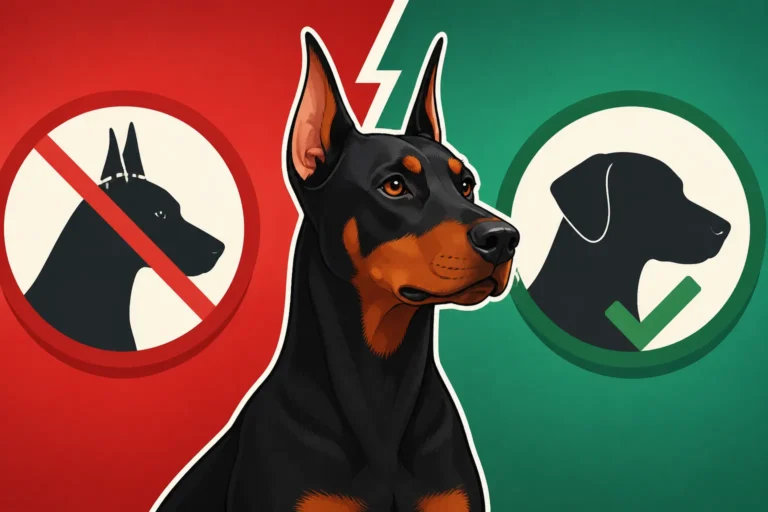
“Pinscher” is part of the official breed name used by some kennel organizations, including the American Kennel Club, which calls the breed the Doberman Pinscher. Other registries use Dobermann or Doberman without the extra word. The absence of “Pinscher” is not a claim that the dog has lost a characteristic, changed type, or become a separate breed.
The word can also create confusion because several distinct breeds include “Pinscher” in their names, such as the German Pinscher and Miniature Pinscher. A Doberman is not simply another name for either of those breeds. Registry names help identify a recognized breed within a particular organization’s records; they are not always designed to give a full description of the dog’s ancestry in ordinary English.
The historical wording can be understood more clearly by looking at the breed’s early standards and organizations. The 1900 German Doberman Standard explores how the breed was formally described, while The Doberman Club Goeller Founded in 1899 gives context for the organizations that helped establish its identity.
Why Some Registries Omit “Pinscher”
Different kennel organizations set different official names
A registry is responsible for its own records and naming conventions. One organization may use a longer name that includes a traditional or distinguishing term, while another may use a shorter name that reflects its own language and breed-standard system. Neither choice automatically changes the dog’s breed.
For example, the AKC’s name is Doberman Pinscher, while the international FCI standard uses Dobermann. The names differ, but that difference does not mean the organizations are describing unrelated dogs. When comparing records, look at the issuing organization, registration number, pedigree, and applicable breed standard rather than treating a single word as decisive.
The AKC’s recognition history is one part of why English-speaking owners often encounter the longer form. AKC Recognition of the Doberman in 1908 explains that organization’s connection to the breed. The breed’s formal name in one registry is not necessarily the name used by every registry around the world.
Shorter names can reduce ambiguity
A registry may choose the shorter name because it considers the breed’s identity clear without “Pinscher,” or because its naming convention differs from that of another country. In some contexts, a concise name is easier to use in catalogs, records, and breed standards. That is an administrative choice, not evidence of a new breed or an official split.
It is useful to distinguish between a registry’s official label and everyday naming. A breeder, veterinarian, rescue group, dog show, and online store may all use slightly different wording. Those labels can help people find information, but they do not necessarily determine the name printed on a dog’s official registration papers.
| Where you see the name | What the wording usually tells you | What it does not prove |
|---|---|---|
| Kennel registry papers | The name used by that organization for its records | That a different wording means a different breed |
| Breed standard | The organization’s formal breed description and terminology | That every registry uses the same title |
| Rescue or shelter listing | The wording chosen for public identification | That the dog’s ancestry has been verified |
| Retail or informational website | A search-friendly or familiar breed label | That the website is a kennel registry |
| Pedigree or show catalog | The naming convention used by the issuing or organizing body | That a name variation changes the dog’s registration |
What the Different Names Mean for Owners
Check the organization, not just the wording
If a breeder gives you papers that say “Doberman Pinscher” and another source describes the breed as “Dobermann,” the difference alone is not a reason to assume the documents conflict. Start by checking which organization issued the papers and whether the dog’s registered identity, parent information, and registration number are consistent across the records you have.
If you are comparing a pedigree with a breed standard, make sure you are looking at the standard from the same registry or country whenever possible. Standards can differ in some details, and a naming difference is only one part of a broader system. For a closer look at how the breed is described, see The Doberman the AKC Standard Describes.
Owners sometimes search a retailer or general information site while trying to understand a breed label. A company such as Chewy may use familiar wording to make products or information easier to find, but a retail label is not the same thing as an official registration entry. If a product search shows “Doberman Pinscher” and your paperwork says “Dobermann,” that is not, on its own, a mismatch.
Keep names consistent on forms when possible
When filling out a veterinary, insurance, travel, or training form, use the name that appears on the dog’s registration paperwork if the form asks for a registered breed. If the form offers only “Doberman” or “Doberman Pinscher,” choose the closest available option and ask the organization how it wants the record entered if accuracy matters for a claim or official document.
For everyday appointments, the practical goal is clear identification. Most clinics and service providers are likely to understand the common names, but it is still helpful to keep a copy of registration papers and note the registry that issued them. This can be especially useful if you are dealing with an imported dog or records from more than one country.
A retailer such as Chewy may also use a broad breed label in a search or product context. Treat that wording as a way to navigate the site, not as a correction to your dog’s paperwork. The same principle applies to shelter profiles and social media posts: convenient labels are not a substitute for official records.
How to Read a Name Variation Without Overthinking It
Separate breed identity from registry paperwork
The phrase “Doberman Pinscher” is a formal breed name in some systems; “Dobermann” is the form used in others. “Doberman” is also a widely used English spelling. Most of the time, these names point to the same recognized breed, and the variation reflects geography, organizational practice, or spelling convention.
That does not mean every dog described online as a Doberman has verified pedigree status. A listing might use the name because a dog resembles the breed, because the previous owner supplied that description, or because the dog is a mix. If you need to know whether a particular dog is registered or pedigreed, ask for the relevant records rather than relying on the label alone.
A store listing is a useful example of why context matters. If Chewy or another retailer uses a familiar phrase in product browsing, that helps shoppers search; it does not confirm lineage, registry membership, or show eligibility. Those questions are answered by the relevant organization and the dog’s own documents.
Use the variation as a clue, not a red flag
Seeing “Pinscher” disappear from a breed name can be surprising, especially if you have always known the dog as a Doberman Pinscher. But the absence of that word does not imply that the breed has been renamed everywhere, that a registry has rejected the term, or that a dog with different wording is automatically suspicious. It is simply a reminder to identify which organization or source you are reading.
If you are choosing a puppy, focus on the breeder’s documentation, health testing, and transparency—not on whether one heading includes “Pinscher.” The broader history of the breed’s naming and development is connected to What Otto Goeller Changed in the Doberman and Why the Doberman Was Bred Calmer Over Time. For more on the breed’s place among working dogs, see The Doberman's Place in the Working Group.
When you encounter a name that looks different, use this simple check:
- Identify whether the source is a kennel registry, breed club, breeder, rescue, retailer, or general website.
- Check the spelling and official name used by the relevant registry.
- Compare the dog’s registration details, not just the breed label.
- Ask the issuing organization or breeder to clarify any genuine discrepancy in the documents.
- Treat commercial and informal listings as search labels unless they link to official records.
In most cases, “Doberman,” “Doberman Pinscher,” and “Dobermann” are different naming conventions for the same breed—not signs that the dog itself has changed.
Disclaimer
This article is for general informational purposes only and does not constitute professional advice. Laws, prices and regulations vary by location and change over time. Consult a qualified professional for guidance on your specific situation.