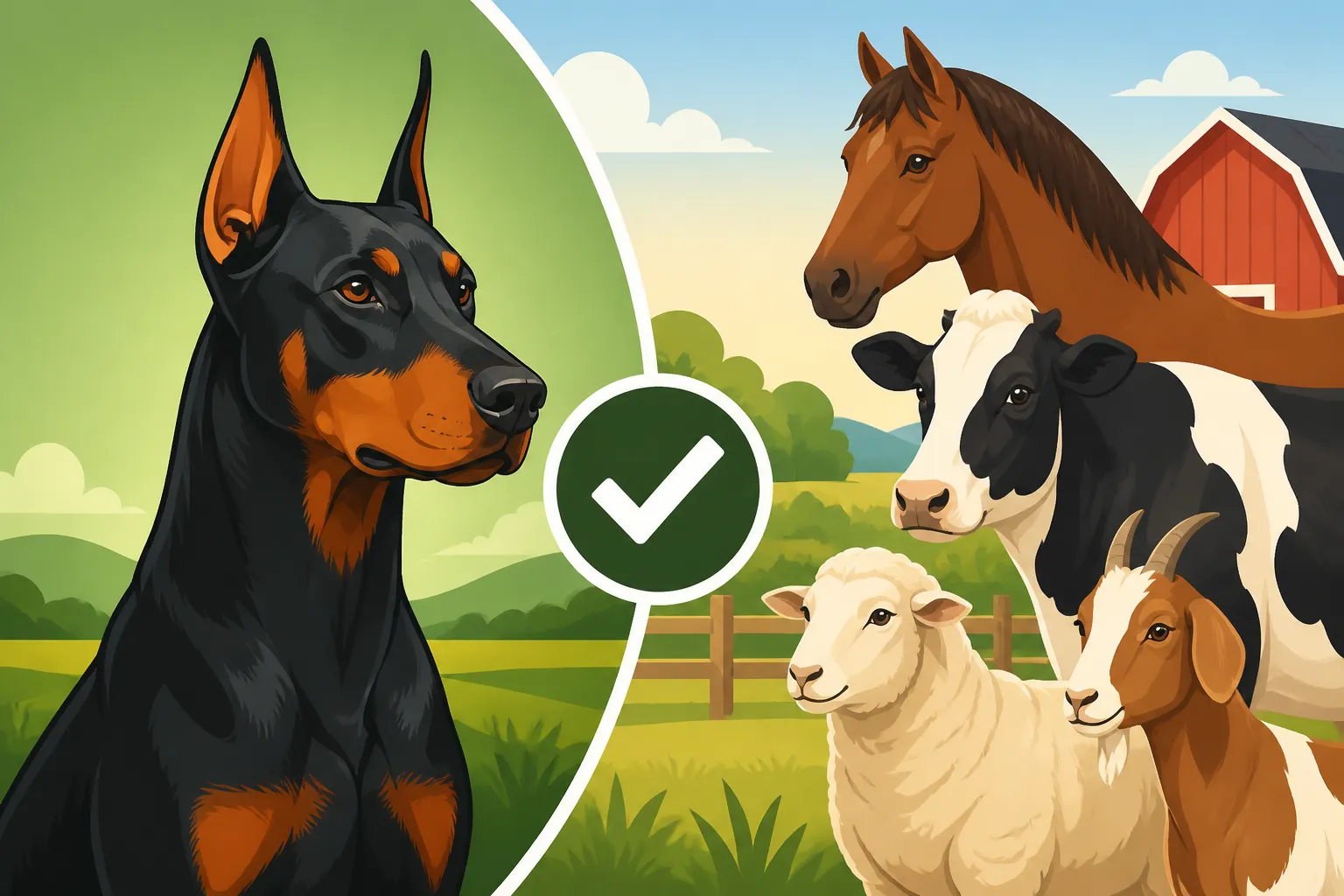
Whether a Doberman Can Live With Livestock
It's a common dream for many Doberman owners: living out in the country, perhaps with a few chickens, some goats, or even larger livestock. You picture your regal Doberman patrolling the perimeter, keeping watch. But then reality sets in, and you start to wonder, can a Doberman actually live harmoniously with farm animals, or is it a recipe for disaster? This guide will dive deep into the Doberman's natural instincts, the extensive training required, and the practical management strategies needed to even consider such a living arrangement.
Understanding the Doberman's Natural Instincts
Before we even talk about training, it's crucial to understand the Doberman's inherent makeup. These aren't your typical farm dogs bred for generations to coexist with or guard livestock. They were originally bred by Karl Dobermann as personal protectors, with a strong prey drive and guarding instincts directed towards humans, not barn animals.
The Doberman's Prey Drive: Understanding the 'Chase'
Dobermans possess a significant prey drive. This isn't a flaw; it's a deeply ingrained instinct, a remnant of their ancestors' hunting behaviors. A quick movement from a chicken, the frantic bleating of a lamb, or a goat bolting across a field can trigger this drive in an instant. For your Doberman, these animals are not companions or charges; they are moving targets that ignite a powerful urge to chase, catch, and potentially harm. It's not about malice; it's about instinct.
Imagine your Doberman out in the yard. A squirrel dashes across the fence line. What happens? Most Dobermans are off like a shot, locked onto that squirrel, ready to pursue it with single-minded focus. Now, substitute that squirrel with a small, vulnerable chick or a startled rabbit. The instinct is the same, but the consequences are far more dire. This prey drive is a fundamental challenge when introducing them to livestock, and it can be incredibly difficult to override, especially if not addressed from a very young age and with consistent, high-level training.
Herd Guarding vs. Prey Drive: A Critical Difference
It's vital to differentiate between a Doberman's natural guarding instinct and the specialized role of a true livestock guardian dog (LGD). Breeds like Great Pyrenees, Anatolian Shepherds, or Maremmas have been selectively bred for centuries to bond with and protect livestock. Their instinct is to deter predators, viewing the sheep or goats as their "flock" to defend. They are typically calm and watchful around their charges, only becoming assertive when a threat appears.
A Doberman, while possessing strong guarding instincts for their human family and property, is simply not wired for this specific type of protection. Their guarding is often assertive and territorial, and their prey drive, as discussed, is inherently antagonistic towards smaller, faster-moving animals. Asking a Doberman to protect chickens from a fox while simultaneously ignoring the urge to chase those same chickens is asking them to perform two conflicting, almost impossible tasks based on their breed genetics. It's like asking a dedicated retriever not to pick up a ball. It goes against their very nature.
Training and Socialization for Coexistence
Given the Doberman's natural inclinations, achieving peaceful coexistence with livestock demands an exceptionally high level of commitment to training and socialization. This isn't a casual endeavor; it requires consistent, rigorous effort starting from puppyhood and continuing throughout the dog's life.
Early Exposure and Puppy Socialization
The absolute best chance you have for a Doberman to tolerate livestock begins in puppyhood. From the moment you bring your Doberman puppy home, and especially during the critical The Sixteen Weeks That Set a Doberman Up, exposure to a wide variety of sights, sounds, and experiences is paramount. However, with livestock, "exposure" doesn't mean letting them run loose together. It means carefully managed, positive, and controlled introductions.
A Doberman puppy needs to learn that farm animals are a normal part of the environment, not toys or prey. This could involve carrying your puppy around the perimeter of the animal pens, always on a leash, rewarding calm behavior. The goal is desensitization – making the presence of livestock boring and unremarkable. This also includes desensitizing them to the associated smells, sounds, and movements of farm life. Enroll in a well-regarded online puppy training program like BAXTER & Bella, which emphasizes positive reinforcement and building a strong foundation of obedience and impulse control. Their curriculum can be a huge asset in shaping a well-mannered pup before specific livestock introductions even begin. Remember, a Doberman puppy that is allowed to chase a chicken "just for fun" is learning a behavior that will be incredibly difficult to undo later. You are essentially building the foundation for impulse control. Building a Doberman Puppy That Is Confident, Not Sharp also plays a role here, as a confident dog is less likely to react out of fear or over-excitement.
Advanced Obedience and Impulse Control
Once your Doberman puppy is past the initial socialization phase, intense obedience training becomes non-negotiable. This goes far beyond basic "sit" and "stay." You need rock-solid recall, an immediate "leave it" command, and a reliable "down-stay" that can hold even with significant distractions. Your Doberman must view you as the ultimate authority and be able to disengage from high-value distractions on command. This takes thousands of repetitions in various environments, including gradually increasing distractions.
Consider a scenario: your Doberman is on a walk near the chicken coop. Suddenly, a chicken flaps its wings loudly, darting across the yard. Your dog's natural instinct will be to lunge. At this moment, your "leave it" or recall command must be instant and unbreakable. This level of control isn't achieved overnight. It requires dedication, consistency, and often, the guidance of a professional trainer experienced in working with high-prey-drive breeds. Training a Doberman That Is Smarter Than You Expect is a good read on how challenging, yet rewarding, training a Doberman can be. They learn quickly, but they can also outsmart you if you're not consistent. Why a Clever Doberman Is Harder to Train highlights this exact point; their intelligence can make them adept at finding loopholes in your training if you're not vigilant. Moreover, Teaching a Doberman to Wait for Permission is a principle that should extend to all interactions, especially around livestock.
A strong understanding of motivation is also critical. What rewards does your Doberman value most? Whether a Doberman Works Better for Food or Tug is an important question to answer for your individual dog, as using their highest-value reward will make training more effective and reinforce desired behaviors over predatory instincts.
Managing Risk and Ensuring Safety
Even with the best training and socialization, managing the inherent risk of a Doberman living with livestock is an ongoing, lifelong commitment. It requires vigilance, appropriate physical infrastructure, and a realistic understanding of potential failures.
Physical Barriers and Supervision
For the vast majority of Dobermans, direct, unsupervised interaction with livestock is simply too risky. Strong, secure physical barriers are your first line of defense. This means robust fencing around all livestock enclosures that your Doberman cannot jump, dig under, or chew through. Think heavy-gauge wire, electric fencing, or solid panels that prevent visual access if necessary. Even a brief moment of unsupervised access can lead to tragedy.
Supervision, when your Doberman is anywhere near livestock, must be 100% active and engaged. This isn't the time to be on your phone or multitasking. Your Doberman should always be on a leash, preferably a long line (think 30-50 feet, easily found on Amazon) so they can explore safely while still under your direct control. A properly fitted harness, perhaps one designed for strong pullers, and a sturdy lead are essential. Harnesses and Leads for a Strong Doberman can offer insights into suitable equipment. A muzzle might even be a necessary tool during initial, controlled introductions, especially if you're dealing with very small or vulnerable animals, providing an extra layer of safety. This isn't punitive; it's responsible management.
Consider the layout of your property. Can you create separate, secure zones where your Doberman cannot access the livestock areas without your direct intervention? This might involve double gates, separate yards, or kennels. The goal is to prevent opportunistic behaviors, which are often the hardest to control.
Desensitization and Counter-Conditioning
For Dobermans that show a high level of excitement or reactivity towards livestock, specific desensitization and counter-conditioning protocols are essential. This involves gradually exposing your Doberman to the livestock at a distance where they remain calm, and then rewarding that calm behavior with high-value treats or praise. The distance is slowly decreased over many, many sessions, always ensuring the dog stays below its "threshold" of reaction.
For example, you might start with your Doberman on a long line, 50 feet away from the chicken coop. Every time they glance at the chickens but remain calm, they get a treat. If they start to strain or whine, you increase the distance again. This teaches them that the presence of livestock predicts something good happening (treats), rather than triggering an overwhelming chase instinct. This process can take weeks, months, or even years, and it may never lead to complete unsupervised trust. Puzzle Work That Actually Tires a Doberman can also be a valuable tool, offering mental stimulation that can reduce overall frustration and provide a healthy outlet for their intelligence, making them less likely to fixate on external stimuli like livestock.
Some trainers might even discuss using tools like e-collars in very specific, high-stakes situations for emergency interruption of prey drive, but this is a highly controversial topic. Whether an E-Collar Belongs on a Doberman delves into the considerations, but such tools should only ever be used under the direct guidance of a certified professional who is experienced with their correct, humane application and understands Doberman temperament. Misuse can cause significant behavioral damage.
When Coexistence Isn't Possible
Despite your best efforts, sometimes, a Doberman and livestock simply aren't a safe combination. It's a hard truth, but recognizing this and taking appropriate action is paramount for the safety of both your animals and your dog.
Recognizing Unmanageable Behavior
There are clear signs that a Doberman's prey drive or guarding instincts towards livestock are simply too strong to manage safely:
- Persistent Fixation: Your Doberman constantly stares, stalks, or obsesses over the livestock, even from a distance. Their body language is stiff, focused, and predatory.
- Failed Commands: Despite rigorous training, your "leave it" or recall commands break down when distractions from livestock are present. The drive overrides their obedience.
- Escalation of Attempts: The Doberman actively tries to breach enclosures, dig under fences, or jumps at gates to get to the animals. This shows a deep-seated intent.
- Actual Incidents: Any instance of the Doberman harming, injuring, or even just aggressively chasing livestock, regardless of the severity, is a huge red flag. Even a "minor" nip can cause immense stress and injury to a farm animal.
- Stress in Livestock: The livestock themselves are constantly agitated, stressed, or injured due to the Doberman's presence. Their quality of life is compromised.
It's important to be honest with yourself about these indicators. Denial or wishful thinking can lead to devastating consequences. The Doberman's Doberman Guarding Instinct and Where It Tips Over can sometimes manifest in ways that are incompatible with livestock, especially if that guarding instinct is misdirected or combined with a high prey drive.
Alternative Solutions for Farm Owners
If you've reached the difficult conclusion that your Doberman cannot safely live with livestock, it's not a failure on your part, but an acknowledgement of reality. There are still ways to manage this situation responsibly:
- Strict Separation: This is the most straightforward and often the safest solution. The Doberman has its dedicated, secure living space, completely separate from all livestock. This means a securely fenced yard, a dedicated kennel, or strictly indoor living with no unsupervised access to farm areas. You might even consider building a "dog run" that gives your Doberman safe outdoor access without any view or proximity to the animals. This will likely mean A Doberman That Chews Through the Door or other destructive behaviors if not given adequate enrichment and exercise in their safe space.
- Rehoming (as a last resort): In rare and extreme cases where the Doberman's drive is so intense that safe management is impossible, even with strict separation, rehoming might need to be considered. This is a heartbreaking decision, but sometimes, finding a home where the Doberman can thrive without the constant trigger of livestock is the most humane choice for all involved. This would ideally be through a Doberman-specific rescue that understands the breed's needs and can find a suitable, livestock-free environment.
- Hiring a Professional: Sometimes, an objective eye from an experienced behaviorist specializing in working breeds and prey drive can help assess the situation and offer tailored strategies. They might identify subtle cues or offer management techniques you hadn't considered. However, even the best behaviorist cannot fundamentally change a breed's hardwired instincts, only help manage them.
Ultimately, integrating a Doberman into a home with livestock is an advanced undertaking that requires an owner who truly understands the breed's nature and is prepared for significant, ongoing training and management. For many, the risks may simply outweigh the benefits.
| Trait / Behavior | Typical Doberman (Unmodified) | Typical Livestock Guardian Dog (LGD) | Implications for Coexistence with Livestock |
|---|---|---|---|
| Primary Breeding Goal | Personal protection, guard human family, deter human threats. | Guarding/protecting livestock, deterring animal predators. | Doberman instincts are directed at people, not animals. |
| Prey Drive | Generally high, stimulated by small, fast-moving animals. | Generally low towards their charges, high towards predators of charges. | Doberman may view livestock as prey. LGDs bond with livestock. |
| Bonding | Strong bond with human family members. | Strong bond with livestock (flock/herd), often aloof with humans. | Doberman's loyalty is to you; LGD's loyalty is to the farm animals. |
| Reaction to Livestock Movement | Often triggers chase instinct, excitement, fixation. | Calm, ignores normal movements; acts to protect if threatened. | Doberman's reaction is potentially dangerous to livestock. |
| Training Focus Needed | Intensive impulse control, "leave it," reliable recall. | Socialization with livestock from puppyhood, gentle handling. | Doberman needs to suppress instinct; LGD needs to nurture instinct. |
| Supervision Level | Constant, direct supervision essential near livestock. | Minimal supervision needed once bonded and mature; operates independently. | Doberman requires perpetual vigilance to prevent incidents. |
| Success Rate for Coexistence | Low, requires exceptional effort and ideal temperament. | High, if properly raised and placed in appropriate environment. | High risk with Dobermans, high reward with true LGDs. |
Disclaimer
This article is for general informational purposes only and does not constitute professional advice. Laws, prices and regulations vary by location and change over time. Consult a qualified professional for guidance on your specific situation.