Whether a Doberman Puppy Is Growing on Schedule
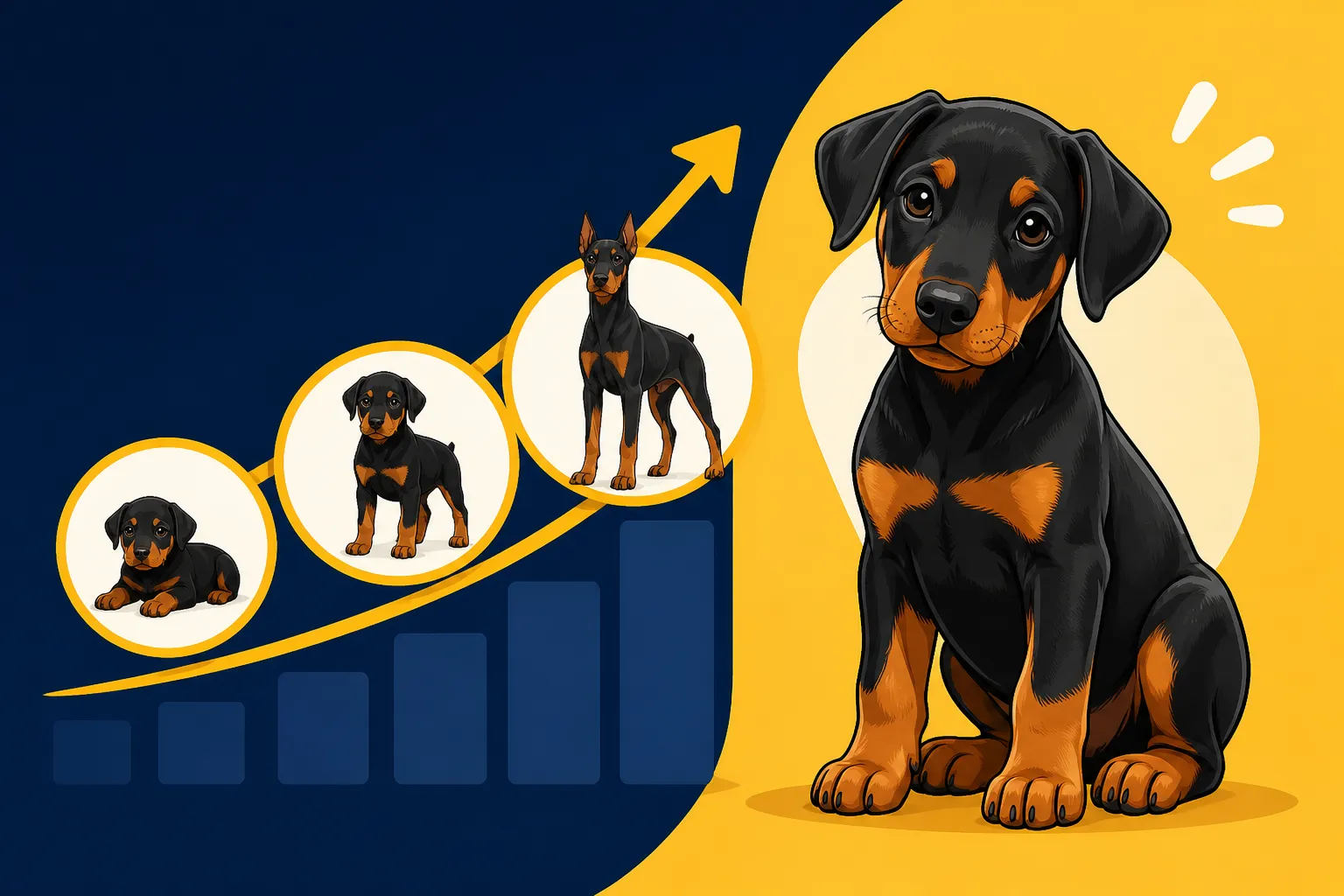
One of the biggest worries for new Doberman owners, especially those with puppies, is watching them grow and wondering if they're developing "correctly." You might see photos of other Dobermans, read breed standards, and then look at your own gangly, sometimes awkward-looking puppy and think, "Is this normal?" This guide aims to ease those anxieties by breaking down the typical growth trajectory of a Doberman puppy, what to expect, and when those growth spurts and lulls are perfectly normal.
Understanding Doberman Growth Stages
Bringing home a Doberman puppy means signing up for a journey of incredible growth. These aren't dogs that mature slowly; they transform from tiny, floppy-eared bundles of energy into sleek, powerful adults in what feels like the blink of an eye. Understanding these stages can help you appreciate the process and spot any genuine concerns early on.
The Rapid Early Weeks (0-16 weeks)
The first few months of a Doberman puppy's life are marked by astonishing, almost daily changes. When you first bring your puppy home, likely around 8-10 weeks, they are still relatively small but gaining weight and height at an incredible pace. During these initial weeks, their little bodies are laying down the foundation for their adult size. You'll notice their legs seem to grow longer overnight, and they might look a bit disproportionate—all ears and paws.
This period is crucial for bone and joint development, even though the growth plates are still open and vulnerable. Their diet needs to support this rapid expansion without encouraging excessively fast growth, which can be detrimental. Good breeders will often have started their puppies on quality food, and continuing this is vital. They're like little sponges, absorbing nutrients to fuel their transformation.
Socialization is also huge here, shaping their mental and emotional growth alongside their physical development. A confident, well-adjusted puppy is just as important as one growing physically "on schedule." They need to experience the world in a positive way during these formative weeks.
Adolescent Growth Spurt (4-12 months)
As your Doberman puppy moves into adolescence, typically from about four months up to a year, they hit their main growth spurt. This is often the phase where they look the most awkward, all legs and not much body. Their height will increase significantly, and they'll likely appear very lean, almost underweight to the untrained eye. It's common for concerned owners to feel every rib and hip bone, mistaking this normal "gangly" phase for malnourishment.
During this time, their energy levels can be through the roof, but their joints are still very much developing. High-impact activities like jumping off furniture, excessive stair climbing, or prolonged, intense running on hard surfaces should be minimized to protect those vulnerable growth plates. Think about controlled exercise, like long walks and gentle play, rather than demanding too much from their still-developing frame.
Many Dobermans will reach close to their adult height by 8-10 months, but they won't have the muscle mass or depth of chest they'll eventually carry. This is the stage where you might start to feel like you're living with a miniature horse that's all knees and elbows, constantly tripping over its own feet. Don't worry, it's a completely normal part of becoming a magnificent adult Doberman.
Filling Out and Maturation (1-2 years)
Once your Doberman has hit their approximate adult height, usually around 10-14 months, the focus of their growth shifts from upward to outward. This is the "filling out" phase. Over the next several months, often extending well into their second year, they will slowly gain muscle mass, their chest will deepen, and their overall body will mature and broaden. You'll start to see that characteristic Doberman athleticism and power take shape.
This maturation can be subtle, happening so gradually that you might not notice it day-to-day until you compare photos from a few months prior. A Doberman might look lean and lanky at a year old, but by 18-24 months, they’ll have developed a much more substantial, powerful physique. The Age a Doberman Reaches Full Height is often earlier than When a Doberman Fills Out After Growing Tall, so patience is key.
Their bones are still strengthening, and their ligaments and tendons are firming up. While they are more robust than a tiny puppy, it's still wise to continue with sensible exercise and a high-quality diet. This phase is also when their adult temperament really solidifies, building on all the foundation work you did in their younger months.
What "On Schedule" Really Means for a Doberman
The phrase "on schedule" can be a bit misleading when it comes to Doberman growth, as it conjures images of strict charts and numbers that every dog must meet. In reality, healthy growth is a bit more nuanced than that.
Beyond Just Weight and Height
While weight and height charts offer a general guideline, they don't tell the whole story of a Doberman's development. A truly "on schedule" Doberman puppy isn't just hitting certain numerical targets; they are also exhibiting overall vitality. This means they have good energy levels appropriate for their age, a bright and alert demeanor, a healthy appetite, and a shiny, supple coat. Their eyes should be clear, and their gums pink.
Their conformation, or how their body is put together, should look balanced over time, even through the awkward adolescent phase. You want to see developing muscle tone, a relatively clear gait (no persistent limping or stiffness), and generally good bone structure. A Doberman might be slightly lighter or shorter than the "average" for their age, but if they are otherwise thriving, eating well, playing, and acting like a happy puppy, then they are likely developing perfectly fine. Don't get too hung up on specific numbers, but rather observe the whole picture of their health and happiness.
Breed Standard vs. Individual Variation
The Doberman breed standard describes the ideal adult dog – a powerful, muscular, squarely built animal. However, this is the finished product, not what your puppy will look like at 6 or 9 months. Furthermore, there's always a range of variation even within a well-bred line. Males are generally larger and heavier than females, and there can be differences between individual puppies in the same litter due to genetics and even uterine position.
Some Dobermans might be naturally smaller-boned and finer, while others are stockier and heavier, even within the acceptable breed standard. European Dobermans, for example, often have a heavier bone structure and broader chests compared to some American lines, which can mean they feel and look "bigger" at the same age. Your puppy's growth will also be influenced by the size and build of their parents and grandparents. If both parents are on the smaller end of the standard, it's unlikely your puppy will grow to be a giant. Similarly, if they come from a line of substantial dogs, you can expect a larger adult.
The Lean, Gangly Phase
It bears repeating: the lean, gangly phase is absolutely normal for a Doberman puppy and adolescent. Many first-time Doberman owners become quite concerned when their puppy, especially between 6 and 14 months, looks incredibly thin. You might see their ribs, hip bones, and spine easily, and think they're not getting enough food. This is often just how Dobermans grow. They shoot up in height first, stretching out their frame, before they start to add muscle and fill out.
Think of it like a human teenager who suddenly grows several inches but hasn't yet put on the muscle or width of an adult. They can look a bit awkward and all arms and legs. Dobermans do the same. This isn't a sign of ill health unless it's accompanied by other worrying symptoms like lethargy, a dull coat, or digestive upset. As long as your vet says your puppy is healthy and your feeding regimen is appropriate for a large breed puppy (we'll get to that!), a lean appearance during adolescence is usually just a phase. They will fill out, often quite dramatically, in their second year.
| Age (Months) | Male Doberman Average Weight (lbs) | Female Doberman Average Weight (lbs) | Notes |
|---|---|---|---|
| 2 | 20-30 | 15-25 | Rapid growth, developing coordination |
| 4 | 40-55 | 35-45 | Entering adolescent growth spurt, often lanky |
| 6 | 60-75 | 50-65 | Significant height gains, very lean appearance |
| 9 | 70-85 | 60-75 | Approaching adult height, still filling out |
| 12 | 80-95 | 65-80 | Near adult height, beginning to gain muscle and breadth |
| 18-24 | 85-100+ | 70-90+ | Fully mature, filled out, peak muscle development |
Note: These are general averages. Individual Dobermans can vary significantly based on genetics, diet, and activity level.
Factors Influencing Your Doberman Puppy's Growth
Several elements play a crucial role in how your Doberman puppy grows. While some, like genetics, are out of your control, others, such as nutrition and exercise, are very much in your hands. Understanding these factors allows you to provide the best possible environment for healthy development.
The Critical Role of Nutrition
Diet is arguably the most impactful factor you control in your Doberman puppy's growth. Large breed puppies like Dobermans require a specific nutritional profile to support their rapid growth without causing problems. The goal isn't to make them grow as fast as possible; it's to support steady, healthy growth that allows their bones and joints to develop properly. Feeding a Doberman Puppy Through a Fast Growth Curve is a balancing act.
Look for high-quality large breed puppy formulas that are specifically designed for their needs. These foods typically have a carefully balanced calcium-to-phosphorus ratio and moderate protein and fat levels, which can help prevent skeletal issues common in fast-growing large breeds. Overfeeding, especially with foods not formulated for large breeds, can lead to excessively rapid growth, putting undue stress on developing joints and potentially contributing to conditions like Doberman Hip Dysplasia.
You’ll want to be diligent about measuring your puppy's food, rather than free-feeding. Reputable brands that offer large breed puppy formulas are available at retailers like Chewy or Amazon, and often include options suitable for Dobermans. Some owners even explore fresh food options like those offered by Ollie, but always ensure they are nutritionally balanced for a growing large breed puppy, perhaps with guidance from a veterinary nutritionist. It’s also a good idea to chat with your breeder about what they feed and recommend, as they often have years of experience with their lines.
Genetics and Lineage
While proper nutrition and care are vital, genetics lay the blueprint for your Doberman's adult size and general growth pattern. Your puppy's ultimate height, weight, and even the speed at which they grow are largely predetermined by the genes inherited from their parents. A responsible breeder will be able to show you the lineage of your puppy, including the size and health history of the sire and dam, and often their grandparents. This gives you a good indication of what to expect in terms of your puppy’s potential adult size.
If your puppy comes from a line of smaller, more refined Dobermans, it's unrealistic to expect them to grow into a massive dog, no matter how much you feed them. Conversely, if their parents are robust, substantial Dobermans, your puppy likely has the genetic potential for a larger frame. Genetic predisposition also impacts the likelihood of certain health conditions, some of which can subtly affect growth or overall vitality. This is why The Health Testing a Doberman Breeder Must Show is so important – it helps ensure you're getting a puppy from lines less prone to inherited issues.
It's important to remember that genetics don't dictate everything, but they set the stage. Environmental factors can certainly influence how that genetic potential is expressed, but you can't force a genetically smaller dog to be larger than its predisposed limits.
Exercise and Environmental Impact
The type and amount of exercise your Doberman puppy receives also influences their growth and musculoskeletal development. Too little exercise can lead to weak muscles and poor bone density, while too much high-impact, strenuous exercise can damage still-developing growth plates. For a rapidly growing large breed like the Doberman, balance is key.
During the rapid growth phases, especially up to 12-18 months, activities that involve repetitive jumping, hard stops and starts, or running long distances on hard surfaces should be limited. Instead, focus on controlled, moderate exercise such as leash walks, swimming (if your puppy enjoys it and it's safe), and gentle play sessions on soft ground. Protecting a Growing Doberman's Joints is paramount. A good rule of thumb is often five minutes of exercise per month of age, twice a day, but this is a guideline – always observe your puppy for signs of fatigue or discomfort.
Beyond exercise, their general environment plays a role. A safe home where they can move freely without risk of injury, a comfortable bed (especially for a bony Doberman puppy!), and a stable, loving routine all contribute to a puppy that can develop without undue stress. A puppy that is constantly stressed or unhealthy is unlikely to grow optimally, regardless of diet or genetics.
When to Worry: Signs Your Doberman Puppy Isn't Thriving
While some variation in growth is perfectly normal, there are certainly signs that indicate your Doberman puppy might not be developing as they should. Being observant and knowing when to consult your veterinarian is crucial for their long-term health.
Stunted Growth and Poor Body Condition
If your Doberman puppy consistently falls far below the average weight or height for their age, or if their growth seems to halt completely for an extended period, it's a red flag. A puppy that is truly stunted won't just look lean; they might appear frail, have a dull, sparse coat, and lack the robust bone structure you’d expect even in an adolescent Doberman. The Weight Range a Doberman Should Hold is a good reference, but persistent deviation warrants attention.
Furthermore, if your puppy has a constantly distended belly despite being thin everywhere else, or if they struggle to maintain weight even with a healthy appetite and appropriate food (like a quality kibble from Chewy or a fresh food option from Ollie), these are signs of potential underlying issues. Parasites, malabsorption syndromes, or other digestive problems could be preventing them from utilizing nutrients effectively. You should also consider A Doberman That Suddenly Stops Eating, as this is almost always a sign something is wrong.
Don't confuse the normal "gangly" phase with true stunted growth. The difference often lies in overall vitality: a healthy lean Doberman is still energetic, playful, and has a good coat. A truly failing puppy will show a general lack of vigor.
Limping, Stiffness, or Reluctance to Move
Limping, stiffness, or an unusual gait in a growing Doberman puppy should never be ignored. While a minor stumble or a brief limp after too much rough play might resolve quickly, persistent or recurring lameness is a serious concern. Dobermans are prone to certain orthopedic issues, and early detection is key for effective management. Conditions like osteochondritis dissecans (OCD), panosteitis (growing pains), or early signs of hip or elbow dysplasia can manifest during puppyhood.
Observe your puppy's movement carefully: Do they favor a leg? Are they reluctant to jump, play, or go up and down stairs? Do they seem stiff when getting up after a nap? Pain or discomfort during growth can indicate a problem with their bones, joints, or soft tissues. Ignoring these signs can lead to more severe, long-term damage as they continue to grow and put weight on affected areas. This is definitely a time to consult your veterinarian, who might recommend X-rays or other diagnostics to identify the cause.
Persistent Digestive Issues
Healthy growth relies on efficient nutrient absorption, so persistent digestive issues are a major red flag for a growing Doberman. Chronic diarrhea, frequent vomiting, or stools that are consistently loose, greasy, or contain undigested food particles suggest that your puppy isn't getting the full benefit from their meals, even if you’re feeding a high-quality food available on Amazon or elsewhere.
These symptoms can point to a range of problems, from common parasites (which are easily treated but can significantly hinder growth) to more complex conditions like inflammatory bowel disease, food sensitivities, or exocrine pancreatic insufficiency (EPI). If your puppy is constantly having digestive upset, they won't be absorbing the vitamins, minerals, and calories needed to fuel their rapid development.
It's vital to discuss any ongoing digestive problems with your vet. They can help diagnose the underlying cause and recommend appropriate treatment, which might include deworming, dietary changes, or specific medications. Addressing these issues promptly can get your Doberman puppy back on track for healthy, robust growth.
Disclaimer
This article is for general informational purposes only and does not constitute professional advice. Laws, prices and regulations vary by location and change over time. Consult a qualified professional for guidance on your specific situation.