Puzzle Work That Actually Tires a Doberman
It’s a common scenario for Doberman owners: you buy what looks like a challenging puzzle toy, excited to finally give your brilliant dog a mental workout, only to find them solving it in two minutes flat before looking at you with that intelligent, demanding gaze that clearly says, "Is that all you've got?" This guide is here to help you move beyond those fleeting distractions and discover puzzle work that actually tires a Doberman, leveraging their unique intelligence and drive to genuinely engage their minds and bodies.
The Unique Doberman Brain and Why It Needs More
Dobermans aren't just physically impressive; they possess formidable intellect. Bred for traits like loyalty, courage, and an uncanny ability to assess situations, their minds are constantly working. This incredible mental capacity means that generic enrichment toys often fall short, leaving your Doberman still brimming with untapped energy and a need for real problem-solving. It's not just about giving them something to do; it's about giving them something to figure out.
Beyond Simple Treat Dispensers
Many commercially available "puzzle toys" are, at their core, simple treat dispensers. They might require a paw swipe, a nose nudge, or a flip to release a kibble or two. While these can be a fun novelty for some breeds, a Doberman often cracks the code within moments. They quickly learn the mechanism, and once mastered, the challenge evaporates. What was once a puzzle becomes a predictable vending machine, offering little in the way of sustained mental engagement.
Think about it from your Doberman's perspective. If you were given a simple maze that you solved in seconds, would you feel mentally stimulated, or just a bit annoyed that there wasn't more to it? Our Dobermans crave that deeper level of cognitive effort, the kind that makes them pause, think, and strategize. Anything less can actually be more frustrating for them, as it highlights their boredom rather than alleviates it. We need to aim for activities that demand more than just a single, repetitive action.
The Boredom Spiral: What Happens When They're Understimulated
When a Doberman's sharp mind isn't given appropriate outlets, it can quickly lead to what I call the "boredom spiral." This isn't just about a dog being a bit lazy; it manifests as destructive chewing, incessant barking, inappropriate digging, or even creating their own "puzzles" out of your furniture. Their intelligence, without proper direction, can become a force for chaos in your home. They aren't doing it to be naughty; they're genuinely trying to find a way to engage their brains and burn off mental energy.
Understanding this is key to managing Doberman behavior. A physically tired Doberman might still be mentally charged, leading to restless behavior indoors. This is why puzzle work isn't an optional extra; it's a vital component of their overall well-being and a preventative measure against behavioral issues. It's about channeling their innate drive to work and solve problems into acceptable and constructive activities. Keeping their minds occupied is just as important as long walks or playtime.
Recognizing True Mental Fatigue in a Doberman
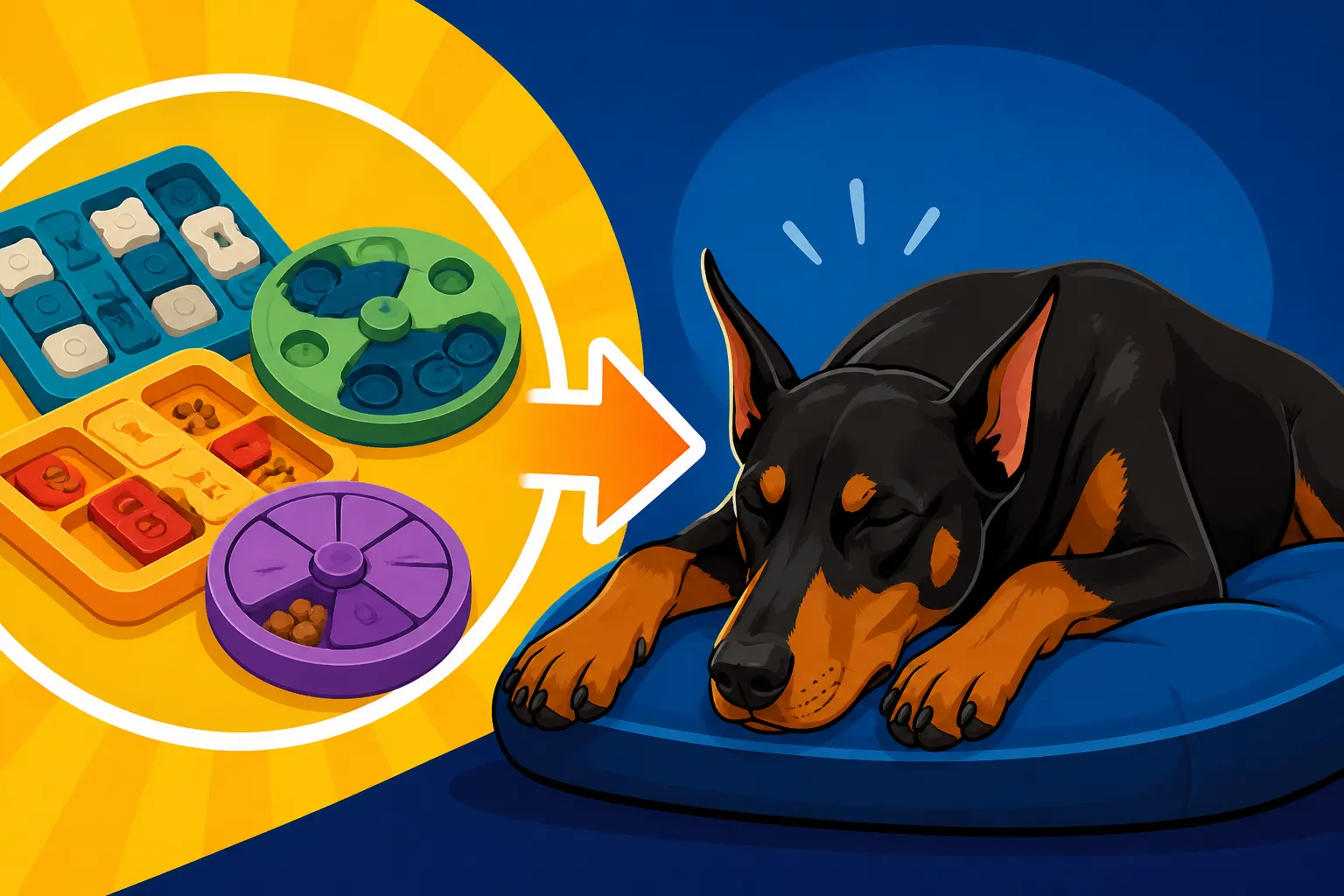
How do you know if your Doberman is truly mentally tired versus just physically exhausted? A physically tired Doberman might flop down, pant, and nap soundly. A mentally tired Doberman will also rest, but with a palpable sense of contentment. Their eyes might be softer, their body language more relaxed, and they'll be less likely to seek out trouble or demand constant attention shortly after. They might even just stare blankly at a wall for a moment, processing, much like we do after a challenging mental task.
Conversely, a Doberman that has just had a lot of physical exercise but no mental stimulation might still pace, follow you relentlessly, or quickly become restless once they've caught their breath. They might start "herding" you around the house or nudging you for attention, even if their legs are weary. This distinction is crucial for effective Doberman ownership. True mental fatigue helps promote a calmer, more settled dog within the home, a dog that can actually relax when it’s time to settle down.
Engaging Their Minds: Puzzle Categories That Work
To truly tire a Doberman, you need to go beyond the basic. We're talking about puzzles that involve multiple steps, require memory, and engage their incredible sense of smell. These aren't just toys; they're tools for cognitive development and emotional satisfaction. The key is to find activities that keep them guessing and learning, rather than just repeating a known action.
Advanced Foraging and Snuffle Mat Challenges
While basic snuffle mats are great, for a Doberman, you need to elevate the game. Instead of just sprinkling kibble, try hiding higher-value treats deep within the fabric folds, or even burying them under other toys placed on the snuffle mat. You can also layer the challenge by putting the snuffle mat inside a larger box, or under a light blanket, requiring them to remove obstacles before they even get to the scent work. This adds a sequential element that transforms a simple sniff into a multi-step investigation.
Consider making your own advanced snuffle blankets from old fleece fabric and a rubber mat with holes, or look for commercially robust options on platforms like Amazon that feature deeper pockets or more intricate designs. Nose Work as a Low-Impact Doberman Sport explains why scent work is so incredibly tiring and rewarding for dogs, and snuffle mats are a fantastic entry point. The act of sniffing intensely and systematically searching for food is profoundly fatiguing for a dog, tapping into their primal instincts and providing immense satisfaction.
Interactive Toys Requiring Sequential Steps
This is where the real mental heavy lifting comes in. Dobermans thrive on puzzles that demand a series of actions to achieve a reward. Think about toys where they have to lift a peg, then slide a cover, then push a lever. Brands like Nina Ottosson offer excellent examples of these multi-stage puzzles. Start with a simpler version, and once your Doberman masters it, move up in complexity. The joy of watching their brain click as they figure out the next step is incredibly rewarding.
These types of puzzles require memory, planning, and persistence. Your Doberman has to remember which actions lead to a result, anticipate the next step, and maintain focus until the reward is achieved. Some of these puzzles can be quite expensive, but they are often well worth the investment for the sustained mental stimulation they provide. Look for durable options made from wood or tough plastic, as a Doberman's powerful jaws can quickly dismantle lesser toys. You might even find some creative ones on Amazon from smaller, specialized brands.
DIY and Homemade Brain Games
You don't always need to spend a fortune on fancy toys. Your Doberman's sharp mind can be challenged with everyday items. Here are a few ideas:
- Towel Roll-Up: Spread some kibble or treats on a towel, roll it up tightly, and tie a loose knot. Your Doberman has to unroll and untie it to get the food. Increase difficulty by using multiple knots or wrapping it around something.
- Muffin Tin Game: Place treats in some of the cups of a muffin tin, then cover all the cups with tennis balls or other small, sturdy toys. Your Doberman needs to remove the balls to find the treats.
- Box and Bottle Puzzle: Cut holes in a cardboard box, insert empty plastic bottles (water bottles work well), and place treats inside the bottles. Your Doberman has to knock the bottles over and manipulate them to get the treats out.
These homemade puzzles are fantastic because you can easily adjust the difficulty. They also encourage creative problem-solving and can be changed up frequently to prevent boredom. The cost is minimal, and the reward for your Doberman is immense. Plus, it's a great way to repurpose items you already have around the house. Just ensure any materials used are safe and non-toxic for your dog.
Integrating Puzzle Work into Your Daily Routine
Puzzle work shouldn't be a sporadic activity; for a Doberman, it needs to be a consistent part of their day. Just like physical exercise, mental exercise requires regularity to maintain cognitive fitness and prevent behavioral issues from bubbling up. Think of it as intellectual homework for your very smart dog.
Setting Up a "Puzzle Station"
Designate a specific area in your home as your Doberman's "puzzle station." This could be a corner of a room, a large mat, or even their crate. Having a dedicated space helps them understand that when they go there, it's time for focused mental work. Keep their puzzle toys stored neatly in a basket or bin nearby. This makes it easy for you to grab a puzzle when you have a few minutes, and it cues your Doberman that an engaging activity is coming.
A puzzle station is particularly useful during times when you need your Doberman to settle independently, such as when you're working from home, making dinner, or even just trying to enjoy a quiet cup of coffee. It teaches them to engage their minds constructively rather than constantly demanding your attention. This kind of independent enrichment can be a lifesaver for busy households and helps prevent the "Velcro Doberman" from becoming overly dependent.
Balancing Physical Exercise with Mental Engagement
It's a common misconception that exhausting a Doberman physically is enough. While physical exercise is absolutely crucial, it’s only half the battle. A truly content Doberman is one that is both physically and mentally drained. Imagine running a marathon and then being asked to solve complex equations right after; you'd be physically tired but your brain would still be active. Dobermans are the same.
The ideal routine for a Doberman often involves a good morning walk or run, followed by a period of mental engagement, such as a puzzle toy, during their rest time. In the afternoon, another burst of physical activity might be paired with some training sessions – Five-Minute Sessions With a Young Doberman can really capitalize on their quick learning. Finally, an evening puzzle or chew can help wind them down. This balance ensures all aspects of their working dog heritage are satisfied, leading to a much more relaxed and well-adjusted companion.
Making Training a Puzzle Itself
Don't underestimate the power of training as a form of puzzle work. Dobermans absolutely thrive on learning and problem-solving through obedience and advanced tricks. Instead of just drilling commands, turn your training sessions into a game. Hide-and-seek with a favorite toy, teaching complex sequences of commands, or even teaching them to fetch specific items by name – these are all mental puzzles that build their intelligence and strengthen your bond.
Structured training programs, even online ones like those offered by BAXTER & Bella, often incorporate creative mental enrichment ideas that go beyond basic sit and stay. They can guide you through a progression of challenges that keep your Doberman engaged and thinking. Teaching new tricks, perfecting advanced obedience, or even delving into The Working Sports a Doberman Was Built For like competitive obedience or rally are all excellent ways to make their minds work hard. For a Doberman, learning is deeply satisfying, and they will work tirelessly for the right Rewards a Doberman Will Work For.
Here's a quick comparison of some puzzle types to consider:
| Puzzle Type | Description | Difficulty (Doberman) | Primary Skills Engaged | Pros | Cons |
|---|---|---|---|---|---|
| Snuffle Mat (Advanced) | Hiding treats deep in fabric, layering with objects, or putting in boxes. | Medium to High | Scent work, fine motor skills | Highly mentally tiring, good for all ages, can be DIY. | Can be messy, needs supervision for chewing. |
| Interactive Slider/Flap | Requires sliding panels or lifting flaps to reveal treats. | Medium | Problem-solving, paw dexterity | Engaging, reusable, clear progression in difficulty. | Some Dobermans solve quickly, can be destroyed if not durable. |
| Multi-Step Dispenser | Involves a sequence of actions (e.g., push, then pull, then drop). | High | Sequential logic, memory | Very stimulating, long-lasting engagement, builds persistence. | Can be expensive, may require initial guidance, some are not robust. |
| DIY Box/Bottle Puzzle | Treats hidden in bottles within a box, requiring manipulation. | Medium to High | Spatial reasoning, dexterity | Cost-effective, easily varied, can be made from household items. | Not as durable, constant supervision needed, can be messy. |
| Training Games | Hide-and-seek, named object retrieval, complex trick chains. | High | Cognitive recall, obedience | Builds bond, no equipment needed, highly adaptable. | Requires active owner participation, consistent effort. |
Troubleshooting and Taking It to the Next Level
Even with the best intentions, puzzle work can present its own set of challenges. Dobermans are quick learners, and what was once a brain-bender can quickly become routine. The goal is to keep them on their mental toes, continually presenting new and evolving challenges.
When Your Doberman Solves Everything Too Quickly
It’s a frustrating but familiar experience: you introduce a new, expensive puzzle toy, convinced this will be the one, only for your Doberman to dismantle its secrets in mere minutes. They might look at you with that all-too-familiar expression, as if to say, "Next!" This isn't a sign of failure on your part, but rather a testament to their incredible intelligence and problem-solving abilities. When this happens, it's time to adjust your approach rather than give up.
One strategy is to immediately increase the difficulty. If a toy has adjustable settings, max them out. If it’s a manual puzzle, add more steps or make the steps less obvious. For example, instead of just sliding a panel, perhaps the panel needs to be wiggled before it slides. Another tactic is to introduce variations. If they’ve mastered one type of sliding puzzle, get one that involves lifting pieces instead. Rotate toys regularly so they don't get bored of the same mechanisms. Remember, A Doberman That Learns Your Routine Too Well will get bored easily, so variety is key.
Keeping It Fresh and Challenging
The secret to long-term success with puzzle work for a Doberman lies in novelty and progressive challenge. Just like we wouldn't want to do the same crossword puzzle every single day, our Dobermans need new intellectual stimulation. This doesn't mean you need to buy a new toy every week, but rather that you need a diverse "library" of puzzles that you can rotate through. Introduce a new puzzle toy once a month or every few weeks, and keep older ones in rotation.
Think about how you present the puzzles too. Sometimes, simply changing the location where the puzzle is solved can add a new layer of complexity. Trying a familiar puzzle outdoors, with new scents and distractions, or in a different room can make it feel fresh. You can also vary the type of treats used, making some sessions higher reward than others. The goal is to always be one step ahead of your Doberman's brilliant mind, ensuring they never quite know what to expect. This continuous mental engagement prevents them from becoming Whether a Doberman Gets Bored of Repetition.
Combining Puzzle Work with Obedience and Scent Training
To truly maximize the mental workout, blend puzzle work with formal obedience and advanced scent training. For example, before you present a puzzle, make your Doberman perform a series of obedience commands like "sit," "stay," "down," and "wait" for an extended period. This adds impulse control and builds anticipation, making the eventual solving of the puzzle even more rewarding. It's not just about the puzzle; it's about the entire process.
Integrating advanced scent work, like that taught in Nose Work as a Low-Impact Doberman Sport, can also elevate puzzle play. Hide puzzle toys in different rooms or even outdoors, and have your Doberman track them down using their nose before they even begin to solve the puzzle itself. This combination of seeking, then solving, is incredibly taxing on their mental faculties and physical senses. Programs like BAXTER & Bella can offer insights into how to weave these different elements into a cohesive training and enrichment plan, helping you unlock your Doberman's full potential.
Disclaimer
This article is for general informational purposes only and does not constitute professional advice. Laws, prices and regulations vary by location and change over time. Consult a qualified professional for guidance on your specific situation.