Whether a Doberman Whale Eye Means Trouble
Many Doberman owners, or those considering bringing one into their home, often find themselves perplexed and even a little anxious when their Doberman's eyes suddenly flash the whites, a phenomenon commonly known as "whale eye." This distinct visual cue can be startling and is frequently misinterpreted, leading to unnecessary worry or, worse, missed signals. This comprehensive guide aims to demystify what Doberman whale eye truly means, separating myth from reality, and equipping you with the knowledge to accurately interpret your Doberman's unique signals so you can respond appropriately.
Understanding Doberman "Whale Eye" – What Is It, Really?
The term "whale eye" is quite descriptive, referring to the moment a dog turns its head away from something but keeps its eyes fixed on it, revealing the whites of the eyes, known as the sclera. It can look a bit like a whale's eye peeking out from the water, hence the name. For Doberman owners, this visual can be particularly unnerving because Dobermans naturally have a very intense and direct gaze, often leading people to misinterpret any deviation from that as a sign of impending trouble.
The Visual Cue of Sclera Exposure
When we talk about whale eye, we're specifically referring to seeing the crescent of white sclera, typically at the inner or outer corners of your Doberman's eyes, or sometimes even a full ring around the iris. This isn't just about their eyes being open wide; it's about the deliberate rotation of the eyeball within the socket to maintain focus on something while the head, and often the body, is angled away. It’s a subtle shift that can speak volumes if you know what you’re looking for.
In a breed like the Doberman, known for its deep, alert, and often almond-shaped eyes, the appearance of whale eye stands out starkly. Their typical expression is one of focus and intelligence, so when the whites of their eyes become visible, it’s a strong indicator that something in their environment or emotional state has shifted. It’s not necessarily a negative shift, but it’s always a signal to pay closer attention. While some breeds naturally show more sclera, in Dobermans, it’s generally a signpost that merits investigation.
Common Triggers for Whale Eye
Whale eye isn't a singular signal with a singular meaning. Instead, it's a visual cue that can be triggered by a range of emotional states and situations. Understanding these common triggers is the first step toward accurate interpretation:
- Stress or Anxiety: This is perhaps the most common reason. Your Doberman might be feeling trapped, overwhelmed by a situation, or anticipating something unpleasant. Imagine your Doberman cornered by an overzealous child or a strange dog, and they can't easily move away. The whale eye might be their way of saying, "I'm uncomfortable, but I can't escape."
- Submissive or Appeasing Gestures: Sometimes, whale eye can be part of a larger appeasement display, where your Doberman is trying to signal to another dog or person that they mean no harm. It might be coupled with a lowered head, a soft yawn, or lip licking. They're trying to de-escalate.
- Resource Guarding: If your Doberman is protecting a prized chew toy, their food bowl, or even their favorite spot on the couch, you might see whale eye as you approach. They are subtly communicating, "This is mine, and I'm watching you." This is a significant trigger to be aware of and respect.
- Surprise or Startle: A sudden, unexpected noise, a new person appearing around a corner, or even an abrupt movement can cause your Doberman to quickly turn its head away while its eyes remain locked on the startling stimulus. This is a reflexive response to assess a potential threat.
- Discomfort or Pain: Sometimes, whale eye can be a very subtle indicator that your Doberman isn't feeling well or is experiencing discomfort. If it's accompanied by other unusual behaviors like lethargy, changes in appetite, or a reluctance to be touched, it's wise to consider a vet visit.
- Extreme Focus: Less common but still possible, a Doberman might show a bit of whale eye when they are intensely focused on a high-value item, like a treat being held just out of reach, or a squirrel dashing up a tree. In these cases, it's often more about tracking movement than emotional distress, but still indicates an elevated state of attention.
Recognizing these triggers helps you move beyond just seeing the white of the eye and start understanding the underlying emotion or intent behind it.
Is Doberman Whale Eye Always a Warning Sign of Aggression?
The quick answer is no, not always. While whale eye can be a component of a warning display, particularly in situations of resource guarding or feeling threatened, it is not inherently a sign of an aggressive dog. It’s crucial to understand the nuances to avoid misinterpreting your Doberman’s signals.
Separating Fear from Threat
Many people equate any sign of discomfort in a powerful breed like a Doberman with aggression, but this is a critical misunderstanding. Often, whale eye stems from fear, anxiety, or feeling cornered rather than an active desire to attack. A Doberman displaying whale eye is often communicating, "I'm worried," "I'm uncomfortable," or "Please give me space," rather than making an offensive move.
Think of it this way: a truly confident, offensively aggressive dog might stare you down, body rigid and forward-leaning, with a direct, hard gaze. A Doberman showing whale eye is often trying to avoid a direct confrontation by turning its head away, while still keeping a wary eye on the perceived threat. If a Doberman is pushed past its comfort zone when displaying these fearful signals, it might resort to snapping or biting, but this is often a defensive reaction born out of fear, not a pre-meditated attack. It highlights how important it is to respect your Doberman’s boundaries and recognize when they are telling you they are stressed. Why Yelling Shuts a Doberman Down can be particularly detrimental to a Doberman already feeling insecure, as it further erodes trust and escalates their anxiety.
Benign Explanations for Showing Whites
While whale eye demands attention, it’s important to remember that not every flash of white means trouble. There are several benign reasons why you might see the whites of your Doberman's eyes:
- Positional Whale Eye: Sometimes, it’s simply a matter of geometry. If your Doberman is lying down and casually looking sharply to the side at something, their head might be still while their eyes move to their maximum range, revealing a sliver of white. This isn't associated with stress but rather with the mechanics of their vision.
- Playful Goofiness: Dobermans can be incredibly silly and playful, especially when they’re wound up during a game. In the throes of a chase or a wrestling match with a favorite toy, they might roll their eyes in a way that exposes some sclera. This is usually accompanied by a loose, wiggly body, open mouth, and general signs of enjoyment, not stress.
- Drowsiness or Fatigue: Just like humans, a very sleepy Doberman might show a bit of whale eye as their eyelids droop, or their eyes roll back slightly before closing completely. If they're in a relaxed state, comfortable, and perhaps just waking up or drifting off, this isn't a concern.
- Sudden Shift in Attention: Occasionally, a Doberman might quickly shift its focus from one object to another without turning its head, causing a momentary flash of white. This is distinct from the sustained, anxious whale eye.
The key takeaway here is that context is absolutely everything. Don't fixate on just the eyes. Instead, learn to read the entire body language ensemble. What Cropped Ears Hide About a Doberman's Mood can be particularly challenging, as the natural ear position offers many cues about a dog's emotional state. Without them, you must rely even more heavily on other signals like the eyes, mouth, and tail.
Decoding Your Doberman's Full Body Language Ensemble
Understanding "whale eye" in isolation is only part of the puzzle. To truly know what your Doberman is communicating, you need to observe their entire body language. Dogs are masters of non-verbal communication, and their signals are rarely singular; they're usually a symphony of cues working together.
Beyond the Eyes: Head, Ears, Mouth, and Tail
When you see whale eye, immediately scan the rest of your Doberman's body for corroborating signals. These pieces of information, when put together, paint a far more accurate picture:
- Head Position: Is their head lowered and averted, suggesting submission or a desire to avoid conflict? Or is it held rigid, perhaps slightly lowered, but with an intense focus, which can indicate guarding or a more serious warning? A Doberman that pushes its head between two people might be seeking attention or feeling anxious about the interaction.
- Ears: Even with cropped ears, you can often discern if they are pinned tightly back against the head (fear, anxiety), flicking nervously (uncertainty), or relaxed and neutral (comfort). For uncropped Dobermans, the ears are an even clearer indicator, drooping or pulled back significantly when stressed.
- Mouth: A tightly closed mouth, pulled-back lips, or excessive lip-licking (which can be a stress signal, not just about food) all point to discomfort. Yawning, when not genuinely sleepy, is also a classic sign of stress. If you see teeth, whether a subtle curl of the lip or a full baring of the fangs, coupled with whale eye, you are in serious warning territory.
- Tail: A tucked tail pressed firmly against the belly is a strong indicator of fear or submission. A tail held stiffly and high, with minimal movement, often indicates arousal or a challenge. A relaxed, low-slung tail with a gentle wag is usually a sign of comfort and ease. Remember, not all wags are happy wags; a stiff, high-speed, low-amplitude wag can also signal tension.
- Overall Posture: Is your Doberman's body stiff, rigid, and leaning away? Are their hackles raised along their back? Or are they soft, fluid, and relaxed? A Doberman that is A Doberman That Stiffens Before It Growls is giving a very clear signal that their tolerance is at its limit. Conversely, if your Doberman is A Doberman That Leans on You Constantly, they are likely seeking comfort and reassurance, often a sign of their strong bond.
Consider this hypothetical: your Doberman is chewing a bone. You walk by, and you see a subtle whale eye. If that's accompanied by a slightly lowered head, a stiff body, and a cessation of chewing, it's a clear "don't come closer." If, however, they just happened to turn their head sharply to watch you but their body remains relaxed and their tail gives a little thump, it's likely benign.
Context is King: Reading the Situation
No single body language cue, including whale eye, should ever be interpreted outside of its context. Always ask yourself:
- What is happening in the environment? Is there a loud noise, a new person or animal, or a sudden change?
- Who is present? Is it a familiar family member, a stranger, or another dog?
- What was happening immediately before the whale eye appeared? Did you reach for something, make a sudden movement, or try to take something away?
- What is your Doberman's general temperament and history? A Doberman with a history of anxiety or reactivity will display signals differently than a generally confident one. The Doberman Temperament as the Standard Describes It emphasizes their fearless and alert nature, but this also means they can be highly sensitive to perceived threats.
For instance, a Doberman showing whale eye when a small child approaches its food bowl is a very different scenario from a Doberman showing whale eye when you playfully jostle them. One is a potential warning about resource guarding; the other might be momentary surprise during play. Understanding the nuances comes with observation and experience. Online resources, like the puppy school offered by BAXTER & Bella, can be invaluable in teaching you how to build a confident Doberman puppy through early socialization and positive exposure to various scenarios, minimizing the likelihood of stress-induced whale eye later in life. Their programs can help you learn to read these signals from the very beginning.
Taking Action Based on Interpretation
Once you've interpreted the full body language and context, you can decide on the appropriate action:
- If Benign: If the whale eye is purely positional, playful, or due to momentary focus without other stress signals, no action is usually needed other than continuing to observe.
- If Fear/Stress-Related: Your primary goal should be to remove the trigger or remove your Doberman from the stressful situation. Create space. If it’s a person, politely ask them to give your dog room. If it’s an object, calmly move your Doberman away. Never force interaction.
- If Guarding-Related: Manage the environment to prevent conflict. This might mean giving your Doberman high-value items only in their crate, separating them from other pets or children when they have chews, or teaching a reliable "leave it" cue. Respect their warning and don't challenge them.
Being proactive and preventing situations that cause stress and whale eye is always better than reacting after the fact. Learning to read Spotting the Moment a Doberman Is Uncomfortable early allows you to intervene before the situation escalates.
| Body Language Cue Combination | Benign Interpretation (Likely) | Concerning Interpretation (High Concern) | Action Needed (General Guidance) |
|---|---|---|---|
| Whale Eye Alone | Looking far to side, playful glance during zoomies, momentary surprise. | Sustained, stiff focus; guarding a resource, fear. | Observe carefully. If stiff, create space. |
| Whale Eye + Lip Lick/Yawn | Mild uncertainty, slight discomfort (e.g., at vet). | Increasing anxiety, likely to avoid confrontation. | Remove stressor/dog from situation. Redirect focus with calm activities. |
| Whale Eye + Tucked Tail | Fear, submission in a non-threatening context. | Significant fear, feeling trapped, potential defensive snap. | Calmly and gently remove dog from situation, provide safe space. |
| Whale Eye + Stiff Body | Mild discomfort, uncertainty, assessing new situation. | Imminent warning, heightened guarding, potential lunge/snap. | Immediately create distance, de-escalate, do not push. Seek professional help if repeated. |
| Whale Eye + Growl | Warning signal, typically associated with resource guarding. | Active threat, severe discomfort, likely to bite. | Safely remove dog/resource, do not challenge. Seek immediate professional behaviorist intervention. |
When to Seek Professional Guidance for Doberman Whale Eye
It’s one thing to interpret your Doberman's whale eye in everyday scenarios, but it’s another when the signals become persistent, intense, or concerning. Knowing when to call in the experts is vital for your Doberman's well-being and the safety of everyone around them.
Red Flags for Concern
While many instances of whale eye are benign or a mild signal of discomfort, there are definite red flags that indicate a need for professional intervention:
- Escalated Warning Signals: If whale eye is consistently accompanied by more overt warning signs like growling, snapping, baring teeth, a stiff forward-leaning posture, or even lunging, it’s a serious indicator that your Doberman is struggling and feels the need to defend itself.
- Sudden Onset or Increase: A sudden increase in the frequency or intensity of whale eye, especially in situations where your Doberman previously seemed comfortable, is a cause for concern. This could signal underlying pain, anxiety, or a shift in temperament. Whether Pain Explains a Doberman's Behavior Change is a crucial consideration, as physical discomfort can drastically alter a dog's behavior.
- Inappropriate Targets: If your Doberman starts displaying whale eye towards familiar family members, particularly children, or in otherwise mundane and non-threatening situations, it suggests a deeper behavioral issue that needs addressing.
- Lack of Resolution: If you consistently remove the trigger or try to de-escalate, but your Doberman continues to display whale eye and related stress signals, their anxiety is likely chronic and requires a more structured approach.
Consulting a Qualified Professional
When you observe these red flags, it's time to reach out to a professional. Not all dog trainers are created equal, and for a breed as sensitive and intelligent as the Doberman, choosing the right professional is paramount.
- Certified Professional Dog Trainer (CPDT-KA): A good starting point for general behavioral issues. Look for someone who emphasizes positive reinforcement and force-free methods. They can help you understand your Doberman's communication and implement behavior modification plans.
- Veterinary Behaviorist (Dip ACVB): For more severe or complex cases, especially those involving aggression, intense fear, or if you suspect an underlying medical component to the behavior, a veterinary behaviorist is the gold standard. They are veterinarians who have specialized in animal behavior and can prescribe medication if necessary, working in conjunction with behavior modification.
It is absolutely crucial to avoid trainers who advocate for harsh or aversive methods, such as shock collars (e-collars), prong collars, or intimidation. Whether an E-Collar Belongs on a Doberman is a question with a resounding "no" from most modern, ethical trainers and behaviorists, especially for sensitive Dobermans. These methods don't address the underlying fear or anxiety; they merely suppress the outward behavior, often making the dog more anxious, resentful, and potentially more dangerous if their warning signals are punished away. Rebuilding trust with a dog that has been harshly handled is a long and challenging road.
A professional will observe your Doberman, assess the specific triggers for their whale eye, and develop a tailored plan. They might recommend specific tools or environmental management strategies, many of which can be found readily. For example, a quality no-pull harness or a long line for safe outdoor exploration can be found on Amazon, as can books on canine body language or calming puzzle toys.
Preventative Measures and Ongoing Training
The best approach to managing and minimizing stress-induced whale eye is through proactive care and consistent, positive training:
- Consistent Positive Reinforcement Training: Start early and keep it up. A well-trained Doberman is a confident Doberman. Focus on building a strong foundation of trust and clear communication. The Sixteen Weeks That Set a Doberman Up are crucial for shaping a Doberman's temperament and confidence.
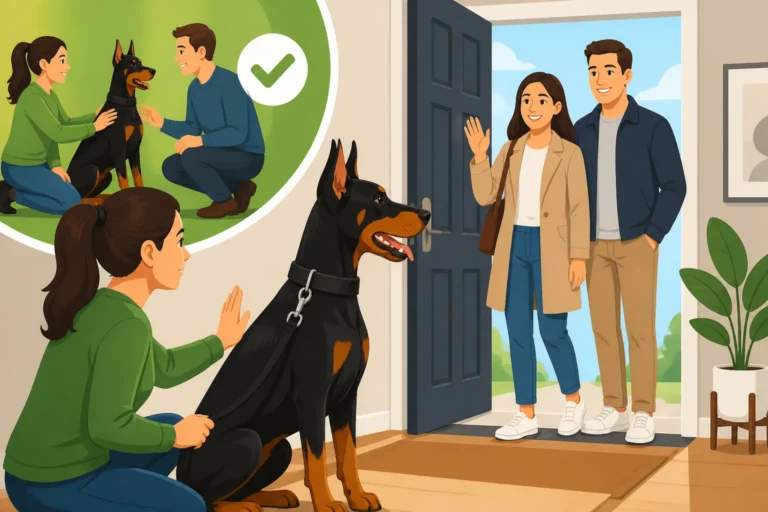
- Ongoing Socialization: Even adult Dobermans benefit from controlled, positive exposure to new sights, sounds, people, and appropriate dog interactions. This helps them build resilience and cope with novel situations without becoming overwhelmed.
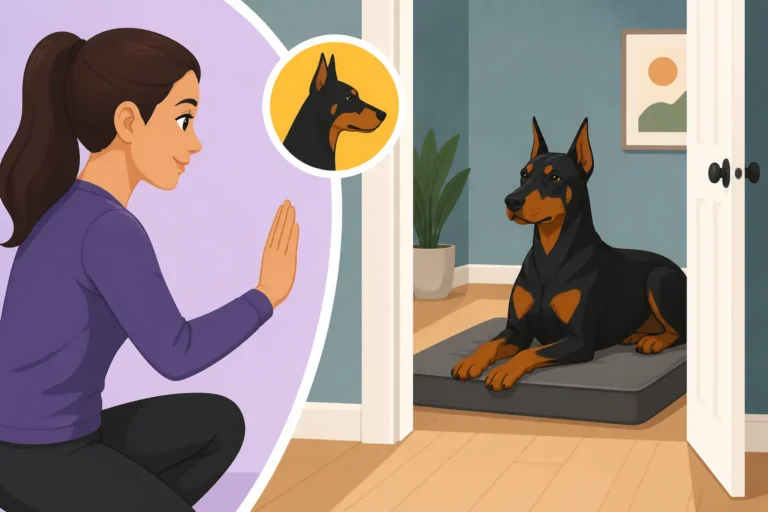
- Safe Retreat Zones: Ensure your Doberman always has a quiet, comfortable place to retreat to when they feel overwhelmed. Their crate or a special bed in a low-traffic area can be their sanctuary.
- Adequate Mental and Physical Exercise: Dobermans are intelligent, high-energy dogs. A bored or under-exercised Doberman is a stressed Doberman. Engage them with activities like obedience, agility, nose work, or Puzzle Work That Actually Tires a Doberman. Physical and mental stimulation can significantly reduce overall anxiety levels.
- Regular Vet Check-ups: Ensure your Doberman has regular veterinary examinations to rule out any underlying medical conditions that might be contributing to behavioral changes or discomfort.
- Learn More: Continuously educating yourself on canine body language is perhaps one of the most powerful tools an owner can have. Many excellent books and online courses are available that delve deeply into understanding dog communication. Searching on Amazon for books by renowned behaviorists like Patricia McConnell or Turid Rugaas can provide invaluable insights into nuanced canine signals.
By understanding what Doberman whale eye means in context and taking appropriate action, you can foster a safer, happier, and more harmonious relationship with your noble companion.
Disclaimer
This article is for general informational purposes only and does not constitute professional advice. Laws, prices and regulations vary by location and change over time. Consult a qualified professional for guidance on your specific situation.