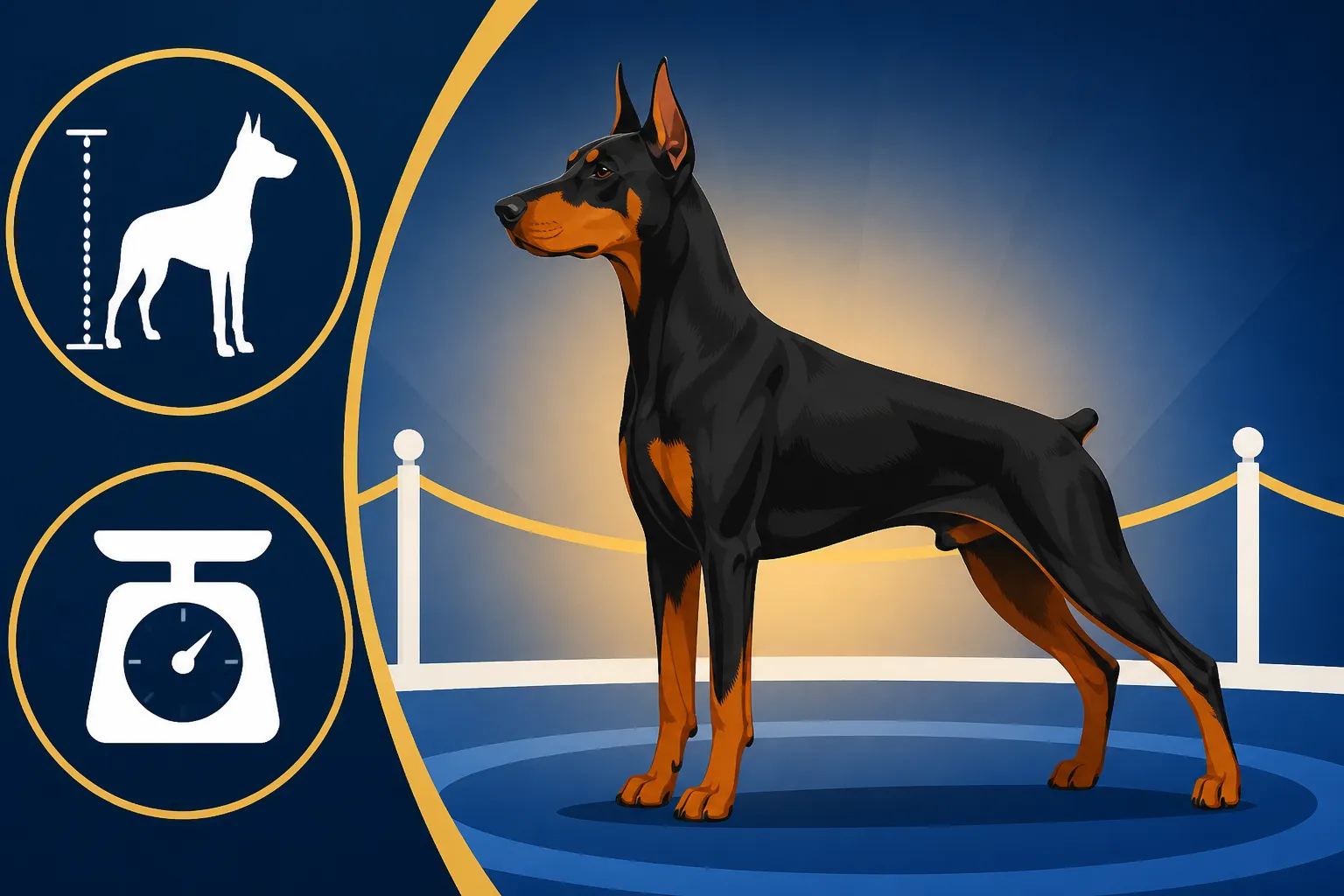
Doberman Height and Weight in the Ring
It’s easy to look at a majestic Doberman Pinscher and think you know what "perfect" looks like, but when it comes to the show ring, judges are looking for very specific characteristics beyond just an impressive presence. Many owners are genuinely perplexed by how height and weight are assessed, especially when their beloved Dobe looks perfectly healthy to them. This guide will demystify the official breed standard, helping you understand precisely what makes for an ideal Doberman physique in competitive exhibition.
Understanding the AKC Doberman Standard for Size
When you hear people talk about "the standard," they're referring to the breed standard set forth by the American Kennel Club (AKC) and interpreted by the parent club, the Doberman Pinscher Club of America (DPCA). This isn't just some arbitrary set of rules; it's a blueprint designed to preserve the original purpose, health, and temperament of the Doberman Pinscher. Every aspect, from ear set to tail length (or lack thereof), and yes, critically, height and weight, is described in detail. For someone new to the world of Dobermans, or even a seasoned owner simply curious, diving into the standard can feel like reading legal jargon. But trust me, once you break it down, it makes a lot of sense. It provides a common goal for breeders and a consistent yardstick for judges, ensuring that Dobermans remain true to their heritage.
The Doberman Pinscher Club of America's Role
The Doberman Pinscher Club of America is the official national breed club for the Doberman Pinscher in the United States, recognized by the AKC. Their role is absolutely pivotal in maintaining the integrity of the breed standard. They don't just write it; they review it periodically, educate members and the public, and strive to ensure that breeding practices align with the ideal Doberman. Think of them as the custodians of the breed's future. For exhibitors, understanding the DPCA's interpretation of the standard is paramount because these are the guidelines judges use when evaluating dogs in the ring. A breeder who truly cares about the breed will be deeply familiar with this document and work tirelessly to produce dogs that conform as closely as possible, both in health and conformation. It’s not about ego; it’s about responsible breeding.
Why the Standard Matters for Breeders and Exhibitors
For a breeder, the standard is their compass. It guides every breeding decision, from selecting parent dogs for their lineage and health clearances to assessing a litter of puppies. Their goal is to produce Dobermans that are sound in mind and body, and that physically embody the breed's distinct characteristics. If a breeder consistently produces dogs that deviate significantly from the standard, they're not really preserving the Doberman Pinscher as it's meant to be.
For exhibitors, mastering the nuances of the standard is essential for success in the show ring. Judges are looking for how well a dog matches this ideal. It’s not just about having a pretty dog; it’s about having a dog whose structure, movement, and overall appearance scream "Doberman Pinscher" in every detail. If your Dobe is too tall, too short, too heavy, or too light, it's not just a minor flaw; it can be a disqualification or a significant fault that prevents them from winning. This is why you see dedicated exhibitors meticulously preparing their dogs, ensuring they are in peak condition, from their gleaming coat to their toned physique. They understand that every inch and every pound is under scrutiny. The Doberman the AKC Standard Describes covers this in more detail, outlining the full scope of what's expected.
Dissecting the Ideal Height for a Doberman
The Doberman Pinscher is a medium-large breed, and its height is a crucial aspect of its overall "type." The standard specifies a very precise range, and stepping outside those boundaries, even by a hair, can be a major fault in the show ring. It's not about how tall you think your Doberman should be, but how tall the standard says it should be. This isn't just for aesthetics; proper height contributes to the Doberman's athletic ability, balance, and characteristic elegant silhouette. A Doberman that is too tall might appear leggy and unbalanced, while one that is too short might seem stocky or heavy, losing that refined appearance the breed is known for.
The Specific Inches for Males and Females
The AKC breed standard clearly defines the height for Doberman Pinschers:
- Males: 26 to 28 inches at the withers (the highest point of the shoulder blades). The ideal is generally considered to be closer to 27 ½ inches.
- Females: 24 to 26 inches at the withers. The ideal is generally closer to 25 ½ inches.
This isn't a suggestion; it's a strict requirement. A male Doberman standing 28.5 inches tall, for example, would be considered over the standard, and this could easily lead to him being overlooked in the ring, regardless of how beautiful he might otherwise be. The same goes for a female measuring 23.5 inches; she'd be faulted for being too small. This precision might seem a bit extreme to a pet owner, but in the competitive world of dog shows, these details define perfection. It’s a fine line to walk, and it takes generations of careful breeding to consistently produce Dobermans within these tight ranges.
How Height Is Measured in the Show Ring
Measuring a Doberman's height in the show ring isn't as simple as standing them next to a ruler. It requires a specific tool, typically a wicket (a type of measuring stick with a crossbar), and a very precise technique. The dog must stand squarely on all fours, with its head held naturally, not stretched up or ducked down. The measurement is taken at the highest point of the withers, directly above the front legs, ensuring the dog is not slumping or hunching. Judges are experienced at this and can often eyeball a dog's height very accurately, but formal measurements can be taken if there's any doubt, especially for dogs on the cusp of the standard's limits.
Imagine a handler meticulously posing their Doberman, trying to get that perfect stack that shows off its conformation. Every slight adjustment can affect the perceived height. It's a skill that handlers practice endlessly, not to cheat the system, but to present their dog in the best possible light, allowing the judge to assess its true structure. This level of detail highlights the seriousness with which the breed standard is approached in the show world.
The Impact of Being Over or Under Height
Being outside the specified height range is considered a "disqualification" in some breeds, or a "serious fault" in others, including the Doberman. For a Doberman, being over or under height is a fault that will significantly penalize the dog. This means that a Doberman that is otherwise excellent in every other aspect of conformation—perfect head, amazing gait, superb temperament—will likely not win if it falls outside the acceptable height.
For example, a gorgeous male Doberman who is just a quarter-inch over 28 inches might not be considered for Best of Breed, even if he's undeniably handsome. This can be heartbreaking for owners and breeders who have poured countless resources into their dogs, but it underscores the breed's commitment to maintaining its defined type. It means judges are always looking for that ideal, well-balanced individual, rather than just the biggest or smallest Doberman in the ring. It’s a crucial differentiator when you're thinking about The Doberman Faults a Judge Cannot Overlook.
Gauging the Correct Weight for a Show Doberman
Unlike height, the AKC Doberman standard doesn't give specific weight ranges in pounds or kilograms. Instead, it describes the impression of weight: "Weight and size must be in proportion to give an appearance of a dog of great endurance and speed." This might sound vague, but it's actually quite precise when you understand what judges are looking for. It means a Doberman should be powerfully built but never bulky, muscular but not fat, and athletic without being spindly. The ideal Doberman in the ring should look like it could work all day, displaying both strength and agility.
Defining "Ideal" Lean Musculature
An ideal show Doberman will have a lean, athletic build with well-defined musculature. You should be able to easily feel their ribs beneath a thin layer of fat, but not see them protruding sharply. Their waist should be evident when viewed from above, and there should be a distinct tuck-up behind the ribs when viewed from the side. This lean condition allows the dog to move freely and powerfully, showcasing the elegant and efficient gait that is so important to the breed.
Think of it like a human athlete—a marathon runner or a sprinter, not a sumo wrestler. They are powerful, but their power comes from sculpted muscle, not excess fat. This level of conditioning requires a careful balance of diet and exercise. Many owners rely on high-quality foods, often found on places like Chewy, to ensure their Doberman is getting the right nutrients without excessive calories. It's a fine line to walk, and it's easy to get wrong.
Visual Cues for Proper Conditioning
To visually assess a Doberman's conditioning, judges look for several key indicators. Beyond the visible waist and tuck-up, they observe the definition of the muscles over the hindquarters and shoulders. When the dog moves, the muscles should ripple under the skin. The coat should be tight, short, and gleaming, indicating good health and proper nutrition.
A Doberman that is overweight will often have a less defined waist, a lack of tuck-up, and rolls of fat over the ribs or at the base of the tail. Conversely, an underweight Doberman might show ribs prominently, have poor muscle mass, and appear bony. Neither extreme is acceptable in the show ring, as both indicate a lack of proper conditioning or underlying health issues. Reading Ribs and Hip Points on a Doberman provides excellent guidance on this, offering a practical way to assess your dog's condition at home.
The Relationship Between Height and Balanced Weight
Because the standard doesn't give a specific weight number, the "correct" weight is inherently tied to the individual Doberman's height and bone structure. A taller Doberman will naturally weigh more than a shorter one, even if both are in perfect show condition. What's crucial is that the weight appears proportionate to the height and overall frame. A Doberman measuring 28 inches might weigh 85-90 pounds and look perfectly balanced, while a 26-inch Doberman might look heavy at that same weight.
This is where the judge's experienced eye comes in. They're not just looking at a number on a scale; they're evaluating the overall picture of the dog, ensuring it presents as a powerful yet agile animal. It's about kinetic energy, the impression of strength without bulk. This balance is key to understanding Whether a Doberman Is Meant to Look Thin—they should be lean, but never emaciated.
Why Structure and Proportion Trump Raw Numbers
While specific measurements are crucial, they are only one piece of the puzzle. A Doberman is judged as a complete package. Imagine building a house: you can have all the right dimensions for individual rooms, but if the foundation is weak or the overall design is awkward, the house won't stand strong or look right. The same applies to a Doberman. A dog might technically fall within the height and weight ranges, but if its angles are off, its proportions are incorrect, or its movement is inefficient, it won't be considered an ideal specimen. This is where the artistry of breeding and the judge's expertise truly come into play.
The Importance of Overall Balance and Type
The breed standard emphasizes "an elegant appearance, of proud carriage, reflecting great nobility and temperament." This isn't just fluffy language; it means every part of the Doberman must contribute to this overall impression. The head must be proportionate to the body, the neck must flow smoothly into the shoulders, the length of the body must be balanced with the length of the legs, and so on. A perfectly square build is a hallmark of the Doberman Pinscher, meaning its body length (from breastbone to buttock) should be equal to its height at the withers.
If a Doberman is too long in the body, it loses that distinctive square profile, affecting its balance and agility. If its head is too large or too small for its frame, it throws off the entire aesthetic. Judges are looking for harmony and flow, where no single feature seems out of place or exaggerated. This pursuit of balance is what defines breed type, and it’s why breeders spend so much time studying pedigrees and evaluating their dogs. Doberman Head, Eye and Expression in the Standard highlights how these elements contribute to the overall picture.
How Judges Assess the Whole Dog
Judges in the show ring use a systematic approach, but they also rely on their trained eye to assess the "whole dog." They'll observe the dog standing still (stacked) to check its structure, angles, and proportions against the standard. Then, and this is incredibly important, they'll watch the dog move (gaiting) around the ring. A Doberman's movement should be free, powerful, and effortless, covering ground efficiently. Any structural flaw that might not be obvious when the dog is standing still will often become glaringly apparent in motion.
For example, a Doberman might have the correct height, but if its shoulders are too straight, it won't have the desired reach and drive in its gait, appearing choppy or restricted. This holistic assessment is what separates a good dog from a truly outstanding one. It's about the entire picture, not just isolated measurements. The dog's attitude and confidence also play a huge role, contributing to its overall presence.
Understanding the "Square" Doberman Build
The "square" build is a defining characteristic of the Doberman Pinscher, as detailed in the AKC standard. This means the dog's body, from its prosternum (breastbone) to the rear-most point of its buttocks, should be approximately equal to its height measured from the highest point of the withers to the ground. This squareness is crucial for the Doberman's athletic prowess and distinctive silhouette. It dictates balance, agility, and the powerful, coordinated movement that the breed is famous for.
A Doberman that is significantly longer than it is tall, often referred to as "long-backed," would be considered a fault in the show ring. This isn't just an aesthetic preference; a longer back can affect spinal health, agility, and overall endurance. Conversely, a Doberman that is shorter than it is tall would appear stocky and heavy, lacking the elegance and reach expected. This square proportion is a key element that distinguishes the Doberman from many other breeds and is a fundamental aspect of its breed type. It’s also often contrasted when discussing How a European Doberman Is Built Differently, as some lines may vary.
Beyond the Tape Measure: The Overall Impression
While numbers like height are non-negotiable, the show ring is ultimately about presenting a complete and compelling picture of the ideal Doberman. This means that a Doberman's condition, temperament, and overall presence can significantly influence a judge's perception, even if the dog meets all the structural requirements. A dog that is technically perfect on paper but lacks confidence, is poorly presented, or seems out of condition will rarely win over a slightly less perfect dog that exudes presence and moves like a dream.
The Influence of Presence and Gait
A Doberman's "presence" is that intangible quality that makes a dog stand out. It's a combination of confidence, alertness, and pride in its carriage. A Doberman should enter the ring with its head held high, eyes bright, and a clear enjoyment of being there. This confident demeanor can make a good dog look great, and a great dog look phenomenal. Coupled with this is gait—the way the dog moves. The Doberman standard calls for a "free, balanced, and vigorous gait, with good reach in front and powerful drive in the rear." The dog should move as if on springs, effortlessly covering ground.
Judges spend a significant amount of time watching dogs gait because it's the ultimate test of their underlying structure. A dog with excellent angles and proportions will move efficiently and beautifully, showcasing its athleticism and endurance. Conversely, a dog with structural faults, even if subtle, will often show an awkward or restricted gait. This is why handlers spend so much time practicing gaiting their dogs, and why Doberman Gait and the Reach the Ring Wants is such a critical component of judging.
Conditioning and Presentation in the Ring
Conditioning goes beyond just weight; it encompasses the dog's overall health and fitness. A show Doberman should be in prime athletic condition, with taut skin, a glistening coat, strong nails, and clear, bright eyes. This level of conditioning doesn't happen overnight; it's the result of consistent, high-quality nutrition and a rigorous exercise regimen. Brands like Chewy offer a wide selection of premium dog foods and supplements that can help owners maintain their Doberman's optimal health and coat condition, which is vital for that show ring gleam.
Presentation also includes grooming—a clean, well-groomed Doberman always looks its best. The short, sleek coat should be free of dirt or loose hair, perhaps polished with a special mitt. Nails should be trimmed short. While Dobermans don't require elaborate grooming like some long-haired breeds, attention to these details signals to the judge that the owner takes pride in their dog and its condition.
What a Judge Looks For Beyond Raw Stats
Judges are looking for the embodiment of the breed standard. They want to see a Doberman that not only measures correctly but looks like a Doberman should. They assess the "Doberman expression"—intelligent, alert, and determined. They look for the correct neck arching smoothly into the withers, the strong back, the well-developed chest, and the proper tail set. Each feature must contribute to the overall picture of a noble, elegant, and powerful guardian.
A judge isn't just holding a tape measure; they are evaluating the dog against an ideal mental image derived from years of experience and deep understanding of the breed. They are looking for that elusive "type" that makes a Doberman instantly recognizable and distinct. It’s why some dogs, despite minor imperfections, might still captivate a judge if they possess that undeniable Doberman essence. The Doberman Neck and Topline Judges Want is another element that ties into this overall desired impression.
Common Misconceptions About Doberman Size
There are a lot of myths and misunderstandings floating around about Doberman size, especially when comparing them to other breeds or even different lines within the Doberman breed itself. These misconceptions can lead to unrealistic expectations for owners and, in some cases, unhealthy practices in breeding or feeding. It's important to clarify these points so that owners can appreciate their Doberman for what it truly is, rather than what they might mistakenly think it should be.
The "Bigger is Better" Trap
One of the most persistent myths is that "bigger is better." Many people, especially those unfamiliar with breed standards, assume that a larger, more imposing Doberman is inherently superior. They might seek out the biggest puppy in a litter or intentionally overfeed their Doberman to try and make it grow larger. This is a common trap that can actually be detrimental to the dog's health and its chances in the show ring.
As we've discussed, the Doberman standard has clear height limits. A Doberman that is significantly over-sized is not an advantage; it's a fault. Furthermore, forcing a Doberman to grow beyond its natural genetic potential through overfeeding can lead to serious health problems, including joint issues (like hip and elbow dysplasia), and can put undue strain on a developing heart. The Doberman's elegance and athleticism come from its proportionate size and lean build, not from sheer bulk. Trying to create a Doberman that resembles a small horse contradicts the very essence of the breed.
Distinguishing American vs. European Doberman Builds
Another area of frequent confusion arises from the perceived differences between American and European Doberman lines. It's true that there can be distinct differences in build, with many European lines often appearing heavier-boned, broader in the chest, and sometimes more substantial in overall musculature. This often leads people to believe that European Dobermans are inherently "bigger" than their American counterparts. While some European dogs might push the upper limits of the AKC height standard (or even exceed it in other countries' standards), the key distinction usually lies in bone structure and overall substance rather than just height.
American Dobermans, bred to the AKC standard, often present a more refined, elegant, and lighter-boned appearance, emphasizing speed and grace. European standards, such as those from the FCI (Fédération Cynologique Internationale), may permit a slightly wider range or emphasize different aspects of build, leading to a dog that appears more robust. However, both types are still very much Dobermans and share the core characteristics of the breed. It's crucial not to generalize too broadly, as there's a wide range of individual variation within both lines. Whether a Big European Doberman Is Over Standard explores this topic in more detail.
The Dangers of Over-feeding for Size
Attempting to "grow" a Doberman larger than its genetic predisposition allows by overfeeding, especially during puppyhood, carries significant health risks. Rapid growth in large breeds can contribute to skeletal problems such as osteochondrosis dissecans (OCD) and exacerbate conditions like hip or elbow dysplasia. Excess weight puts additional strain on developing joints and can lead to irreversible damage.
Beyond skeletal issues, an overweight Doberman is at a higher risk for other health problems, including heart disease (a concern in the breed anyway), diabetes, and reduced lifespan. It also compromises their athleticism and comfort, making them prone to overheating and less capable of the vigorous exercise they need. Feeding a balanced, high-quality diet appropriate for their age and activity level, rather than overfeeding, is essential for healthy development. Products available on platforms like Chewy, specifically formulated for large breed puppies or adult Dobermans, can help ensure proper nutrition without encouraging unhealthy growth rates. Always consult with your veterinarian to establish a proper feeding plan for your Doberman.
Doberman Show Standard: Height & Weight Overview
| Characteristic | Male Doberman (AKC Standard) | Female Doberman (AKC Standard) | Assessment |
|---|---|---|---|
| Height | 26-28 inches at withers | 24-26 inches at withers | Measured precisely with a wicket. Being over or under is a serious fault. |
| Weight | Proportionate to height | Proportionate to height | No specific pounds; assessed by lean musculature, visible waist, tuck-up. Should reflect endurance and speed. |
| Condition | Lean, athletic, well-muscled | Lean, athletic, well-muscled | Ribs easily felt, not seen; defined waist and tuck-up. Neither overweight nor underweight. |
| Proportion | Square (body length = height) | Square (body length = height) | Critical for balance, agility, and breed type. Assessed visually and structurally. |
| Overall Aim | Noble, elegant, powerful | Noble, elegant, powerful | Judges look for harmony, confident presence, and efficient, vigorous gait. |
Disclaimer
This article is for general informational purposes only and does not constitute professional advice. Laws, prices and regulations vary by location and change over time. Consult a qualified professional for guidance on your specific situation.