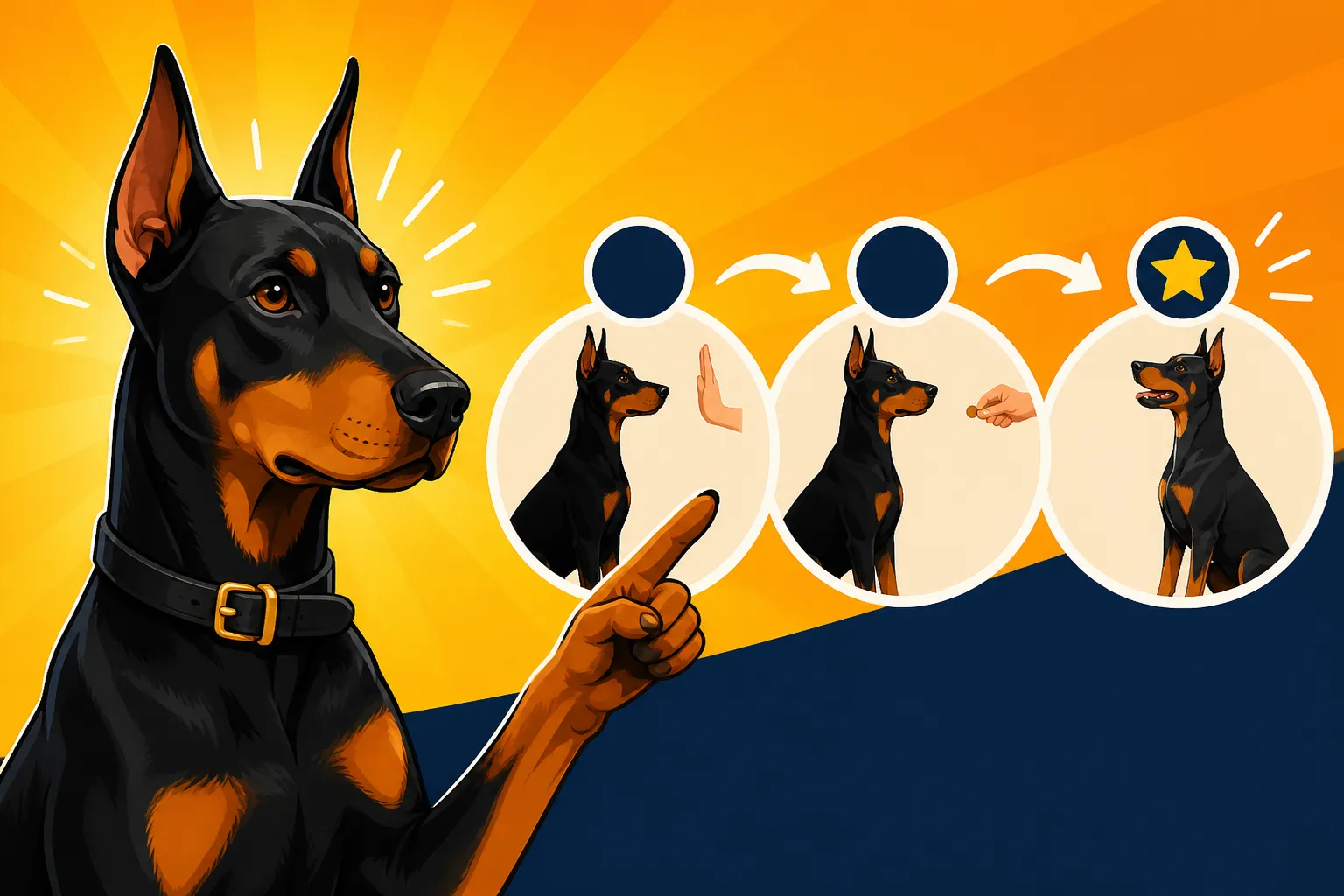
Why a Doberman Learns a Cue in Three Repetitions
It’s a common experience for Doberman owners: you teach a new trick or cue, and your Dobe seems to grasp it in a blink, often within just a few repetitions. While this rapid learning is incredibly rewarding, it can also be a little intimidating, leading many to wonder why these dogs seem to pick things up so much faster than other breeds. This guide dives deep into the fascinating intelligence and unique biddability of the Doberman, explaining just why they often learn a new cue in what feels like mere moments, and how you can best harness this incredible capacity.
The Doberman's Unique Cognitive Blueprint
The Doberman Pinscher isn't just a pretty face; they possess a distinct cognitive makeup that allows for exceptionally fast learning. Their history as working dogs, combined with innate intelligence and a strong desire to please, creates a powerful recipe for rapid comprehension. Many owners find themselves thinking, "Did he just get that already?" after only a handful of tries.
Intelligence and Biddability: A Potent Combination
When we talk about canine intelligence, it's not a single, monolithic trait. It encompasses problem-solving, adaptability, memory, and responsiveness to training. Dobermans consistently rank high in categories of working intelligence and obedience. This means they are not only smart enough to understand what you're asking, but they also want to do it. This biddability – the eagerness to comply and work alongside their human partner – is a cornerstone of their quick learning. It's not just that they figure out the puzzle; it's that they are actively trying to figure it out for you.
Imagine trying to teach a complex sequence of actions to a dog that's clever but would rather chase squirrels or sniff every blade of grass. Now picture a Doberman, eyes locked on you, intensely processing every gesture and word, eager for the next piece of information. That focus, combined with their inherent smarts, dramatically shortens the learning curve. They aren't just memorizing; they're understanding the underlying principle of the cue and the consequence of their action. This allows them to generalize quickly, making connections that other breeds might take many more repetitions to establish. It's why many experienced Doberman owners advocate for programs like those offered by BAXTER & Bella, which focus on clear communication and building a strong working relationship right from puppyhood.
Bred for Purpose: The Historical Context
The Doberman Pinscher was originally bred by Karl Dobermann, a tax collector in Germany, with a very specific job in mind: protection. He needed a dog that was intelligent, fearless, and utterly devoted to its handler, capable of learning quickly and responding reliably under pressure. To achieve this, he selectively bred dogs with traits that would lend themselves to immediate understanding and execution of commands. While the exact breeds that went into the Doberman's initial creation are debated, it’s widely believed that various working and guarding breeds, including Rottweilers, German Pinschers, and possibly even Greyhounds and Weimaraners, contributed to their genetic makeup.
This foundational purpose means that every Doberman carries generations of selective breeding for traits like alertness, discernment, and a strong drive to work. They weren't bred for independent decision-making like some herding breeds, nor solely for companionship; they were bred to be highly trainable partners. This historical context provides a crucial insight into The Tax Collector Who Invented the Doberman and What Went Into the First Dobermans. Their very essence is geared towards absorbing information from their handler and acting upon it, making those first few repetitions incredibly impactful. This lineage gives them an unparalleled edge in picking up new behaviors and cues at an astonishing pace.
Mastering the Art of Communication: Beyond Just "Commands"
While a Doberman’s intelligence is undeniable, it’s the human handler’s communication style that often unlocks their full learning potential. It’s not simply about barking orders; it’s about a nuanced dance of clarity, consistency, and reinforcement that speaks directly to their intelligent nature.
Precision in Positive Reinforcement
With a Doberman, every interaction is a teaching moment, and precision in your reinforcement matters immensely. If you're teaching a "sit" cue, the moment your Doberman's rear touches the ground, that's your window for reward. A delay of even a few seconds can dilute the message for such an intelligent dog, making them wonder what exactly earned the treat or praise. They connect cause and effect incredibly quickly, and if the effect (the reward) isn't immediately tied to the desired cause (the action), they'll start experimenting with other behaviors to try and get the reward.
This is where methods like marker training become incredibly powerful. Using a clicker or a consistent verbal marker ("Yes!" or "Good!") pinpoints the exact moment the Doberman performed the correct action, allowing for a precise and unambiguous communication. Followed immediately by a high-value treat, this creates a strong, positive association that speeds up learning. For a Doberman, this isn't just a game; it's a clear dialogue where their effort is recognized and rewarded instantly. If you're struggling to find the right training tools, you can explore various clickers, treat pouches, and high-value training treats readily available on Amazon. The clearer you are, the faster your Doberman will understand, often needing just a handful of successful repetitions before the lightbulb goes on. Marker Training a Doberman From Scratch can be a game-changer.
The Critical Role of Consistency and Clarity
Dobermans thrive on consistency and clarity. They are always observing, always learning, and always looking for patterns. If your "sit" cue sometimes means "sit," sometimes means "lie down," or sometimes isn't reinforced at all, a Doberman will quickly become confused or, worse, decide that the cue is optional. Their ability to learn quickly can be a double-edged sword; they can learn inconsistencies just as fast as they learn desired behaviors.
Imagine trying to teach your Doberman to stay. If sometimes you reward a two-second stay, and other times you only reward a thirty-second stay without building up to it, your Doberman won't understand the expectation. Being consistent with the cue word, the hand signal, the duration of the stay, and the criteria for the reward is paramount. This unwavering approach makes the learning process incredibly efficient. Any deviation can slow them down or teach them that they can "try their luck" with different responses. This dedication to consistent messaging is essential not just in formal training sessions but in every interaction. The BAXTER & Bella online program, for example, heavily emphasizes this kind of consistent, structured approach to help owners build a solid foundation with their puppies.
From Quick Learner to Reliable Partner
Learning a cue in three repetitions is impressive, but it’s just the first step. The true measure of a well-trained Doberman is not how fast they learn something, but how reliably they perform it in any situation. This journey from initial grasp to unwavering reliability requires careful generalization and sustained engagement.
Generalization Beyond the Initial "Three"
The fact that your Doberman learned "sit" in three repetitions in your quiet living room doesn't necessarily mean they'll perform it instantly at a busy dog park. This is where generalization comes in. For Dobermans, who are so intelligent and context-aware, you have to actively teach them that a cue means the same thing regardless of the environment, distractions, or who is asking. They pick up the core concept quickly, but then you need to show them its universal application.
This means practicing the cue in various locations: in the backyard, down the street, at a friend's house, and eventually in more distracting environments. Start with minimal distractions and gradually increase the challenge. Reward heavily for success in new places, reinforcing the idea that "sit" always means "sit." This systematic approach ensures that the initial rapid learning isn't just a parlor trick but a foundation for reliable obedience. Without this crucial step, a Doberman might simply conclude that "sit" is a "living room word." This takes more than three repetitions, but it builds on that quick initial understanding. Puzzle Work That Actually Tires a Doberman can also help reinforce generalization by making them problem-solve in different contexts.
Here's a simple table illustrating the stages of generalization for a new cue:
| Stage | Environment | Distractions | Goal |
|---|---|---|---|
| Initial Learning | Quiet, familiar home | None | Doberman understands the cue concept. |
| Low Distraction | Backyard, quiet room | Mild (e.g., quiet TV) | Doberman performs cue with minor background. |
| Moderate Distraction | Park (off-peak), pet store | Moderate (e.g., other people, distant dogs) | Doberman focuses on cue despite some activity. |
| High Distraction | Busy park, dog event | High (e.g., close dogs, loud noises) | Doberman reliably performs cue under pressure. |
| Fluency | Any environment | Any level | Doberman performs cue automatically and cheerfully. |
Sustaining Engagement and Preventing Mental Slump
Because Dobermans learn so quickly, they can also get bored just as fast. Repeating the same ten cues in the same order, day in and day out, will turn training into a tedious chore for a Doberman, not a stimulating challenge. Their sharp minds need constant engagement to prevent them from becoming mentally stale or, worse, inventing their own "games" that might not be to your liking. Whether a Doberman Gets Bored of Repetition is a very real concern for this breed.
To keep a Doberman engaged, vary your training sessions. Introduce new tricks, practice old ones in novel ways, or incorporate them into daily activities. Make training fun and unpredictable. Use different types of rewards—not just food, but also toys, praise, or opportunities to do a favorite activity. Short, frequent training sessions (even just Five-Minute Sessions With a Young Doberman) are often more effective than long, drawn-out ones. For instance, instead of asking for ten sits in a row, ask for a sit, then a down, then a spin, then a sit again. Keep them guessing, keep them thinking, and always end on a positive note. This ensures that their keen intellect remains sharp and their desire to work with you stays strong, making them not just quick learners but enthusiastic, lifelong partners. Keeping a Doberman Mentally Tired is essential for their overall well-being.
Common Hurdles When Training a Highly Intelligent Doberman
While their intelligence is a huge advantage, it also presents unique challenges. What works for some breeds might backfire with a Doberman, making it crucial for owners to understand how their Dobe's quick mind can lead to both brilliance and mischievousness.
The Double-Edged Sword of Boredom and Creativity
A Doberman's quick learning ability is fantastic, but it means they can get bored with repetition very, very quickly. If you're not consistently engaging their minds, they'll often decide to create their own entertainment. And trust me, a bored Doberman's idea of "fun" rarely aligns with yours. This could manifest as counter-surfing, destructive chewing, excessive barking, or even testing boundaries in ways that seem like deliberate defiance. It's not maliciousness; it's simply a highly intelligent dog seeking mental stimulation.
For example, if your Doberman learned "leave it" for a dropped treat in three repetitions, but now you rarely practice it or make it challenging enough, they might start "testing" whether "leave it" applies to your dinner plate. They're constantly evaluating the rules and looking for loopholes if the mental reward isn't there. This is where Why a Clever Doberman Is Harder to Train comes into play. You need to be just as clever and creative in your training as they are in finding ways to entertain themselves. Rotating puzzle toys, engaging in scent work, or practicing advanced obedience are all ways to channel their intelligence constructively. If you're finding your Doberman getting into trouble, consider if their magnificent brain is simply underutilized. Online platforms and communities, including those associated with BAXTER & Bella, often provide fresh ideas and advanced training exercises to keep highly intelligent dogs like Dobermans mentally stimulated.
Avoiding Over-Correction and Building Resilience
Another significant hurdle with such intelligent and sensitive dogs like Dobermans is the danger of over-correction or harsh training methods. Because they learn so rapidly, they often don't need intense physical corrections or yelling. In fact, these methods can be incredibly detrimental, causing a Doberman to shut down, become fearful, or even develop defensive aggression. Their sensitivity means they internalize negative experiences deeply, and what might be a minor correction for a more robust breed can be a profound setback for a Doberman. Why Yelling Shuts a Doberman Down is a critical concept for Doberman owners to grasp.
If a Doberman is corrected too harshly, especially during the learning phase, they can quickly associate the cue or the act of training itself with unpleasantness. Instead of thinking, "I need to do X to get Y," they might think, "If I try to do X, something bad happens." This can lead to a dog that hesitates, offers many different behaviors to avoid punishment, or simply refuses to engage. Rebuilding trust and confidence with a Doberman after harsh handling can be a long and arduous process, as detailed in Rebuilding Trust With a Harshly Handled Doberman. It's far more effective to use positive reinforcement, clear communication, and management strategies to prevent unwanted behaviors. Focus on showing them what you do want, rather than punishing what you don't. Their intelligence allows them to understand nuanced positive feedback and thrive on that positive connection with their owner.
In summary, the Doberman's capacity to learn a cue in what seems like three repetitions is a testament to their remarkable intelligence, biddability, and history as purposeful working dogs. However, harnessing this incredible trait effectively requires a commitment from the owner to consistent, clear, and positive communication, along with a dedication to keeping their highly intelligent companion mentally engaged and challenged. When you understand and respect this unique cognitive blueprint, training a Doberman becomes an incredibly rewarding partnership, transforming quick learners into reliable and cherished companions.
Disclaimer
This article is for general informational purposes only and does not constitute professional advice. Laws, prices and regulations vary by location and change over time. Consult a qualified professional for guidance on your specific situation.