Daily Calories for an Adult Doberman
Figuring out exactly how many calories your adult Doberman needs each day can feel like trying to hit a moving target. You look at their lean, athletic build and wonder if you're feeding them enough, or perhaps too much if they've put on a little weight. It's a common struggle, and getting it right is crucial for their health, energy, and longevity. This guide is here to walk you through the ins and outs of calculating and fine-tuning your Doberman's daily caloric intake, helping you feel confident you’re fueling your magnificent companion properly.
Understanding Your Doberman's Unique Metabolism and Energy Needs
Dobermans aren't just any dog. Their physiology, history, and typical temperament make their dietary needs a bit more specific than many other breeds. You can't just follow the generic guidelines on a kibble bag and expect optimal results.
Why Dobermans Aren't Your Average Dog When It Comes to Calories
Let's be real, a Doberman isn't a lumbering giant or a fluffy lap dog. They are built for speed, agility, and power, with a lean, muscular frame that’s constantly ready for action. This means their metabolism tends to run a little hotter, burning through calories at a faster rate than, say, a Basset Hound. Their historical role as working dogs, bred for stamina and alertness by Karl Dobermann himself, means they possess an inherent drive and often a high energy level that translates directly into caloric demands. Even when they seem to be "relaxing" indoors, many Dobermans are in a state of alert awareness, their brains constantly working, or they're following you from room to room – earning them the affectionate nickname of "velcro dogs." All this mental and physical activity consumes energy.
Many Doberman owners find themselves questioning Whether a Doberman Is Meant to Look Thin. The answer is yes, to a degree. You should typically be able to feel their ribs without pressing hard, and they should have a discernible waist when viewed from above. This lean physique, however, doesn't mean they don't need substantial fuel. It simply means that their energy is channeled into maintaining that powerful musculature and high metabolism rather than storing excess fat. This balance is tricky to achieve, and underfeeding can lead to muscle loss and lethargy, while overfeeding can quickly mask their athletic build with unnecessary pounds, putting strain on their joints and overall health.
Factors That Influence Your Doberman's Daily Caloric Burn
It would be wonderfully simple if every adult Doberman needed the exact same number of calories, wouldn't it? But just like people, dogs are individuals, and several factors play a huge role in their actual energy expenditure. Ignoring these can lead to an imbalance, leaving your Doberman either constantly hungry or slowly gaining weight.
Firstly, consider their activity level. Is your Doberman a true couch potato, content with short leashed walks around the block? Or are they a working dog, involved in Schutzhund, agility, or extensive hiking? A Doberman training for competitive sport or accompanying you on daily multi-mile runs will obviously need significantly more fuel than one whose primary exercise involves chasing squirrels in the backyard for 30 minutes. Even subtle differences, like whether they have a canine companion to wrestle with all day, can impact their burn rate.
Then there's age. A young, energetic Doberman between one and four years old, still in their prime, will likely have a higher caloric requirement than a senior Doberman who is starting to slow down. As Dobermans enter their later years, their metabolism can decrease, and their activity levels naturally wane, meaning their caloric needs will shift downwards to prevent unwanted weight gain. The Nine to Twelve Year Doberman Lifespan often brings with it changes in activity that demand dietary adjustments.
Sex and reproductive status also matter. Intact males and females often have slightly higher metabolic rates than their spayed or neutered counterparts. Spaying or neutering can sometimes lead to a decrease in metabolism and an increased propensity for weight gain, requiring a slight reduction in daily calories to maintain an ideal body condition. This is a common phenomenon many owners observe, and it's something to be mindful of after their surgery.
Finally, think about climate. Dogs burn more calories simply trying to stay warm in colder temperatures. If your Doberman spends time outdoors in a colder climate, their body works harder to maintain core temperature, thus increasing their caloric needs. Conversely, in very hot weather, intense exercise might be reduced, potentially lowering their daily requirements. Individual metabolism is also a factor; some Dobermans are just naturally "hotter" and leaner, burning through food faster, while others are a bit more efficient with their calories. It's a spectrum, and your Doberman falls somewhere on it.
Calculating Basal Metabolic Rate (BMR) and Resting Energy Requirement (RER)
Alright, let's get into a bit of the science behind how veterinarians and nutritionists start to figure out a dog's caloric needs. It sounds intimidating, but it's really just a baseline, a starting point that we can then adjust based on all those factors we just talked about.
The Science Behind Your Doberman's Basic Calorie Needs
Every living creature needs a certain amount of energy just to keep its body functioning – breathing, circulating blood, digesting food, maintaining body temperature, and simply existing. This fundamental energy requirement is called the Basal Metabolic Rate (BMR), or more commonly in veterinary circles, the Resting Energy Requirement (RER). Think of it as the calories your Doberman would burn if they just laid perfectly still all day in a neutral temperature environment, not doing anything at all. It's their bare minimum.
For dogs, RER is usually calculated using a formula based on their body weight. A common simplified formula for adult dogs over 2 kg is:
RER (kcal/day) = 70 * (Body Weight in kg)^0.75
Now, I know, "weight to the power of 0.75" might sound like you need a science degree! Many online calculators can do this for you, or your vet can easily provide this number. For a practical example, let's say your adult Doberman weighs 80 pounds. First, convert that to kilograms (80 lbs ÷ 2.2 kg/lb ≈ 36.36 kg).
So, for an 80-pound (36.36 kg) Doberman, the RER would be approximately:
70 * (36.36)^0.75 ≈ 70 * 14.5 ≈ 1015 kcal/day.
This 1015 kcal is just the resting energy. It's the absolute baseline. It doesn't account for walks, playtime, training, or even the energy it takes to stand up and greet you at the door. It's a crucial first step, but it's definitely not the final answer to how much food you'll be pouring into their bowl. The beauty of knowing this RER is that it gives us a scientifically grounded number to build upon, rather than just guessing.
Translating RER into Daily Energy Requirement (DER) with Multipliers
Once you have your Doberman's RER, the next step is to translate that into their Daily Energy Requirement (DER). This is the actual number of calories they need to consume each day to maintain their ideal body weight, factoring in all their daily activities. We do this by applying an "activity multiplier" to the RER.
These multipliers are general guidelines, and they vary depending on the dog's lifestyle:
| Activity Level Category | Description | Multiplier (x RER) |
|---|---|---|
| Inactive/Senior | Minimal activity, mostly sleeping, short potty breaks. | 1.2 – 1.4 |
| Neutered/Spayed Adult | Average activity, regular walks, some playtime. | 1.4 – 1.6 |
| Intact Adult | Higher metabolic rate than altered dogs, average activity. | 1.6 – 1.8 |
| Active Adult | Daily long walks, regular runs, moderate training, agility, hiking. | 1.8 – 2.0 |
| Working Dog | Intensive training (e.g., protection sports), endurance activities, cold weather. | 2.0 – 5.0+ |
| Puppy | Growing puppies need much higher ratios, consult your vet. | 2.0 – 3.0 (or more) |
Let's use our 80-pound Doberman example with an RER of approximately 1015 kcal/day:
-
Example 1: The "Average" Pet Doberman (Neutered/Spayed Adult)
- If your Doberman is neutered, gets a couple of good walks a day, and enjoys some playtime in the yard, you might use a multiplier of 1.5.
- DER = 1015 kcal * 1.5 = 1522.5 kcal/day
-
Example 2: The "Active" Doberman (Intact Adult, Regular Exercise)
- If your Doberman is intact, goes on daily 3-mile runs with you, and has active training sessions a few times a week, a multiplier of 1.9 might be more appropriate.
- DER = 1015 kcal * 1.9 = 1928.5 kcal/day
-
Example 3: The "Working" Doberman (Intact, High-Intensity Training)
- For a Doberman actively involved in high-level protection sport or a similar demanding activity, especially if they are intact, the multiplier could easily be 2.5 or higher.
- DER = 1015 kcal * 2.5 = 2537.5 kcal/day
These examples clearly show how vastly different the caloric needs can be even for Dobermans of the same weight. It really hammers home that these are just guidelines. The true magic happens when you start monitoring and adjusting in real-time. Your Doberman is an individual, and their actual needs might fall slightly outside these ranges. The goal isn't to hit an exact number, but to use these calculations as an educated starting point for what you pour into their bowl.
Practical Approaches to Determining Your Doberman's Ideal Weight and Calorie Intake
While the formulas give us a scientific baseline, the art of feeding your Doberman comes down to careful observation and smart adjustments. Numbers on a calculator are great, but your Doberman’s actual body condition and energy levels tell the real story.
The Importance of Body Condition Scoring (BCS) Over Just Weight
When we talk about weight for a Doberman, it's easy to get fixated on the number on the scale. However, for a breed as lean and muscular as the Doberman, a number alone doesn't tell the whole story. What truly matters is their Body Condition Score (BCS). This is a hands-on assessment that helps you evaluate your dog's fat reserves and muscle mass, giving you a much better picture of their overall health than just pounds or kilograms. Reading Ribs and Hip Points on a Doberman is a critical skill for any Doberman owner.
Most veterinary professionals use a 9-point scale, where 1 is emaciated and 9 is morbidly obese. For a Doberman, an ideal BCS is generally between 4 and 5 out of 9. Here’s what that looks like:
- How to Perform a BCS:
- Ribs: Gently feel along your Doberman's side. You should be able to easily feel the ribs without pressing hard, almost like feeling the back of your hand. If you can see them protruding sharply without feeling, they might be too thin (BCS 1-3). If you have to press firmly to feel them through a layer of fat, they might be overweight (BCS 6+).
- Waist: Look at your Doberman from above. They should have a distinct "tuck" or hourglass shape behind their ribs. If they look like a straight line or are wider in the middle, they're likely carrying too much weight.
- Abdominal Tuck: Look at them from the side. Their abdomen should tuck up nicely behind their rib cage, not hang low or be straight across.
An ideal Doberman at a BCS of 4-5/9 will look athletic and powerful. Their musculature should be well-defined, and their movements fluid. If your Doberman is consistently at a BCS of 3 or less, you need to consider Putting Weight on an Underweight Doberman. Conversely, if they are consistently at a BCS of 6 or more, you need to think about Slimming a Doberman That Has Thickened. This hands-on assessment is far more valuable than the number on the scale, as two Dobermans of the exact same weight could have very different body compositions due to muscle mass.
Monitoring and Adjusting Food Portions in Real-Time
Once you have your RER and DER calculations, and you've assessed their BCS, it's time to put that knowledge into action and then observe, observe, observe! Feeding isn't a "set it and forget it" process, especially with a Doberman. Their needs can fluctuate with changes in weather, activity, or even just a growth spurt or aging.
Start by feeding the calculated DER, divided into at least two meals a day (more on this later!). Give it about two weeks, then reassess their body condition and energy levels. Don't expect immediate changes, as bodies take time to adapt.
- If your Doberman is starting to look a little too lean, or their ribs are becoming too prominent (BCS of 3 or less), increase their daily caloric intake by about 10-20%. This might mean adding a quarter or a half cup of food per day. Continue for another week or two, then reassess.
- If they're starting to look a bit thick around the middle, or you're having to press harder to feel their ribs (BCS of 6 or more), reduce their daily caloric intake by 10-20%. Again, give it time and re-evaluate.
Beyond their physical appearance, pay attention to their energy levels, coat condition, and stool quality. A properly nourished Doberman should have bright eyes, a sleek, shiny coat, consistent energy, and firm, healthy stools. If they're sluggish, have a dull coat, or their stools are consistently soft or too hard, it might indicate that their diet isn't quite right, either in quantity or quality.
And here's a big one: don't forget about treats! Those little rewards, training aids, or bedtime snacks add up quickly. If your Doberman is getting a handful of treats throughout the day, those calories must be factored into their total daily intake. Many owners inadvertently overfeed by underestimating the caloric contribution of treats. If you're using a lot of treats for training, opt for low-calorie options like small pieces of cooked chicken or carrot, or choose commercially available low-calorie training treats available from places like Chewy or Amazon. Remember, every bite counts towards that total daily calorie goal.
Choosing the Right Food and Feeding Schedule for Your Doberman
The type of food you choose and how you deliver it are just as important as the quantity. A Doberman needs high-quality fuel to thrive, and their unique physiology dictates a careful feeding routine to minimize certain health risks.
Deciphering Food Labels: Calories, Protein, and Fat Content
Navigating the pet food aisle can be overwhelming with countless brands and formulas. The key to making an informed choice for your Doberman lies in understanding the information on the food label, especially the caloric density and macronutrient breakdown.
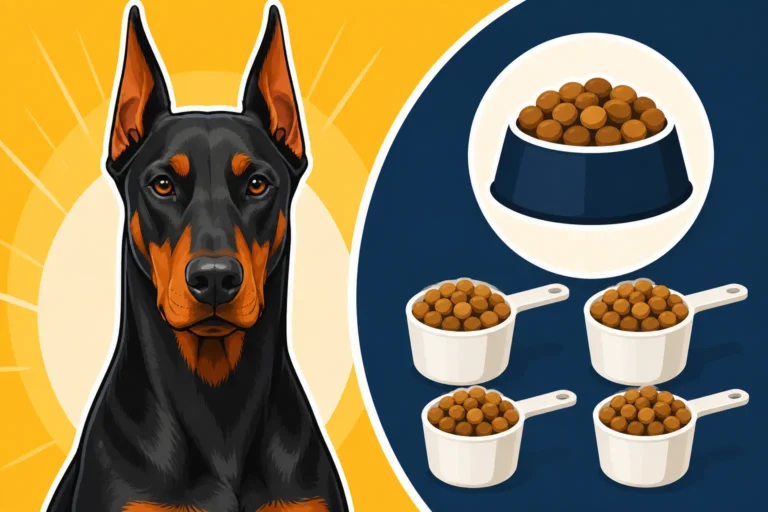
Every reputable dog food will list its caloric content, usually as "kcal per cup" or "kcal per kilogram." This is vital because it allows you to accurately measure portions based on your Doberman's calculated DER. For example, if your Doberman needs 1800 kcal/day and your chosen kibble has 400 kcal/cup, you'd feed 4.5 cups per day (1800 ÷ 400 = 4.5). This is where the calculation meets the scoop! Without this number, you're truly guessing.
Beyond calories, pay close attention to protein and fat levels. Dobermans, as athletic, muscular dogs, generally thrive on diets with higher protein content. Look for foods where protein is a primary ingredient and makes up at least 25-30% of the dry matter content, and often more for highly active or working dogs. This supports their muscle mass and overall vigor. Protein and Fat for a Lean Working Doberman are crucial for maintaining their powerful physique. High-quality animal proteins like chicken, beef, lamb, or fish should be at the top of the ingredient list.
Fat is also a concentrated source of energy and essential for skin and coat health, as well as nutrient absorption. For most adult Dobermans, a fat content of 15-20% is appropriate, though very active dogs might benefit from slightly higher levels. Remember that fat adds a lot of calories, so a food with higher fat content will require smaller portion sizes.
You'll encounter various food types: dry kibble, wet food, fresh food, or raw diets. Dry kibble is usually the most calorie-dense and economical. Wet food, while often highly palatable, has a much higher water content, meaning you'd need to feed a significantly larger volume to meet the same caloric needs, which can become quite expensive for an 80-pound Doberman. Fresh food options, like those offered by Ollie, provide excellent nutrition and often high digestibility, but again, ensure you understand their caloric density to avoid over or underfeeding. Always look for a statement indicating the food meets AAFCO (Association of American Feed Control Officials) nutritional standards for adult maintenance. When in doubt, a quick search on Chewy or Amazon can show you a wide array of options, but always double-check the nutritional panels.
Optimal Feeding Schedules and Avoiding Bloat Risk
For Dobermans, how you feed is almost as important as what you feed. Due to their deep, narrow chests, Dobermans are unfortunately predisposed to Gastric Dilatation-Volvulus (GDV), commonly known as bloat or stomach twist. This is a life-threatening condition where the stomach fills with gas and can then twist, cutting off blood supply. Recognizing a Doberman Stomach Twist in Time is critical for any Doberman owner. While the exact causes are complex, feeding habits are a significant factor we can control.
The golden rule for Dobermans to minimize bloat risk is to feed at least two meals a day, preferably three, rather than one large meal. This divides their total daily caloric intake into smaller, more manageable portions, preventing the stomach from becoming excessively distended. Meal Timing on a Deep-Narrow Doberman Chest is not just about convenience; it's a preventative measure. For our 80-pound Doberman needing 1800 kcal/day (4.5 cups of a 400 kcal/cup food), this would mean 2.25 cups twice a day, or 1.5 cups three times a day.
Another critical piece of advice is to ensure your Doberman rests before and after meals. Avoid strenuous exercise, excessive excitement, or guzzling large amounts of water immediately surrounding meal times. A good rule of thumb is to wait at least an hour before and after meals for any intense activity. Letting them settle down for 15-20 minutes before they eat, and then allowing them to relax calmly for an hour or so afterwards, can make a huge difference.
Additionally, consider using slow feeder bowls or other enrichment tools that encourage slower eating. These bowls have various ridges or obstacles that force your Doberman to take smaller bites, preventing them from gulping down their food too quickly, which can introduce excess air into the stomach. These are widely available on platforms like Chewy and are a smart investment for any Doberman owner concerned about bloat. Elevating food bowls used to be recommended to prevent bloat, but more recent research suggests it may actually increase the risk in large, deep-chested breeds. So, it's generally best to feed your Doberman with their bowl on the floor.
Special Dietary Considerations for Dobermans
Beyond the basics, Dobermans sometimes present unique dietary challenges or considerations that owners need to be aware of. Staying informed about these issues can make a huge difference in their long-term health.
The Grain-Free Controversy and Heart Health
If you've spent any time researching dog food in recent years, you've likely encountered the "grain-free" trend. For Dobermans, this trend has come with a significant caution. There has been an ongoing investigation by veterinary cardiologists and the FDA into a potential link between certain "boutique," "grain-free," and "exotic ingredient" (BEG) diets and an increased incidence of canine Dilated Cardiomyopathy (DCM) in breeds not genetically predisposed to it, including Dobermans, though Dobermans are genetically predisposed. This is a serious concern, given that DCM is The Heart Disease That Reaches Most Dobermans.
While the exact mechanism is still being studied, the leading hypothesis points to a possible deficiency in taurine or other essential nutrients, or the presence of anti-nutrients, often found in high concentrations of peas, lentils, legumes, and potatoes used as substitutes for grains in these BEG diets. For Dobermans, who are already at a high risk for DCM, adding another potential dietary risk factor is something to take very seriously.
My advice, and the advice of many veterinary nutritionists, is to choose a dog food from a reputable brand that employs veterinary nutritionists and conducts extensive feeding trials. These are typically larger, well-established brands that have invested in scientific research. Look for diets that contain traditional grains (unless your Doberman has a diagnosed grain allergy, which is rare). The Grain-Free Question in a Doberman's Bowl is not just a marketing fad; it's a legitimate health consideration that Doberman owners cannot afford to ignore. If you're feeding a BEG diet or are concerned, it's crucial to consult your veterinarian or a board-certified veterinary nutritionist immediately to discuss alternatives and potentially test your Doberman's taurine levels.
Supplements, Treats, and the Calorie Creep
In our desire to give our Dobermans the best, it's easy to fall into the trap of over-supplementing or over-treating, leading to what I call "calorie creep." While some supplements can be beneficial, and treats are wonderful for bonding and training, they all contribute to the daily caloric intake and need to be considered.
Let's talk about supplements. For Dobermans, certain supplements like Taurine and Carnitine in a Doberman Diet might be recommended by a cardiologist, especially if they have a family history of DCM or are on specific medications. However, adding a multitude of supplements without veterinary guidance can be unnecessary, potentially harmful, and certainly adds to their daily calorie count. Always discuss any supplements with your vet to ensure they are appropriate and don't interact negatively with their diet or any existing conditions. Many joint supplements, for instance, come in palatable chew forms that contain surprisingly high numbers of calories.
As for treats, we touched on this earlier, but it bears repeating: they are calories! Even small pieces of kibble used for training add up. If you're giving your Doberman several commercial treats, a chew stick, and a few spoonfuls of peanut butter throughout the day, those calories can easily equal an extra meal's worth of food. This is a common reason why Dobermans gain weight, despite their owners believing they're feeding the "right" amount of dog food.
To manage calorie creep from treats:
- Factor them in: If you know your Doberman gets X amount of treats daily, reduce their main meal portions accordingly.
- Choose wisely: Opt for low-calorie, healthy treats like plain cooked vegetables (carrots, green beans, broccoli florets), apple slices (without seeds), or ice cubes. These offer bulk and satisfaction without a massive calorie hit.
- Measure: Just like their food, measure out daily treat allowances, especially if you're working on weight management. Don't just eyeball it.
- Use their kibble: For training sessions, use a portion of their daily kibble ration as rewards. This way, you're not adding extra calories.
Remember, the goal is balance. Your Doberman needs sufficient, high-quality calories to maintain their lean, muscular physique and high energy levels, but every calorie counts. Careful management of food, treats, and supplements will help ensure your Doberman stays at their ideal body condition for a long, healthy, and active life.
Disclaimer
This article is for general informational purposes only and does not constitute professional advice. Laws, prices and regulations vary by location and change over time. Consult a qualified professional for guidance on your specific situation.