Whether Doberman Health Has Improved Since 2000
A Doberman today may receive heart imaging, rhythm monitoring, genetic testing, and earlier treatment that were less familiar to many owners in 2000. But better tools do not automatically mean healthier dogs. This guide separates what has genuinely improved in Doberman care from what remains uncertain, including the breed’s inherited heart risks and the limits of comparing dogs across generations.
What “improved health” means for Dobermans
Better screening is not the same as fewer illnesses
When people ask whether Doberman health has improved since 2000, they may mean several different things: Are dogs developing fewer inherited diseases? Are they living longer? Are illnesses being found earlier? Or are veterinarians simply better equipped to diagnose and manage them? Those questions overlap, but they do not have the same answer.
A Doberman whose heart problem is detected before obvious symptoms is benefiting from improved surveillance, even if the underlying risk of developing the problem has not changed. Likewise, a dog that receives effective treatment may have a better experience after diagnosis without representing a breed-wide reduction in disease. It is important to distinguish prevention, earlier diagnosis, and better management from a proven improvement in overall health.
There is no single, consistent set of records that makes it easy to compare every Doberman born around 2000 with every Doberman born today. The dogs included in studies can differ, diagnostic methods change, and owners may be more likely to report or investigate certain problems now. Without comparable long-term data, sweeping claims that the breed is simply healthier—or less healthy—can be misleading.
More conditions are recognized and measured
Veterinary cardiology has developed practical ways to look for heart disease before a dog appears unwell. An echocardiogram examines the heart’s structure and function, while a Holter monitor records the heart’s electrical rhythm over an extended period. Blood tests can add useful information, but they do not replace imaging or rhythm monitoring. These tools give veterinarians and owners more ways to investigate concerns than relying on symptoms or a brief examination alone.
The same change applies beyond the heart. Owners may encounter more discussion of genetic testing, hip evaluation, thyroid testing, and liver screening than was common in everyday conversations about Doberman health decades ago. Better awareness can raise the number of diagnoses recorded, even if the actual number of affected dogs has not increased. A rise in reported cases is not automatically proof that a disease has become more common.
This distinction matters especially for dilated cardiomyopathy, or DCM, a serious inherited heart condition in Dobermans. Greater awareness and more testing can help identify dogs that need follow-up, but a normal result at one point in time does not guarantee that a dog will stay healthy. For a closer look at why symptoms can be absent early on, see Why a Doberman Heart Fails Before Anyone Notices and The Silent Years Before a Doberman's Heart Shows.
A fair comparison needs more than lifespan stories
Individual stories are meaningful to families, but they cannot establish a breed-wide trend. One owner may remember a Doberman who died young of heart disease, while another may have had a dog that reached an advanced age. Both experiences are real; neither tells us whether the average health of the breed has improved.
Comparisons also depend on how “healthy” is defined. A study tracking only deaths may miss dogs living with chronic disease. A survey asking owners about diagnoses may miss conditions that were never tested for. A veterinary clinic’s records may reflect the local population and the tests that clinic offers. Even lifespan figures can shift with changes in record keeping, owner reporting, and the proportion of dogs included.
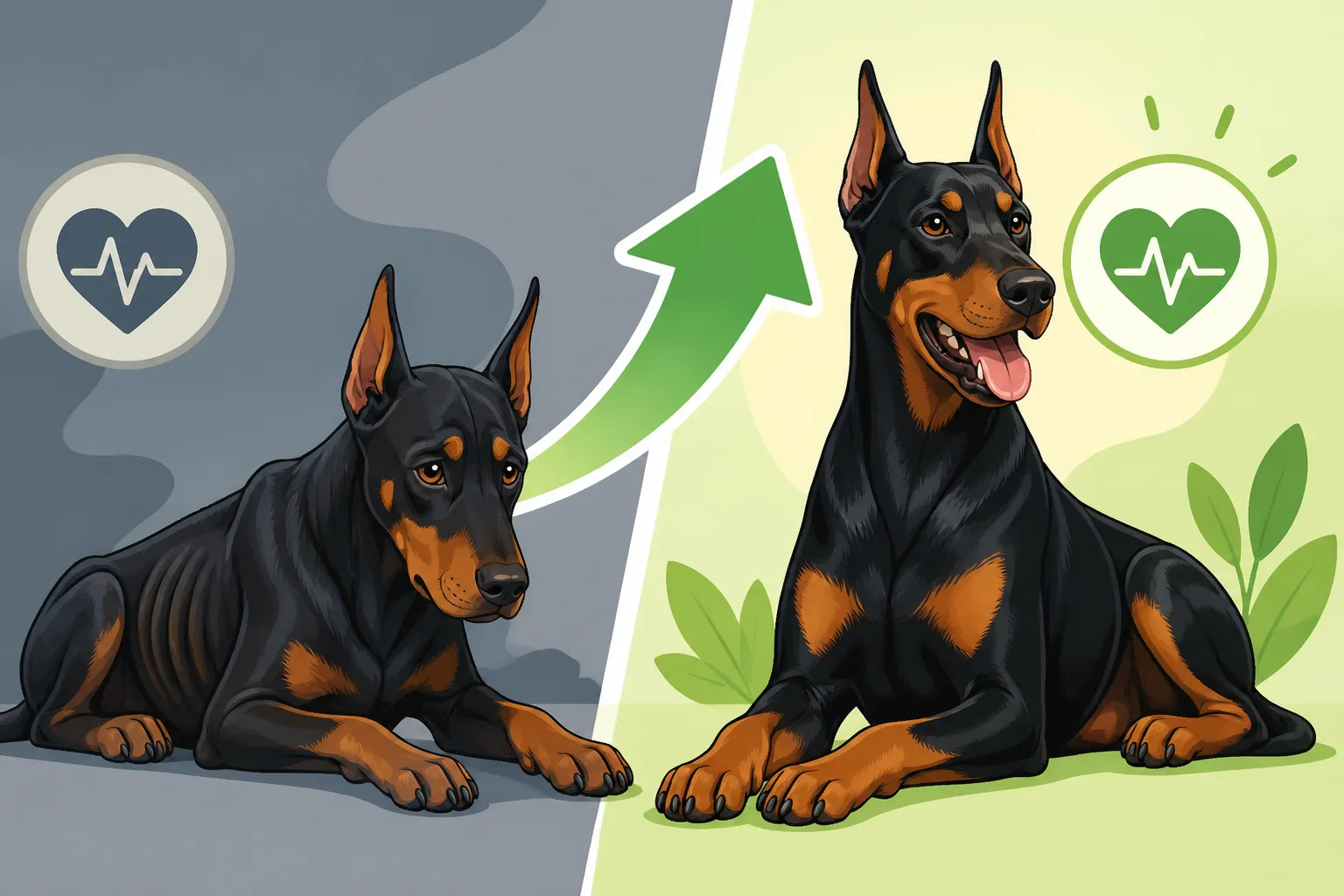
A useful conclusion is therefore a measured one: Doberman owners and veterinarians have stronger tools for detecting and managing certain diseases, but that alone does not prove that the breed’s inherited disease burden has fallen since 2000.
Where Doberman care has made practical progress
Heart screening gives owners more ways to act early
Heart screening is one of the clearest areas where the practical options for owners have expanded. A physical exam can be reassuring, but it cannot rule out every early heart change or intermittent abnormal rhythm. A cardiologist may recommend an echocardiogram, a Holter monitor, or both, depending on the dog’s age, history, examination, and previous results.
Repeated screening matters because a clear test is a snapshot, not a lifelong guarantee. A Doberman can have a normal result and develop a detectable change later. Owners sometimes find this frustrating: they have spent time and money on testing, only to be told to repeat it. The reason is that monitoring is intended to catch changes over time, not to issue a permanent all-clear.
Ask the veterinarian what each test can and cannot show, how the result will affect the next step, and when a recheck is appropriate. If a result is abnormal, ask whether interpretation by a veterinary cardiologist would be useful. The details of screening and result interpretation are covered in Annual Echo and Holter Screening for a Doberman and Reading a Doberman's Holter Result.
Genetic tests can inform decisions, but they cannot predict everything
Genetic tests have given breeders and owners another piece of information to consider. For Dobermans, tests for variants associated with DCM can help describe a dog’s genetic status. A DNA result is not the same as a diagnosis, however, and it cannot establish that a dog will or will not develop heart disease. DCM is complex, and a test that identifies particular variants cannot capture every factor that may contribute to disease.
This is why a test panel should be viewed as one part of a broader health picture. A dog with a clear result still needs appropriate health monitoring, and a dog with a positive result should not be treated as though illness is inevitable. Owners can learn more in The Two Doberman DCM Gene Tests and A Doberman That Tests Clear and Still Gets DCM.
Genetic testing can also support thoughtful breeding decisions, but only when results are interpreted alongside family history, clinical screening, and the health of related dogs. A certificate by itself does not show that a breeding program is addressing every major concern. For help assessing the wider picture, read The Health Testing a Doberman Breeder Must Show.
Screening for non-heart conditions has become more familiar
Doberman health is not just heart health. Owners and breeders also need to consider inherited bleeding disorders, neck and spinal problems, liver disease, thyroid conditions, cancer, and other concerns. Awareness and access to testing can make it easier to investigate some of these issues, although availability and usefulness vary by condition and by individual dog.
For example, a DNA test can identify a Doberman’s status for von Willebrand disease, a clotting disorder, but a result needs to be understood in context before surgery or other medical care. Some owners first learn about the condition when a dog has prolonged bleeding after a minor injury or procedure. The guide The Von Willebrand DNA Test for Dobermans explains what that test can contribute.
A similar point applies to liver screening. Bloodwork may flag a concern and prompt further investigation, but an enzyme result alone does not necessarily identify the cause. If testing finds an abnormality, the veterinarian may recommend repeat bloodwork or additional diagnostics. In other words, improved testing can create a clearer path to investigation, but it does not eliminate the diseases themselves.
| Area of Doberman health | What has improved in practice | What the improvement does not prove |
|---|---|---|
| Heart disease | More ways to assess heart structure and rhythm, including echocardiography and Holter monitoring | That fewer Dobermans develop DCM |
| Genetic risk | More information about specific inherited variants | That a clear result rules out DCM or that a positive result predicts certain illness |
| Other inherited conditions | Greater owner awareness and access to selected tests | That every condition is preventable or fully captured by testing |
| Diagnosis and follow-up | Earlier investigation may be possible when screening is used appropriately | That earlier diagnosis automatically means a longer lifespan |
| Breeding decisions | More health information can be considered alongside family history | That test certificates alone guarantee a healthy litter |
What has not clearly improved
DCM remains a major concern
The existence of heart screening and genetic tests should not be mistaken for a solution to DCM. The disease remains a serious concern for the breed, and screening can identify some changes without preventing the condition from arising. A Doberman can look energetic, eat normally, and enjoy walks while an early heart problem is not obvious to the family.
That gap between appearance and disease is emotionally difficult. Owners may feel they should have noticed something sooner, especially when a dog has seemed completely normal. But early heart disease may not produce clear outward signs. Screening is useful precisely because watching for symptoms alone may not be enough. If your dog develops coughing, breathlessness, fainting, or a sudden drop in stamina, contact a veterinarian promptly rather than waiting for the next planned screening visit.
For practical information about signs that may be subtle, see Why a Doberman Can Look Fine and Be Ill. For the broader question of how much heart disease affects the breed, How Many Dobermans Develop DCM gives a focused overview.
A longer life for some dogs is not proof of a breed-wide change
A particular Doberman may live longer today because its family recognizes warning signs, schedules testing, and has access to specialist care. That is worthwhile progress for that dog. It does not establish that Dobermans as a whole now live longer than they did in 2000.
Lifespan is influenced by many things besides inherited disease: accidents, cancer, other medical conditions, body condition, preventive care, and access to treatment all matter. Changes in how owners manage these factors can affect individual outcomes without changing the underlying genetics of the population. Reliable comparisons need large, well-defined groups and consistent records across time.
It is also possible for a breed to improve in one area while remaining vulnerable in another. Better awareness of screening may help some heart cases be found earlier, while other inherited conditions continue to affect families. A single number or anecdote cannot capture that uneven picture. The article Doberman Lifespan and Why It Is Short explores why longevity needs to be discussed alongside the breed’s health risks.
Uneven testing makes progress hard to measure
Health testing is only useful as a population-level tool if it is used consistently and interpreted well. Some owners screen regularly; others may test only after symptoms appear. Some breeders make health information easy to review, while others provide limited records. Tests can also differ in what they measure, and a result can be misunderstood if it is treated as a guarantee.
There is a practical barrier, too: screening takes planning, travel, follow-up, and money. A family may live far from a veterinary cardiologist or have trouble arranging a Holter monitor around work and daily routines. A veterinarian can help prioritize which tests are appropriate and identify clinics or specialists to contact. Owners buying routine food or care supplies through Chewy, for example, should keep that separate from medical decisions: a retailer does not determine which diagnostic tests a Doberman needs.
A growing number of tests or health certificates does not automatically mean the breed is improving. To demonstrate a lasting change, researchers would need to know whether disease rates are falling across comparable generations, not merely whether more dogs are being checked.
How owners can use today’s knowledge
Build a health record that follows the dog
Keep copies of screening results, laboratory reports, medication instructions, and the dates of follow-up recommendations. If a dog changes veterinarians, a complete record helps the new clinic see what has already been checked and what needs repeating. This is particularly helpful when a result is described as “normal” without much explanation: keep the actual report so a specialist can review the details if questions arise later.
Ask specific questions during appointments. What condition was this test intended to assess? Does this result change the plan? When should it be repeated? What signs at home would warrant an earlier call? These questions turn a test result into a practical care plan rather than a piece of paper that gets filed away.
If your dog has a family history of heart disease or another inherited condition, share that information rather than assuming it is already in the chart. A veterinarian may recommend a different monitoring plan based on age, symptoms, examination findings, and relatives’ health history.
Choose breeders by the quality of the evidence they share
For people considering a puppy, health information should include more than a claim that the parents are “tested.” Ask which tests were completed, when they were performed, who interpreted them, and whether results can be reviewed. Ask about the health history of close relatives and what the breeder does when a puppy or adult dog develops a serious condition.
Good breeding decisions involve trade-offs and long-term thinking. A single test cannot guarantee a healthy dog, and no breeder can promise that a puppy will never develop an inherited disease. But transparent records and a willingness to discuss difficult health outcomes are more meaningful than broad assurances. The article Reading a Doberman Puppy's Test Certificates can help owners understand what paperwork does—and does not—tell them.
Make monitoring sustainable for your household
A care plan works best when it fits real life. If specialist appointments are difficult to arrange, ask your primary veterinarian what can be done locally and when referral is important. Keep screening dates in a calendar, request reminders from the clinic, and budget for planned preventive care as well as unexpected visits.
Everyday support matters, too, though it cannot replace testing. Follow your veterinarian’s guidance on food, exercise, weight, medications, and follow-up. If your vet recommends a particular food or routine supplies, Chewy may be one place to check availability, but confirm that any diet or product is appropriate for your dog’s medical needs. For prescription products, follow the veterinarian’s instructions and the dispensing requirements.
The most realistic answer to whether Doberman health has improved since 2000 is that owners have better tools and more awareness to identify and manage some problems. That is meaningful progress in care. It is not, by itself, proof that inherited disease has become less common or that the breed’s overall lifespan has increased. Thoughtful screening, transparent breeding records, and careful interpretation of results remain essential.
Disclaimer
This article is for general informational purposes only and does not constitute professional advice. Laws, prices and regulations vary by location and change over time. Consult a qualified professional for guidance on your specific situation.