Doberman Gait and the Reach the Ring Wants
Walking your Doberman should be a magnificent sight, a powerful, elegant animal gliding effortlessly beside you. But many Doberman owners, especially those new to the breed, might not realize just how crucial that specific "glide" is, not just for aesthetics, but as a direct indicator of proper structure and health. This guide will dive deep into the Doberman's ideal gait, explaining what judges look for in the show ring and why understanding it is vital for every Doberman owner.
Understanding the Doberman's Purpose-Driven Gait
When you watch a Doberman move, you're not just seeing a dog walk; you're witnessing the culmination of generations of careful breeding designed for a specific purpose. Their gait, or the way they move, is perhaps one of the most defining characteristics of the breed, speaking volumes about their athletic ability, endurance, and structural integrity. It’s a dynamic display of power and grace, reflecting the very essence of what a Doberman was created to be.
The Historical Role of Movement
The Doberman Pinscher was originally bred by Karl Friedrich Louis Dobermann, a tax collector in Germany, in the late 19th century. He needed a dog that could serve as a protector and companion on his rounds, a formidable yet agile animal capable of covering ground quickly and efficiently, often in challenging situations. This meant selecting dogs with strong, coordinated movement, excellent stamina, and an imposing presence. The early Dobermans weren't just about looks; they were about function, and their ability to move freely and powerfully was paramount. They needed to be able to keep up with their master, patrol territory, and react swiftly if danger arose. This historical imperative laid the groundwork for the breed's distinctive gait.
Without this background, it's easy to dismiss a dog's movement as mere shuffling. But for the Doberman, every stride, every flex of muscle, is a nod to its working heritage. A Doberman that moves correctly is a Doberman that could still perform its original duties with ease. It's not just about looking good in a ring; it's about being fundamentally sound and ready for action. This is why when you see a Doberman with an incredible gait, you're looking at a dog that truly embodies its historical blueprint.
Form Dictates Function
The Doberman breed standard is meticulously written to describe a dog whose physical attributes directly enable its function. Every aspect of their bone structure, musculature, and overall proportion contributes to their ability to move with the desired reach and drive. A well-constructed Doberman isn't just a pretty picture; it's an engineering marvel built for efficient locomotion. Think of it like a finely tuned machine, where each part works in perfect harmony with the others.
For instance, a properly laid-back shoulder and well-angled upper arm are crucial for adequate forward reach. Without these correct angles, the dog's front legs can't extend as far, resulting in a short, choppy stride. Similarly, the powerful hindquarters, with their broad thighs and correctly angled stifles and hocks, provide the explosive drive needed to propel the dog forward. When these elements are out of alignment, even subtly, the efficiency of movement suffers, and the dog expends more energy for less ground covered. This principle of "form dictating function" is central to understanding why the Doberman's gait is so highly valued in the show ring and in everyday life. If you're looking at The Doberman the AKC Standard Describes, you'll see how these structural details underpin their movement.
The Ideal Doberman Gait According to the Standard
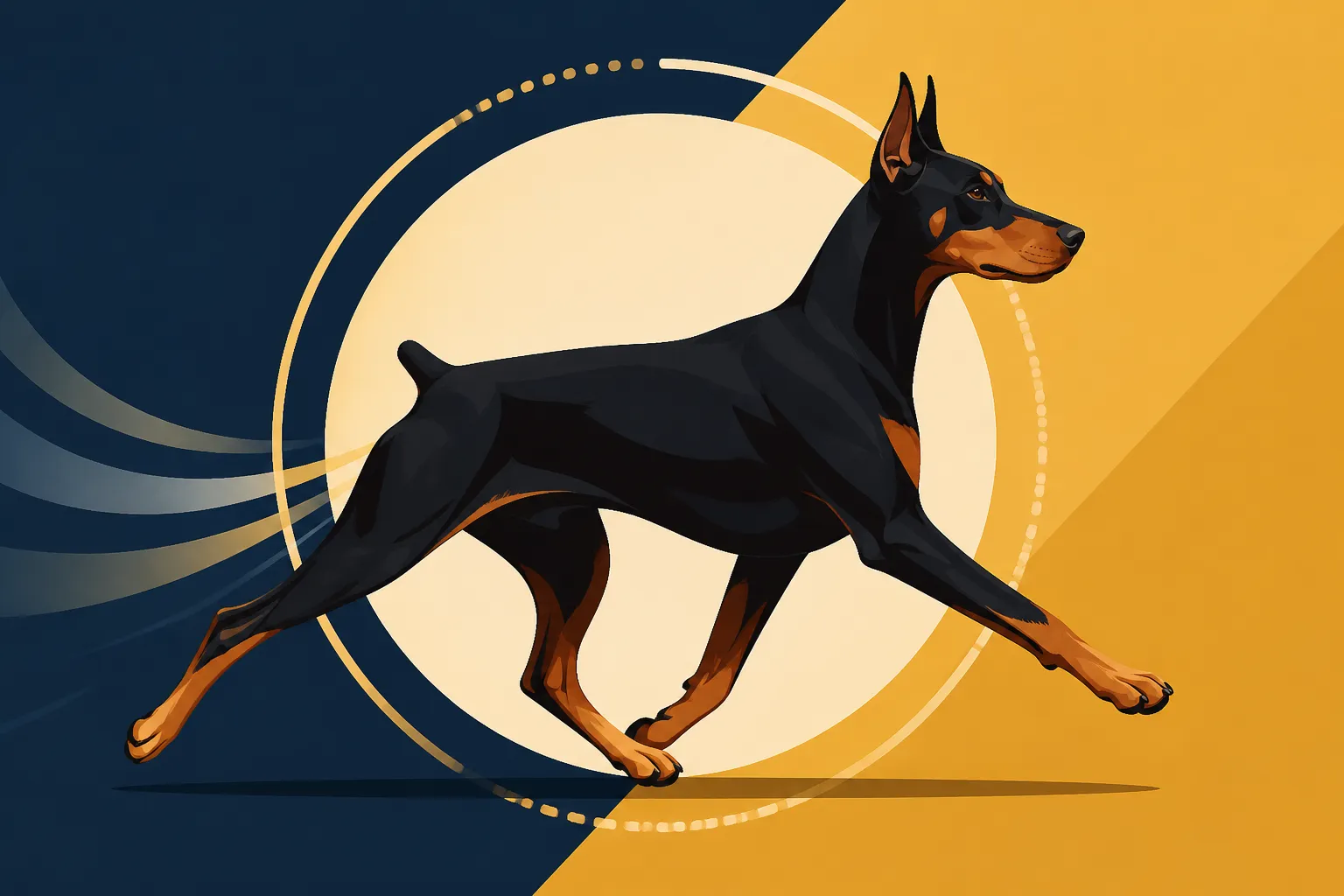
The American Kennel Club (AKC) standard for the Doberman Pinscher describes a gait that is "free, balanced, and vigorous, with good reach in front and powerful drive in the rear." It's more than just putting one foot in front of the other; it's about a symphony of motion, a testament to proper conformation and athletic prowess. When you observe a Doberman moving, you should feel a sense of power combined with an almost effortless grace, as if they could keep going all day without tiring.
Reach and Drive: The Power Behind the Movement
"Reach" refers to how far forward the front legs extend during each stride. In an ideal Doberman gait, the front paw should reach almost to the tip of the nose when viewed from the side, with the leg appearing to swing freely from the shoulder. This expansive reach allows the dog to cover a significant amount of ground with each step, contributing to their efficiency and speed. It signifies well-laid shoulders and a strong, flexible front assembly. If the reach is insufficient, the dog will take more steps to cover the same distance, leading to quicker fatigue.
"Drive," on the other hand, describes the powerful propulsion generated by the hindquarters. As the rear legs extend backward, they should push off with force, propelling the dog forward. The hocks should exhibit strong flexion and extension, driving the dog with purpose and authority. Good drive comes from strong, well-muscled hindquarters with correct angulation, enabling a powerful follow-through. A Doberman with excellent drive appears to glide, with its rear legs working in perfect synchronicity with its front, pushing the dog along effortlessly. You can often feel this power when you're on a walk; a Doberman with great drive seems to pull you along with enthusiasm, though they should be trained to walk politely.
The "Spring" in Their Step: Elasticity and Effortless Flow
Beyond just reach and drive, the ideal Doberman gait possesses an undeniable "spring" or elasticity that makes their movement appear light, resilient, and utterly effortless. This quality comes from a combination of excellent conditioning, flexible joints, and a responsive musculature. It’s that subtle bounce, that fluid transition from one stride to the next, which distinguishes a truly exceptional mover. The dog doesn't plod or lumber; it flows across the ground.
This effortless flow is what prevents the dog from expending unnecessary energy. A Doberman should be able to trot for extended periods without showing signs of fatigue, maintaining that balanced, vigorous gait. When you see a Doberman exhibiting this, it's a joy to behold. Their topline remains steady and level, their head carriage proud, and their eyes alert. It's a picture of controlled power and athletic elegance, perfectly in line with The Doberman's Place in the Working Group and their heritage. This spring is a hallmark of a healthy, well-conditioned, and structurally sound Doberman.
Analyzing Key Components of Doberman Movement
Understanding the Doberman's gait isn't just about watching the whole dog move; it’s about breaking down the individual components and seeing how they all contribute to the overall picture. Each part of the Doberman’s anatomy plays a critical role in producing that desired free, balanced, and vigorous stride.
Front Assembly: The Reach in Motion
The front assembly of a Doberman—comprising the shoulder blades, upper arm, and forelegs—is responsible for the breed's impressive reach. The shoulder blades should be long, flat, and laid back at about a 45-degree angle, meeting the upper arm at roughly a 90-degree angle. This specific angulation allows for maximum extension of the foreleg. When these angles are correct, the Doberman can effectively "reach" forward, placing its foot well ahead of its body's center of gravity.
As the Doberman moves, the elbows should remain close to the body, neither turning in nor out. The forelegs should move straight forward, parallel to each other, maintaining a clean, efficient line of motion. Any deviation, such as paddling (paws swinging out) or crabbing (paws swinging in), indicates a structural fault that impedes smooth movement and can put undue stress on joints. A Doberman with correct front assembly will appear to glide forward, with minimal effort, showcasing that beautiful, ground-covering stride.
Rear Assembly: The Drive and Propulsion
The rear assembly is the engine of the Doberman, providing the powerful drive that propels the dog forward. This includes the pelvis, upper thigh, lower thigh, and hock joint. Strong, well-developed muscles in the thighs are essential for generating power, and the angulation of the stifle (knee) and hock joints must be correct to allow for optimal leverage and extension. The standard calls for a powerful, athletic rear, capable of flexing and extending to provide maximum thrust.
When viewed from behind, the rear legs should move parallel to each other, with the hocks flexing and extending strongly. The pads of the feet should show good lift and push-off, giving that impression of powerful propulsion. If the hocks are too straight, they won't provide enough spring and drive, leading to a stiff, less efficient gait. Conversely, if they are overly angled, the dog may appear weak or even cow-hocked (hocks turning inward), which also compromises stability and power. A Doberman with exceptional rear drive appears to surge forward, with its hindquarters visibly working to propel its strong body. You can almost feel the ground shaking under their powerful steps, especially on a solid surface.
Topline and Tail: Stability and Balance
The topline and tail are not directly involved in moving the legs, but they are absolutely crucial for maintaining balance, stability, and conveying the overall impression of a Doberman's powerful and elegant movement. The Doberman standard describes a firm, muscular back that is short enough to allow for maximum power and flexibility. As the dog moves at a trot, its topline should remain level and steady, showing minimal bounce or roll. A "rolling" topline can indicate weak back muscles or poor abdominal strength, forcing the dog to compensate and expend more energy.
The tail, typically docked short and carried erect, acts as a counterbalance, helping the dog maintain stability and change direction swiftly. While a docked tail might not have the same nuanced communication as a natural tail, its carriage during movement is still an important indicator. A Doberman with a proper gait will carry its tail proudly and steadily, complementing its balanced movement. The Doberman Neck and Topline Judges Want describes in more detail how this critical component contributes to the breed's overall appearance and function, which are both integral to its movement. Without a stable topline and appropriate tail carriage, even a dog with good limb movement will appear unbalanced and less efficient.
Common Gait Faults and What They Indicate
Even with generations of careful breeding, not every Doberman will exhibit a perfect gait. Many common faults can arise due to genetics, environment, or injury. Recognizing these issues is not just about judging a dog in the ring, but about understanding potential structural weaknesses or health concerns in your own Doberman. These faults can lead to discomfort, inefficient movement, and even long-term health problems if not addressed.
Crabbing, Pacing, and Hackneying
These are three distinct gait faults that often catch a judge's eye and can signal underlying structural issues.
- Crabbing (or sidewinding): This occurs when a Doberman moves with its body angled, rather than straight, with its hindquarters offset to one side or the other. It's often an attempt to compensate for a structural imbalance, such as unequal leg lengths or poor angulation in either the front or rear. While some dogs might crab slightly at slower speeds, persistent crabbing at a brisk trot is a definite fault and suggests inefficient movement.
- Pacing: This is a two-beat gait where the dog moves both legs on the same side of its body at the same time (e.g., left front and left rear move together, then right front and right rear). While some breeds naturally pace, it is considered incorrect for a Doberman, which should have a diagonal, four-beat trot. Pacing often indicates a lack of balance, a weak topline, or sometimes discomfort that prevents the dog from extending properly. It's an energy-inefficient gait for a Doberman.
- Hackneying: This fault involves an exaggerated, high-stepping action of the front legs, similar to a hackney horse. The Doberman will lift its front feet high with excessive knee bend rather than extending them forward smoothly. This can be caused by overly straight front angulation or a tight, constricted shoulder, which limits forward reach. Hackneying looks flashy to some, but it's very inefficient, expending a lot of energy vertically rather than covering ground horizontally, and indicates a structural defect rather than a desired movement.
These gait deviations are more than just cosmetic issues; they directly impact the dog's ability to move efficiently and comfortably. If your Doberman consistently exhibits any of these, it's worth a discussion with your veterinarian or a reputable breeder to assess potential causes.
Lack of Reach or Drive
A Doberman's gait should be characterized by expansive reach in the front and powerful drive in the rear. When either of these is lacking, the overall movement appears less efficient, less powerful, and less characteristic of the breed. A "short-striding" Doberman, for example, is one whose front legs don't extend sufficiently, often taking many small, quick steps rather than long, flowing ones. This usually points to overly straight shoulder angulation, which restricts the natural swing of the leg.
Similarly, a lack of drive from the rear means the hindquarters aren't pushing off with enough force. The dog might appear to drag its rear or take weak, tentative steps. This can stem from insufficient angulation in the stifle or hock, weak musculature, or even pain in the hips or lower back. Both lack of reach and lack of drive ultimately mean the dog isn't covering ground efficiently, leading to faster fatigue and a less impressive overall picture. It’s a bit like driving a car with a faulty transmission – you’re getting power, but it’s not being translated into efficient forward motion.
Structural Imperfections Reflected in Movement
Many gait faults are direct manifestations of underlying structural imperfections that deviate from the breed standard. For instance, a Doberman with a straight shoulder will have limited reach, leading to a choppy front gait. A dog with cow hocks (hocks turning inward) will lack stability and powerful drive from the rear. These are not minor flaws; they are fundamental deviations from the ideal blueprint that compromise the dog's health and athleticism.
Beyond these specific examples, issues like a soft or roached (arched) back, a narrow chest, or incorrect bone substance can all affect the Doberman's ability to move correctly. These problems can increase stress on joints, ligaments, and muscles, potentially leading to orthopedic issues down the line, such as Doberman Hip Dysplasia or spinal problems like Wobbler Syndrome in the Doberman. A Doberman breeder of quality will pay close attention to structural soundness in their breeding stock, understanding that proper form is the foundation of healthy, functional movement. This is precisely why things like The Health Testing a Doberman Breeder Must Show are so important, as they aim to identify and reduce the prevalence of such structural weaknesses.
How Judges Evaluate Doberman Gait in the Show Ring
For those unfamiliar with dog shows, watching Dobermans move around a ring might seem a bit mysterious. However, the evaluation of gait is one of the most critical aspects of judging a Doberman, as it directly reflects the dog's adherence to the breed standard and its functional soundness. Judges aren't just looking for speed; they're looking for precision, power, and poetry in motion.
The Gaited Performance: Ringside Expectations
In the show ring, Dobermans are typically asked to trot in a continuous circle around the ring, and then often in a straight line down and back. The trot is the gait that best showcases the Doberman's ideal movement, as it's a rhythmic, ground-covering, and balanced gait where the diagonal pairs of legs move together (e.g., left front and right rear, then right front and left rear). Handlers are trained to move their Doberman at a speed that highlights the dog's best attributes, finding that sweet spot where reach and drive are maximized without becoming rushed or out of control.
The handler’s role is to present the dog in a way that allows the judge to clearly see its movement. This means keeping the dog focused, responsive, and moving at a consistent, energetic trot. It’s a dance between handler and dog, where both must be in sync to demonstrate the Doberman's natural ability. The judge is observing not just the dog's physical movement, but also its attitude and willingness to work with its handler, which contributes to the overall impression of confidence and soundness.
Observing from All Angles
Judges observe the Doberman's gait from multiple perspectives to get a complete picture.
- From the side: This view allows the judge to assess the dog's reach and drive, the length of its stride, the steadiness of its topline, and its overall balance. They want to see the front legs extending well forward, the rear legs driving powerfully, and the dog moving with an effortless, elastic flow. This is where The Reaching Stride a Doberman Is Judged On really comes into play, as the fluidity and ground coverage are paramount.
- From the front: As the Doberman approaches, the judge evaluates how straight and true its front legs move. They look for parallel movement, without the elbows turning out (fiddle-front) or in, and without the dog appearing too wide or too narrow. Any tendency to "wing" (paws swinging out) or "cross over" is noted as a fault.
- From the rear: As the Doberman moves away, the judge assesses the power and straightness of the hindquarters. They look for the rear legs to move parallel to each other, with strong hock action, without being too close (posty) or too wide, and without any tendency for the hocks to turn in (cow-hocked) or out (bow-legged).
This multi-angled approach ensures that the judge thoroughly evaluates every aspect of the Doberman's movement, leaving no stone unturned when assessing its structural soundness.
The Impact of Conditioning and Handling
While ideal structure is fundamental, even the most perfectly built Doberman won't show its best gait without proper conditioning and expert handling. A Doberman that is overweight, under-exercised, or simply out of condition will not move with the desired vigor and elasticity. Their muscles might be weak, their stamina low, and their movement sluggish or stiff. Think of an athlete trying to perform at their peak without proper training; it just won't happen.
Similarly, the handler plays a massive role. A skilled handler can enhance a Doberman's natural movement, encouraging it to stretch out and drive, and presenting it at the ideal speed. Conversely, a novice or less-skilled handler can inadvertently mask a good gait or exaggerate a fault by moving too fast, too slow, or not maintaining the dog's focus. This partnership is vital, as a judge is evaluating the dog's inherent qualities as presented by the handler. Good conditioning often includes a balanced diet, perhaps through a reputable brand available on Chewy, ensuring the dog has the energy and muscle mass to perform.
Nurturing a Healthy Gait Throughout a Doberman's Life
A beautiful, functional gait isn't just about genetics; it's also about careful nurturing, proper care, and responsible management throughout a Doberman's life. From puppyhood to their senior years, maintaining physical health is paramount to preserving that elegant stride.
Early Development and Exercise
The foundation for a healthy gait is laid during puppyhood. Rapid growth in Dobermans means that their bones and joints are particularly vulnerable in the first year or two. Over-exercising a Doberman puppy with forced runs, excessive jumping, or prolonged strenuous activity can put undue stress on developing joints and lead to problems down the road. Instead, controlled exercise, like regular walks on varied terrains, free play in a safe, fenced yard, and short bursts of activity, is ideal.
It’s about building strength and coordination gradually, allowing the bones and soft tissues to mature without injury. Puppy classes and gentle socialization are also important, allowing the puppy to move naturally and confidently. Neglecting this crucial developmental period can lead to compensations in movement later on that manifest as gait faults. Anyone looking to Protecting a Growing Doberman's Joints understands the importance of these early considerations.
Nutrition and Joint Health Support
Nutrition plays a surprisingly significant role in maintaining optimal gait. A balanced diet provides the building blocks for strong bones, healthy joints, and powerful muscles. High-quality dog food, appropriate for a large, active breed, ensures your Doberman gets the right balance of protein, fats, vitamins, and minerals. Being overweight places immense stress on a Doberman's joints, exacerbating any predispositions to orthopedic issues and inevitably impacting their gait. Keeping your Doberman at a lean, healthy weight is one of the best things you can do for their long-term mobility.
Beyond basic nutrition, some Doberman owners consider joint supplements, especially as their dogs age or if they participate in demanding activities. Ingredients like glucosamine, chondroitin, and omega-3 fatty acids are commonly used to support joint health, though their efficacy can vary. Discussing these options with your vet is always a good idea. Brands found on Chewy often carry a variety of joint supplements tailored for large breeds. For more information, you might look into Whether Joint Supplements Help a Long-Backed Doberman. Remember, a healthy diet, like that described in Feeding an Eighty-Pound Doberman Well, is a cornerstone of overall physical well-being.
Regular Vet Care and Monitoring
Consistent veterinary care is non-negotiable for preserving your Doberman's gait and overall health. Regular check-ups allow your vet to monitor your dog's weight, assess their musculoskeletal health, and catch any subtle changes in movement that might indicate an emerging issue. As Dobermans age, they can become prone to conditions that affect mobility, such as arthritis, spinal issues, or even cardiac problems that impact stamina. Catching these early can make a huge difference in managing the condition and maintaining quality of life.
Your vet can also help identify if a change in gait is due to pain or discomfort, which could be anything from a minor sprain to a more serious neurological condition. Conditions like Stiffness in a Doberman That Used to Sprint can significantly alter a dog's movement. Don't hesitate to mention any limping, stiffness, or reluctance to move that you observe. Early intervention, whether through medication, physical therapy, or lifestyle adjustments, can often slow the progression of conditions that impair movement. For a breed like the Doberman, prone to specific health issues, proactive care is key. This includes important screenings like Annual Echo and Holter Screening for a Doberman to ensure overall health.
| Gait Characteristic | Ideal Doberman Gait | Common Faults | Indicators/Consequences |
|---|---|---|---|
| Reach | Expansive, front paw near nose, free swing | Short, choppy strides, high-stepping (Hackneying) | Inefficient movement, early fatigue, restrictive shoulder angulation |
| Drive | Powerful propulsion from rear, strong hock action | Weak push-off, dragging rear, stiff hocks | Lack of power, poor endurance, insufficient rear angulation, hip/spinal pain |
| Foot Placement | Straight, parallel tracking of all four paws | Crabbing (sidewinding), paddling (out), crossing over (in) | Imbalance, structural asymmetry, increased joint stress |
| Topline | Firm, level, steady with minimal bounce | Rolling, dipping, roached (arched) | Weak back muscles, poor core strength, spinal issues |
| Elbows | Close to body, moving freely | Turning in (pinched), turning out (loose, fiddle-front) | Foreleg instability, uneven gait |
| Hocks | Strong flexion/extension, parallel movement | Turning in (cow-hocked), turning out (bow-legged), straight (posty) | Instability, poor power, increased stress on stifles |
| Overall Flow | Elastic, balanced, effortless, vigorous | Stiff, labored, unbalanced, tiring quickly | Poor conditioning, pain, severe structural flaws, age-related decline |
Disclaimer
This article is for general informational purposes only and does not constitute professional advice. Laws, prices and regulations vary by location and change over time. Consult a qualified professional for guidance on your specific situation.